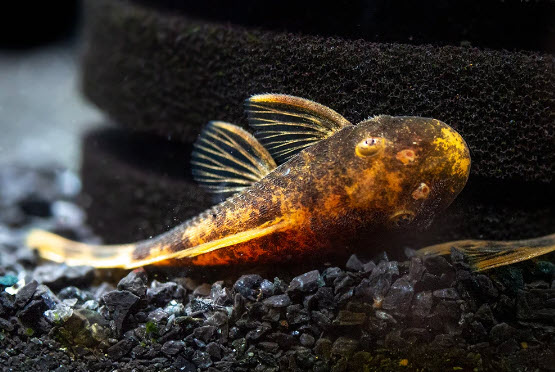
Ancistrus sp. Calico Calico Bristlenose
New
| Qty (Stock) | Size | Sex | Unit price (Tax included) |
|---|---|---|---|
17 en stock | 2" | - | 28$ 2 pour 49$ |
IMPORTANT
Keeping fish in an aquarium requires an ethical and responsible approach that prioritizes animal welfare. Purchasing fish for an aquarium should never be an impulsive decision. It is essential to understand the specific needs of each species, including water quality, aquarium size, behavior, and diet. Only fish with similar water quality requirements should be kept together in the same aquarium.
A Little More Information...
Ancistrus sp. Calico, also called Calico Bristlenose, is an aquarium variety valued for its marbled pattern and small sucker-catfish appearance. Associated with the genus Ancistrus, this calico form usually shows a grayish-brown body marked with paler patches and a mouth adapted for grazing surfaces. Because it is a trade name rather than a precisely defined species, appearance can vary from one line to another. It is reasonably easy to keep in a mature, well-filtered aquarium furnished with wood and hiding places. Its availability is moderate, making it an appealing but sometimes less consistently available choice for aquarists looking for a distinctive bristlenose catfish.
General species description
Ancistrus sp. Calico is a calico form of bristlenose catfish sold through the aquarium trade. The name Ancistrus refers to a group of South American loricariid catfish, but the trade name does not establish a single wild species with certainty. Like other bristlenose catfish, it has a ventral sucker mouth, armored plates and activity that is mainly crepuscular or nocturnal. Individuals spend much of their time on wood, rocks and glass grazing biofilm. A mature, well-oxygenated aquarium with suitable shelters supports its natural behavior. It should not be treated as a simple cleaner fish, since its diet still requires deliberate feeding with vegetables and sinking foods. The variety is moderately available and its coloration may differ between breeding lines, so buyers should assess each fish individually rather than relying only on the word calico.
Geographical origin and biotope
Reference country: South America. The calico form is not associated with a specific natural population; it is generally distributed as a captive-bred variety under the trade name Calico Bristlenose. Its environmental reference is the type of tropical stream inhabited by bristlenose catfish: calm to moderately flowing water, good oxygenation, submerged roots, rocks and plant debris. The bottom may include sand, fine gravel or coarser material, with surfaces where biofilm can develop. In the aquarium, aim for a layout with natural wood and shelters rather than a bare, brightly lit tank. Efficient filtration, regular maintenance and gentle to moderate flow also support good condition. Stable tropical water is more important than trying to reproduce extreme chemistry.
Precise location and local name
The Ancistrus sp. Calico variety does not have a collection locality generally associated with its commercial name. The trade name used internationally is Calico Bristlenose, while French-speaking aquarists may use ancistrus calico or calico bristlenose pleco. These names mainly describe the color pattern and body shape and do not constitute a complete taxonomic identification. When purchasing one, check the expected adult size, fin shape and captive-bred source instead of relying only on the word calico. Mature males may develop the facial tentacles typical of bristlenose catfish, although their number and development vary. Choose active fish that attach normally to surfaces, have a well-filled belly and show undamaged fins. This is especially useful for a variety whose exact locality is not included in the commercial name.
Appearance and physical characteristics
The body of Ancistrus sp. Calico is stout, flattened underneath and covered with bony plates. Its sucker mouth allows it to cling to décor and rasp surfaces. The calico pattern usually combines a brown, beige or gray background with irregular lighter markings, sometimes accompanied by darker areas on the head and fins. Coloration varies between individuals, which is part of the appeal of this form. Adult males generally develop facial bristles on the snout; females usually have fewer, or only small growths around the edge of the snout. Fins may be short or show extensions depending on the line offered. Adult size commonly reaches about 12 to 15 cm, with a sturdy shape and mainly nocturnal activity. Clean, stable water helps maintain the condition of its armor and fins.
General diet
Ancistrus sp. Calico is mainly herbivorous with omnivorous tendencies and should receive a varied diet. Spirulina-based wafers, zucchini slices, cucumber, blanched spinach and other vegetables can supplement the biofilm naturally found on wood and aquarium surfaces. Real wood is useful because it provides grazing surfaces and enriches the structure of the habitat. Place a small portion of sinking food after the lights go out so the fish can feed without excessive competition. Protein-rich foods may be offered occasionally, but an overly meaty or excessive diet can contribute to water-quality problems. Remove leftovers after a few hours. The essentials are regular feeding, a good source of fiber and constant access to biofilm-covered surfaces; do not rely solely on aquarium algae for its vegetable nutrition.
Essential data
- River of origin: —
- Local name used: Calico Bristlenose
- Origin of the scientific name: The genus Ancistrus identifies a group of loricariid catfish; “sp.” indicates identification only to genus level.
- Etymology of the full name: Ancistrus comes from Greek and refers to a hook; “sp.” abbreviates species; “Calico” describes the color pattern.
- Common or vernacular names: Calico Bristlenose; calico ancistrus; calico bristlenose pleco.
- Family: Loricariidae
- Subfamily: Ancistrinae
- Name pronunciation: an-SIS-trus - sp.
- Discovery: —
- Maximum adult size: About 15 cm
- Water temperature and pH: 23 to 28 °C; pH 6.0 to 7.8
- Stream appearance and surrounding vegetation: Oxygenated tropical streams with roots, wood, rocks and plant debris.
- Typical tankmates: Paracheirodon axelrodi, Hoplisoma paleatus, Hemigrammus rhodostomus, Apistogramma borelli, Otocinclus vestitus, Brochis splendens
- Temperament and behavior: Peaceful, secretive and mainly crepuscular or nocturnal; males may become territorial in cramped spaces.
- Water depth: Shallow to intermediate areas of small streams.
- Sexual dimorphism: Males generally develop more prominent facial bristles; females have a smoother snout and often a rounder body.
- Bottom structure and flow: Sand, fine gravel, wood and rocks; gentle to moderate flow with good oxygenation.
In your aquarium
To succeed with Ancistrus sp. Calico, provide a mature aquarium, stable water and a layout rich in roots and shelters. Offer sinking vegetable foods regularly, especially after lights-out, and watch for competition near the bottom. Efficient filtration, good oxygenation and consistent water changes support long-term health. Although it helps consume biofilm, it does not replace aquarium maintenance. With these straightforward conditions and peaceful tankmates, this calico bristlenose becomes a hardy, unusual and rewarding bottom-dweller to observe.
{168,202,252,1131,317,101}