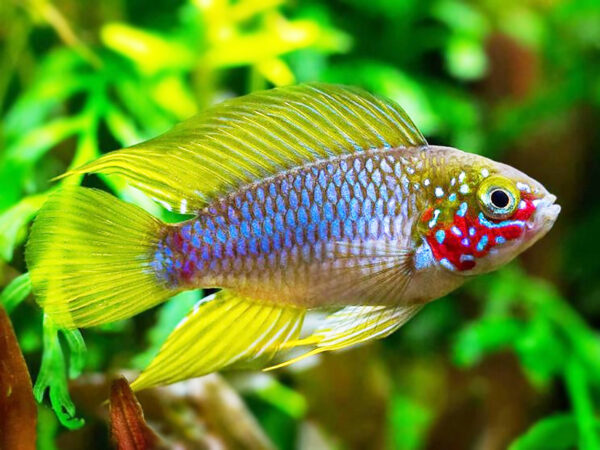
Apistogramma borelli Red Mask
New
| Qty (Stock) | Size | Sex | Unit price (Tax included) |
|---|---|---|---|
| 1 ¾" | - | 45$ 2 pour 80$ |
IMPORTANT
Keeping fish in an aquarium requires an ethical and responsible approach that prioritizes animal welfare. Purchasing fish for an aquarium should never be an impulsive decision. It is essential to understand the specific needs of each species, including water quality, aquarium size, behavior, and diet. Only fish with similar water quality requirements should be kept together in the same aquarium.
A Little More Information...
Apistogramma borelli, also sold as Red Mask, is a small South American cichlid valued for its courtship behavior and changing colors. The male usually has a slender body, well-developed fins, and yellow, blue, or reddish tones that vary with mood. The female becomes especially colorful during breeding. Native to the Rio Paraguay basin, this fish inhabits calm, shallow waters often filled with fallen leaves. Its modest size, generally peaceful nature, and parental care make it an interesting aquarium subject for attentive aquarists. A carefully arranged tank is essential to provide shelter and reduce territorial pressure.
General species description
Apistogramma borelli is a dwarf cichlid in the genus Apistogramma, commonly kept as a pair or in a harem depending on the available floor space. The male defends a small territory, while the female mainly cares for the eggs and larvae. The species prefers a mature, quiet aquarium structured with roots, caves, and plants. Despite its small size, it displays a clear hierarchy and may become territorial during spawning. Outside that period, its temperament is usually moderate. This species is fairly sought after in the aquarium trade, although availability varies with shipments. Stable water, gentle filtration, and visual barriers are more important than strong flow.
Geographic origin and biotope
Countries of reference: Argentina, Bolivia, Brazil, and Paraguay. Apistogramma borelli comes from the Rio Paraguay basin and connected areas of the Pantanal and upper Paraná basin. In the wild, it inhabits side channels, floodplain pools, and shallow areas with little current. The water may be clear or tea-colored from tannins, with low to moderate mineral content. The bottom is often made of fine sand, mud, and plant debris. Fallen leaves provide shelter and add structure to the habitat. In an aquarium, subdued lighting, catappa leaves, and soft to slightly acidic water recreate this environment effectively.
Precise location and local name
The known range of Apistogramma borelli is centered in the Rio Paraguay basin, particularly in calm habitats of the Pantanal and neighboring regions of Paraguay, Bolivia, Brazil, and Argentina. The aquarium trade mainly uses the name Red Mask, referring to reddish markings that may appear on the head and face. The informal name “Apisto” is also used for members of the genus, but it is not a traditional local name. Coloration may vary according to geographic origin and captive-bred lineage.
Appearance and physical characteristics
The adult male generally reaches about 6 cm, while the female remains smaller. The body is elongated and laterally compressed, with a terminal mouth and relatively extended dorsal and anal fins. The base coloration may range from yellow to grayish brown, with blue reflections and variable dark markings. The head may show an orange-red tone, especially in some commercial Red Mask lines. A breeding female often turns bright yellow and develops stronger black contrasts. The male’s unpaired fins are usually more developed than those of the female.
General diet
Apistogramma borelli is a small opportunistic predator that searches for tiny invertebrates among the substrate and plant debris. Its diet should include varied, high-quality foods such as brine shrimp, daphnia, cyclops, bloodworms, and fine pellets formulated for dwarf cichlids. Frozen or live foods effectively stimulate natural behavior and reproductive condition. Fry benefit from very small foods, including newly hatched brine shrimp. Small portions should be offered because the species does not handle excess food well. A varied diet supports better coloration, steady growth, and good vitality.
Essential data
- Name of original river: Rio Paraguay
- Local name used: Red Mask
- Origin of the scientific name: Name assigned by Charles Tate Regan when the species was described.
- Complete-name etymology: Apistogramma comes from Greek and refers to a particular mark or line; borellii honors the Italian naturalist Alfredo Borelli.
- Common/vernacular names: Red Mask, Borellii dwarf cichlid, Borelli’s dwarf cichlid
- Family: Cichlidae
- Subfamily: Cichlinae
- Name pronunciation: ah-pis-toh-GRAM-mah - boh-REL-lee-eye
- Discovery: Charles Tate Regan, 1906
- Maximum adult size: About 6 cm for the male; the female is smaller.
- Water temperature and pH: 22 to 28 °C; pH 5.5 to 7.5
- Stream appearance and surrounding vegetation: Calm, sometimes tea-colored water bordered by riparian vegetation, aquatic plants, roots, and leaf litter.
- Typical tankmates: Corydoras agassizi, Hemigrammus rhodostomus, Nannostomus eques
- Temperament and behavior: Peaceful to territorial; the male defends an area and the female protects eggs and fry.
- Water depth: Usually shallow to moderate in side channels, pools, and flooded areas.
- Sexual dimorphism: Male larger, more slender, and more colorful, with more developed fins; female smaller and bright yellow while breeding.
- Bottom structure and flow: Fine sand, mud, and fallen leaves; low to nearly stagnant flow.
For greater success
Success depends on a layout offering several bottom-level hiding places, clean water, and regular water changes. Moderate flow, subdued lighting, and varied meaty foods are especially suitable. During spawning, the female may defend her cave vigorously, so overcrowding and highly active tankmates should be avoided. Stable temperature and slightly acidic water support breeding, but stability is more important than pursuing one exact value. With a calm, well-structured environment, Apistogramma borelli becomes an expressive and long-lived dwarf cichlid.
{1022,252,1132}