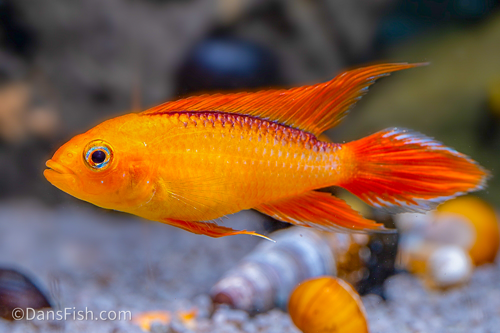
Apistogramma agassizi var. Super Fire Red
New
| Qty (Stock) | Size | Sex | Unit price (Tax included) |
|---|---|---|---|
| Currently Out of Stock! Contact us for more information | |||
IMPORTANT
Keeping fish in an aquarium requires an ethical and responsible approach that prioritizes animal welfare. Purchasing fish for an aquarium should never be an impulsive decision. It is essential to understand the specific needs of each species, including water quality, aquarium size, behavior, and diet. Only fish with similar water quality requirements should be kept together in the same aquarium.
A Little More Information...
Apistogramma agassizi var., also sold under the trade name Super Fire Red, is a highly colorful aquarium form of Apistogramma agassizii, a small South American cichlid valued for its fascinating behavior. This variety generally emphasizes bright red tones, especially in males, while retaining the body shape and territorial habits of the species. It is suited to a well-decorated aquarium with shelters, a soft substrate, and stable water. Despite its small size, this fish remains a territorial cichlid, particularly during breeding. Successful care therefore requires thoughtful space management and peaceful tank mates.
General species description
Apistogramma agassizi var. belongs to the group of small South American dwarf cichlids. The Super Fire Red variety is a selectively bred form developed to intensify red coloration rather than a distinct wild geographic population. As in the reference species, the male generally occupies the upper part of the territorial hierarchy, while the female actively protects a spawning area. An aquarium arranged with roots, plants, and small cavities helps reduce confrontations. The species has a strong personality: it explores its surroundings, defends a sector, and communicates through body posture and color changes. It can live in a community aquarium as long as its companions are calm and the layout provides several refuges. Water quality and parameter stability are more important than perfectly clear water.
Geographic origin and biotope
Countries of reference: Brazil and Peru. The species Apistogramma agassizii is associated with the Amazon Basin, particularly tributaries and lowland floodplain areas. Its habitat includes quiet margins, shallow backwaters, and areas filled with leaves, branches, and roots. Depending on the location, the water may be tea-colored from tannins or relatively clear, but it is generally soft and low in mineral content. Riparian vegetation often provides substantial cover, creating shade and many refuges. The Super Fire Red variety sold in the aquarium trade comes from captive-bred lines and should not be regarded as a wild-collected form. A layout inspired by the Amazonian biotope, with subdued lighting and leaf litter, encourages natural behavior.
Precise location and local name
The species’ type locality is generally reported as the Rio Manacapuru, in Amazonas State, Brazil. The species is also known from various areas of the Amazon Basin, but the name Super Fire Red is primarily a commercial designation used for an aquarium line. It is not a specific Indigenous local name associated with a particular population. In stores and among breeders, the names Super Fire Red, Fire Red, or sometimes Red Agassizi are commonly used. These names describe color selection and do not replace the scientific name. To avoid confusion, it is best to retain the identification Apistogramma agassizii var. and treat the coloration as a strain characteristic rather than a geographic indication.
Appearance and physical characteristics
The body of Apistogramma agassizi var. is elongated and slightly laterally compressed, with a large dorsal fin and a well-developed caudal fin. In males, the fins may become more extended and display contrasting edges. The most desirable feature of this variety is its intense red coloration, which may extend across the body, fins, and head depending on the line, age, and social status. Dark markings may appear during stress, courtship, or territorial defense. Females are smaller and often show yellow, brown, or gray coloration, with stronger contrasts during breeding. Colors vary with lighting, surroundings, and general condition. The male usually reaches nearly 9 cm, while the female remains noticeably smaller.
General feeding
In the wild, the species mainly feeds on small prey and organisms associated with the substrate. In aquariums, Apistogramma agassizi var. accepts quality dry foods, but its diet benefits from regular frozen or live foods. Brine shrimp, mosquito larvae, daphnia, and bloodworms are especially suitable for healthy adults. Young fish benefit from very small, frequent meals. A varied diet supports vitality and strong coloration, but it does not replace clean water and regular water changes. It is better to offer small portions than to overfeed, since leftovers can quickly degrade soft, acidic water. During breeding, rich but controlled feeding helps the female maintain her condition and may encourage spawning behavior.
Essential data
- River of origin: Rio Manacapuru, the species’ type locality.
- Local name used: No specific local name; Super Fire Red is the trade name.
- Origin of the scientific name: The name was assigned by Franz Steindachner.
- Full-name etymology: Apistogramma comes from the Greek apistos, uncertain or unreliable, and gramma, line or mark; agassizii honors Louis Agassiz.
- Common/vernacular names: Agassiz’s dwarf cichlid; Super Fire Red; Fire Red Agassizi.
- Family: Cichlidae
- Subfamily: Cichlinae
- Name pronunciation: ah-pis-toh-GRAM-mah ah-gah-SEE-zee-eye
- Discovery: Franz Steindachner, 1875.
- Maximum adult size: About 9 cm for males; females are smaller.
- Water temperature and pH: 24 to 29 °C; pH 5.0 to 7.0.
- Appearance of the watercourse and surrounding vegetation: Quiet margins, sometimes tannin-stained water, leaf litter, roots, branches, and dense vegetation.
- Typical tank mates: Peaceful small tetras, Nannostomus beckfordi, Otocinclus macrospilus, Corydoras trilineatus, and calm small surface fish.
- Temperament and behavior: Peaceful outside breeding but territorial; the female vigorously protects the spawn.
- Water depth: Shallow areas, often around 0.2 to 1 m near the margins.
- Sexual dimorphism: Males are larger and more colorful, with more developed fins; females are smaller and often yellow during breeding.
- Bottom structure and flow: Fine sand, mud, leaves, and plant debris; low to moderate current.
For greater success
Success with Apistogramma agassizi var. depends on a mature, well-structured aquarium maintained consistently. Provide separate hiding places, moderate lighting, and a substrate that will not injure fish while they forage. Gentle filtration, regular water changes, and a varied diet support good health. During spawning, pay particular attention to the female, since her territory can become strongly defended. Overactive or aggressive tank mates interfere with natural behavior. With warm, soft, stable water, this variety can become a spectacular dwarf cichlid that is highly rewarding to observe.
{}