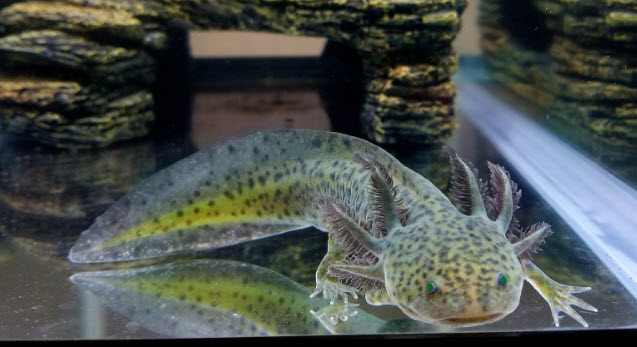
Ambystoma mexicanum (Axolotl) Green GFP Wild Type
| Qty (Stock) | Size | Sex | Unit price (Tax included) |
|---|---|---|---|
2 en stock | 4" | - | 144$ |
IMPORTANT
Keeping fish in an aquarium requires an ethical and responsible approach that prioritizes animal welfare. Purchasing fish for an aquarium should never be an impulsive decision. It is essential to understand the specific needs of each species, including water quality, aquarium size, behavior, and diet. Only fish with similar water quality requirements should be kept together in the same aquarium.
A Little More Information...
Ambystoma mexicanum (Axolotl) is a neotenic aquatic salamander from Mexico, not a fish despite its common aquarium trade label. This Green GFP Wild Type form retains the general appearance of the wild type while expressing green fluorescence under suitable lighting. Very common in the aquarium trade, the axolotl is nevertheless a demanding amphibian that requires cool, clean, well-oxygenated water. Its calm behavior, external gills, and remarkable regenerative abilities make it fascinating to keep. It should be housed in a purpose-designed aquarium rather than in a traditional warm tropical community setup.
General species description
Ambystoma mexicanum (Axolotl) is the aquatic, neotenic form of a salamander in the family Ambystomatidae. It retains larval features into adulthood, including its feathery external gills, caudal fin, and fully aquatic lifestyle. The species is generally peaceful, but it may swallow tank mates small enough to fit in its mouth. This Green GFP Wild Type variety shows dark or brownish wild-type pigmentation together with green fluorescence associated with GFP. It is better suited to a species aquarium than to a conventional tropical community aquarium.
Geographic origin and biotope
Country of reference: Mexico. The species is associated with the lake system of the Valley of Mexico, especially the canals of Xochimilco, which are remnants of a former lake environment. Its natural habitat includes cool, calm, relatively shallow water bordered by aquatic vegetation and muddy banks. Habitat degradation, pollution, and introduced predators have greatly reduced wild populations. In an aquarium, the goal is to reproduce cool, stable water with gentle movement rather than the conditions of a warm tropical aquarium.
Precise location and local name
The best-known locality is the canal network of Xochimilco, in southern Mexico City. In Mexican Spanish, the axolotl is called ajolote, a word derived from the Nahuatl axolotl. Historical populations were also associated with Lake Chalco, which has since been extensively altered. The local name is strongly connected with Nahua traditions and the Valley of Mexico. In captivity, axolotl is used internationally, while Green GFP Wild Type refers here to the commercial form and its wild-type coloration.
Appearance and physical characteristics
The body is elongated, the head is broad, and the eyes lack movable eyelids. Three pairs of branched external gills extend behind the head, while a fin runs along the back and tail. The limbs are short, with four toes on the front feet and five on the hind feet. Wild-type animals are generally gray, brown, or blackish and may be speckled. In this form, green fluorescence under blue light is added to the wild-type pigmentation without making the animal albino or leucistic.
General diet
Ambystoma mexicanum (Axolotl) is an opportunistic predator that mainly detects prey through movement and vibrations. Its diet can include earthworms, suitable red worms, other small invertebrates, and quality carnivorous foods formulated for axolotls. Sinking pellets can provide a practical staple, but variety is beneficial. Food should be appropriately sized, and leftovers should be removed. Live or frozen foods must come from reliable sources to reduce the risk of parasites and contamination. Very fatty foods and feeder fish should be avoided.
Essential data
- Name of the river of origin: Not applicable: lake habitat and canal network of Xochimilco.
- Local name used: Ajolote.
- Origin of the scientific name: Ambystoma comes from Greek and refers to a blunt or rounded mouth; mexicanum means from Mexico.
- Etymology of the full name: Ambystoma: blunt or cup-shaped mouth; mexicanum: relating to Mexico.
- Common/vernacular names: Axolotl, ajolote, Mexican salamander; Green GFP Wild Type.
- Family: Ambystomatidae.
- Subfamily: Ambystomatinae.
- Name pronunciation: am-bis-STO-mah mek-si-KA-num.
- Discovery: Scientifically described by George Shaw in 1789.
- Maximum adult size: About 30 cm.
- Water temperature and pH: Approximately 16 to 20 °C; pH 6.5 to 8.0.
- Waterway appearance and surrounding vegetation: Calm canals, cool water, muddy bottoms, and abundant aquatic vegetation.
- Typical cohabitants: Chirostoma jordani, Girardinichthys viviparus, Cambarellus montezumae; in aquariums, fish cohabitation is generally not recommended.
- Temperament and behavior: Calm, slow-moving, and mainly crepuscular or nocturnal; an aspiration-feeding predator.
- Water depth: Shallow to moderate water in canals and lake habitats.
- Sexual dimorphism: Adult males generally have a larger cloacal region, while females often have a broader abdomen.
- Bottom structure and flow: Mud, silt, and plant debris; weak current and calm-water areas.
In your aquarium
Success depends on a spacious aquarium with efficient filtration, no strong current, and water kept cool year-round. Use very fine sand or a bare bottom, smooth shelters, and moderate lighting. Avoid small gravel that can be swallowed, high temperatures, and tank mates that nip the gills. A measured meaty diet, regular water changes, and close monitoring of water quality will help keep Ambystoma mexicanum (Axolotl) healthy. Its fluorescence is visually appealing, but it never replaces the species’ fundamental care requirements.