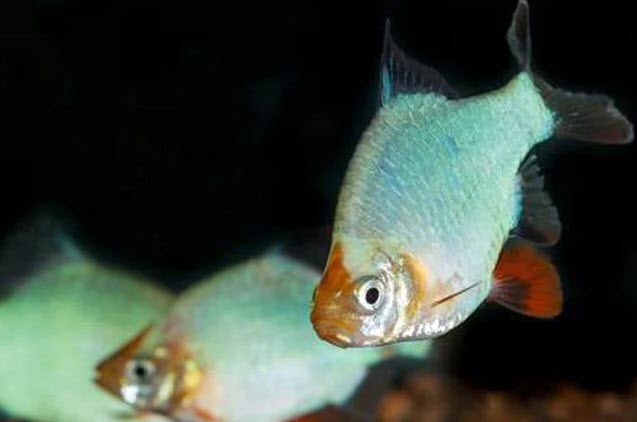
Puntigrus pentazona var. Platinum / Green Jade Barb
Nouveau
| Qté (Stock) | Taille | Sexe | Prix unitaire (Taxes incluses) |
|---|---|---|---|
| 1 ¾" | - | 14$ |
IMPORTANT
La possession de poissons en aquarium requiert une approche éthique et responsable pour respecter les animaux. L'acquisition de poissons pour maintenance en aquarium ne doit pas se faire sur un coup de tête (achat impulsif). Il est essentiel de s'informer sur les besoins spécifiques des espèces (qualité eau, dimensions aquarium, comportement, alimentat). Seuls les poissons ayant des exigences similaires en matière de qualité d'eau devraient être maintenus ensemble dans un même aquarium.
Un peu plus d'informations...
Puntigrus pentazona var. is a captive-bred form of the small five-banded barb, valued for its metallic sheen and lively schooling behavior. Sold as Platinum Barb or Green Jade Barb, this variety retains the slender shape and social nature of its Asian Cyprinidae relative. Its color may range from silvery to greenish or jade tones, depending on the strain, lighting, and condition of the fish. It adapts well to a peaceful community aquarium when provided with clean, well-oxygenated water and suitable tankmates. Keeping a proper shoal encourages natural interactions, reduces nervousness, and allows the fish to display its active midwater behavior more confidently.
General species description
Puntigrus pentazona var. is an ornamental variety related to Puntigrus pentazona, commonly known as the five-banded barb. It is a small, active, schooling Asian Cyprinidae that is generally peaceful when maintained in a suitable group. The Platinum / Green Jade Barb is distinguished mainly by its lighter metallic coloration rather than by a different body shape. A group of at least 8 to 10 fish supports a more stable social structure and more natural behavior. It usually occupies the middle levels of the aquarium while exploring plants, roots, and open swimming areas. It works well in a community aquarium with similarly sized, calm species. Good filtration, gentle to moderate circulation, regular water changes, and stable parameters are more important than strong current or an extremely open layout.
Geographic origin and habitat
Countries of reference: Indonesia, Malaysia, and southern Thailand. Wild Puntigrus pentazona is associated with soft water habitats in Southeast Asia, including forest streams, small tributaries, and swampy areas connected to local river basins. These environments are often shaded by dense riparian vegetation, with water stained by leaf litter and decomposing wood. Current is generally slow to moderate, while the substrate may include sand, mud, fallen leaves, and small branches. In the aquarium, dense planting, roots, and subdued lighting reproduce this setting more effectively than a completely open layout. Stable, slightly acidic to neutral water with good oxygenation is appropriate for long-term care. Gentle tannins may also help create a more natural visual environment.
Precise locality and local name
Puntigrus pentazona var. is an aquarium variety, and individual commercial strains cannot always be connected to a precise geographic population. The nominal species is reported from parts of the Malay Peninsula, Sumatra, and Borneo, where it occurs in forest streams and quiet waters linked to local drainage systems. The most common aquarium vernacular name is Five-banded Barb. Platinum Barb and Green Jade Barb describe the selected color form sold in the trade. Common names may vary among suppliers, so the scientific name remains the most useful reference. In English-language aquarium use, the names Platinum Barb and Green Jade Barb should be treated as trade descriptions for a color variety rather than as separate species.
Appearance and physical characteristics
Puntigrus pentazona var. has a compact, laterally compressed body suited to quick movement among plants and branches. The nominal form usually shows five dark vertical bands over a golden, brownish, or silvery background. In this variety, the base color is paler, with platinum, green jade, or metallic gray reflections; intensity changes with lighting and the fish’s condition. The fins are relatively short and may show reddish or amber tones. Adult females are often deeper-bodied, while males may be slimmer and more intensely colored, particularly during spawning activity. Its modest adult size suits a community aquarium, provided the tank offers enough swimming length, cover, and a properly sized shoal rather than relying only on overall water volume.
General diet
Omnivorous and opportunistic, Puntigrus pentazona var. readily accepts a varied aquarium diet. Offer quality flakes or small pellets in modest portions, supplemented with frozen foods such as brine shrimp, daphnia, or bloodworms. Occasional plant matter, supplied through spirulina-enriched foods or suitable small vegetable portions, adds balance. Live or frozen foods can encourage feeding activity and natural chasing behavior. It is better to provide two small feedings daily than one large meal, reducing waste and helping preserve water quality. A varied diet supports coloration, growth, and general condition, but overfeeding remains a common cause of excess nutrients and poor aquarium conditions. Remove uneaten food whenever possible, especially in smaller, heavily planted systems.
Essential data
- Native river name: River basins of the Malay Peninsula, Sumatra, and Borneo.
- Local name used: Five-banded Barb.
- Origin of the scientific name: Puntigrus is a modern generic name related to Puntius and referring to the tiger-like pattern; pentazona refers to five bands.
- Full-name etymology: Puntigrus identifies the genus; penta means five and zona means band or zone.
- Common/vernacular names: Platinum Barb, Green Jade Barb, Five-banded Barb.
- Family: Cyprinidae.
- Subfamily: Smiliogastrinae.
- Name pronunciation: pun-TIG-russ pen-tah-ZOH-nah.
- Discovery: George Albert Boulenger, 1894.
- Maximum adult size: About 5 cm.
- Water temperature and pH: 23 to 27 °C; pH 5.5 to 7.0.
- Stream appearance and surrounding vegetation: Shaded forest waters, often leaf-stained, with riparian plants, roots, and decomposing vegetation.
- Typical tankmates: Puntius titteya, Trigonostigma heteromorpha, Pangio semicincta, Gastromyzon punctulatus.
- Temperament and behavior: Active, schooling, and generally peaceful; may become nervous in a very small group.
- Water depth: Shallow to moderately deep streams and quiet waters.
- Sexual dimorphism: Females are usually stockier; males are often slimmer and more brightly colored.
- Bottom structure and flow: Sand, mud, leaf litter, and branches; low to moderate flow.
For greater success
Success with Puntigrus pentazona var. depends on a mature, well-filtered, planted aquarium that combines open swimming space with cover along the sides. Keep a suitable shoal, avoid boisterous tankmates, and monitor water quality closely. Moderate lighting, roots, and leaf litter can improve security and bring out the fish’s coloration. A varied diet, frequent small water changes, and stable temperature are the most important elements for long-term care. When these conditions are provided, this attractive color variety remains active, social, and well suited to a peaceful Southeast Asian community setup.
{932,779,602,842}