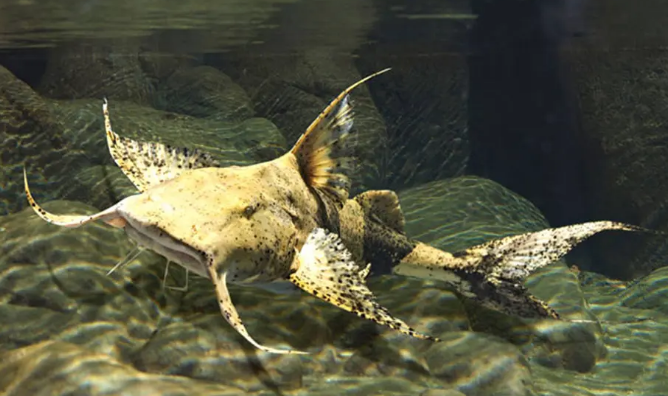
Bagarius yarrelli Goonch Catfish
New Wild caught origin Exclusive
| Qté (Stock) | Taille | Sexe | Prix unitaire (Taxes incluses) |
|---|---|---|---|
| Aucun en stock en ce moment! Communiquez avec nous | |||
IMPORTANT
La possession de poissons en aquarium requiert une approche éthique et responsable pour respecter les animaux. L'acquisition de poissons pour maintenance en aquarium ne doit pas se faire sur un coup de tête (achat impulsif). Il est essentiel de s'informer sur les besoins spécifiques des espèces (qualité eau, dimensions aquarium, comportement, alimentat). Seuls les poissons ayant des exigences similaires en matière de qualité d'eau devraient être maintenus ensemble dans un même aquarium.
Un peu plus d'informations...
Bagarius yarrelli, also known as the Goonch Catfish, is a large predatory catfish from the major rivers of South Asia. Its robust body, flattened head, and mottled brownish-gray coloration help it blend among rocks and bottom debris. This benthic species generally seeks areas with strong current and high oxygen levels. It can reach an impressive size and therefore requires facilities far beyond those used for ordinary aquarium catfish. This profile concerns a wild-collected species considered uncommon in the aquarium trade, and offered exclusively by Ton.Fish in Canada.
General species description
Bagarius yarrelli is a large siluriform fish in the family Sisoridae, specialized for life along river bottoms. Its massive build, broad mouth, and sensitive barbels reflect an opportunistic predatory lifestyle. It often remains motionless near rocks before making a rapid strike at prey passing within range. Younger fish are more active and may appear relatively discreet, while adults become very large and territorial around their shelters. In aquariums, this is not an ordinary community catfish: its adult size, appetite, and hunting behavior severely limit suitable tankmates. It is best suited to specialized, extremely spacious systems with heavy-duty equipment. Its presence in the trade remains infrequent, particularly for large specimens.
Geographic origin and biotope
Bagarius yarrelli originates in South Asia, especially the Ganges and Brahmaputra basins, with records from several major river systems across the subcontinent. Reference countries: India, Nepal, Bangladesh, and Pakistan. It mainly inhabits large rivers in Himalayan foothill and adjacent lowland regions, in rocky areas exposed to substantial current. Water may be clear to moderately turbid depending on the season, with high oxygen levels and changing suspended sediment during monsoon periods. The bottom consists of gravel, cobbles, and boulders, with hollows that provide shelter. Aquatic vegetation is usually limited in fast-flowing sections, while riverbanks may support trees, grasses, and shrubs. In aquaria, the key ecological priorities are space, oxygenation, and current.
Precise location and local name
Across its range, Bagarius yarrelli is associated with major rivers in the Ganges and Brahmaputra basins, especially rocky stretches of Himalayan and sub-Himalayan regions. The most widely used vernacular name in English-language sources is Goonch, also spelled Gunch or Goonch Catfish. Local names may vary from one region to another, but “goonch” remains the most broadly recognized name for this species. It is often found in deep areas behind boulders, below steep banks, or close to obstacles that locally reduce current speed. These microhabitats provide an ambush position while protecting the fish from the full force of the flow. In captivity, shelters must be large enough for an adult and arranged without creating dangerous gaps where the fish could become trapped.
Appearance and physical characteristics
The body of Bagarius yarrelli is elongated, powerful, and slightly compressed toward the rear. The head is broad and flattened, with a large mouth surrounded by several pairs of barbels. The base color ranges from brown to olive gray, with irregular darker markings that resemble rocks and gravel. The fins are sturdy and suited to maintaining stability in turbulent water. As in many benthic siluriforms, the barbels help detect prey and obstacles in low-light conditions. The species may reach approximately 200 cm in total length according to available data, although captive specimens are usually much smaller. Its growth and body mass make a very large aquarium essential, with no small fish that could be swallowed.
General diet
Bagarius yarrelli is a carnivorous predator that mainly feeds on fish and other aquatic animals of suitable size. Its diet may also include crustaceans and bottom-dwelling prey when available. It often hunts from a shelter, using its barbels to locate prey and its broad mouth to swallow it quickly. In captivity, suitable meaty foods may include quality whole fish, shrimp, and pieces of marine or freshwater fish flesh. Meals should be carefully measured to prevent obesity and water-quality problems. Feeder fish from uncertain sources should be avoided because they may introduce parasites or provide an unbalanced diet. The essential principle is to respect its ambush-predator behavior while maintaining exceptionally clean water after feeding.
Essential data
- River of origin: Ganges
- Local name used: Goonch, Gunch
- Origin of the scientific name: Bagarius is a Latinized genus name; yarrelli honors William Yarrell.
- Etymology of the full name: Bagarius is associated with the vernacular name used for these fish; yarrelli means dedicated to Yarrell.
- Common/vernacular names: Goonch Catfish, Goonch, Gunch
- Family: Sisoridae
- Subfamily: Sisorinae
- Name pronunciation: bag-AIR-ee-us - yar-EL-eye
- Discovery: Richard Sykes, 1839
- Maximum adult size: approximately 200 cm
- Water temperature and pH: approximately 18 to 26 °C; pH 6.5 to 7.5
- River appearance and surrounding vegetation: large rocky rivers, strong current, wooded or grassy banks; limited aquatic vegetation in rapids
- Typical tankmates: Tor putitora, Schizothorax richardsonii, Wallago attu, Labeo rohita, Bagarius bagarius
- Temperament and behavior: predatory, discreet, benthic, and potentially territorial around shelters
- Water depth: deep sections and pools near boulders or riverbanks
- Sexual dimorphism: difficult to distinguish externally
- Bottom structure and flow: gravel, cobbles, and boulders, with moderate to strong flow and excellent oxygenation
For greater success
Keeping Bagarius yarrelli requires an exceptional setup: a very large aquarium, oversized filtration, highly oxygenated water, and shelters made from heavy, stable materials. Its nocturnal or crepuscular predatory behavior means that small tankmates should be avoided. Any handling must be planned carefully because a powerful adult can injure itself or shift the décor. A controlled carnivorous diet and regular water changes are essential for maintaining good condition. Since this is a wild-collected fish that remains uncommon in the hobby, acquiring one should be a carefully considered decision reserved for aquarists able to meet its long-term requirements.
{}