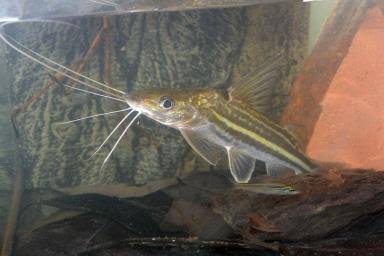
Pimelodus tetramerus Four-line Pimelodus
New Wild caught origin
| Qty (Stock) | Size | Sex | Unit price (Tax included) |
|---|---|---|---|
| 5" | - | 34$ |
IMPORTANT
Keeping fish in an aquarium requires an ethical and responsible approach that prioritizes animal welfare. Purchasing fish for an aquarium should never be an impulsive decision. It is essential to understand the specific needs of each species, including water quality, aquarium size, behavior, and diet. Only fish with similar water quality requirements should be kept together in the same aquarium.
A Little More Information...
The Pimelodus tetramerus, also known as the Four-line Pimelodus, is a South American catfish from the Pimelodidae family. This species is recognized by its slender body, long barbels, and dark-lined pattern, features reflected in its common name. Native to the Amazon basin, it inhabits slow to moderately flowing areas where branches, roots, and rocks provide shelter along the bottom. Its activity is mainly crepuscular and nocturnal. Because this is a wild-collected fish, patient acclimation, stable water conditions, and a varied diet are especially important in the aquarium.
General species description
Pimelodus tetramerus is a bottom-oriented catfish belonging to the Pimelodidae family. Its elongated body and barbel-equipped head allow it to search efficiently through the substrate, particularly when light levels are low. The species is mainly crepuscular and nocturnal; it may remain secretive during the day before actively exploring the aquarium for food. It is suitable for a large community aquarium containing South American fish of comparable size. Very small fish that could be swallowed, as well as highly aggressive or strongly territorial tankmates, should be avoided. Its availability remains fairly occasional in the aquarium trade, making it less common than several better-known pimelodid species.
Geographic origin and habitat
Country reference: Brazil. Pimelodus tetramerus is associated with the rio Madeira basin, within the Amazon system. Its natural environment includes tropical freshwater with slow areas, channel margins, and sections filled with woody debris. The bottom may consist of sand, mud, and fine gravel, with leaves and branches accumulating in sheltered areas. Riparian vegetation provides shade and adds organic matter to the watercourse. In an aquarium, this setting can be recreated with moderate lighting, sturdy hiding places, and open bottom space. Clean, well-oxygenated water that is slightly acidic to neutral is generally appropriate for this type of habitat.
Precise location and local name
The documented range used for Pimelodus tetramerus is the rio Madeira basin in Brazil. The most practical trade name remains Four-line Pimelodus, while the scientific name is used among aquarists and ichthyologists. Regional vernacular names are not standardized for this species. In a store, it is therefore preferable to verify the scientific identification rather than relying only on a trade label. Since the fish is wild collected, body size, pattern intensity, and behavior may vary according to its origin and transport conditions.
Appearance and physical characteristics
Pimelodus tetramerus has a streamlined body, a somewhat flattened head, and several pairs of barbels used to locate food in dim water. Its base color is generally silvery to grayish, with dark longitudinal lines associated with the name Four-line Pimelodus. The fins are translucent to lightly tinted, and the dorsal and pectoral fins contain spiny rays that may catch in a net. The lower-positioned mouth and barbels are typical adaptations for a bottom-searching fish. An adult size of approximately 20 cm should be expected, making a spacious aquarium more appropriate than a small community tank.
General diet
In nature, Pimelodus tetramerus searches the bottom for small invertebrates, aquatic larvae, crustaceans, and organic debris, with an important animal component in its diet. In the aquarium, it accepts sinking wafers, catfish pellets, and frozen foods such as bloodworms, brine shrimp, and chopped prawns. Food is best offered after the aquarium lights have been dimmed, when its activity increases. A varied diet helps maintain condition, especially after transport of a wild fish. Portions should remain moderate because uneaten food accumulating in the substrate can quickly reduce water quality. This is not a specialized algae-eating species.
Essential data
- River of origin: Rio Madeira
- Local name used: Four-line Pimelodus
- Origin of the scientific name: The genus name is built from Greek roots; the species epithet refers to four elements or parts.
- Full-name etymology: Pimelodus comes from the Greek pimelē, fat, and odous, tooth; tetramerus comes from tetra, four, and meros, part.
- Common/vernacular names: Four-line Pimelodus
- Family: Pimelodidae
- Subfamily: Pimelodinae
- Name pronunciation: pi-meh-LOH-dus - teh-trah-MEH-rus
- Discovery: Carl H. Eigenmann, 1912
- Maximum adult size: Approximately 20 cm
- Water temperature and pH: 24 to 28 °C; pH 6.0 to 7.5
- Watercourse appearance and surrounding vegetation: Tropical freshwater, shaded margins, submerged branches, leaf litter, and abundant riparian vegetation.
- Typical tankmates: Acarichthys heckelii, Geophagus altifrons, Pterophyllum scalare, Pimelodus pictus
- Temperament and behavior: Peaceful with similarly sized fish; mainly active at dusk and at night while exploring the bottom.
- Water depth: Bottom areas and channel margins; depth is variable.
- Sexual dimorphism: Difficult to identify in aquarium specimens; mature females may be more robust.
- Bottom structure and flow: Sand, mud, fine gravel, and woody debris; slow to moderate current.
For aquarium success
To keep Pimelodus tetramerus successfully, provide a long aquarium with good filtration, a smooth, non-abrasive substrate, and hiding places made from wood or rock. Leave open bottom space for nocturnal movement and offer a varied sinking diet. Like any wild-collected fish, it benefits from gradual acclimation and careful quarantine. Stable parameters, well-oxygenated water, and tankmates large enough not to be viewed as prey are the keys to long-term success.
{205,636,986,226}