American Cichlids
Cichlasoma var. Yellow Tiger
Liste de poissons Cichlids Cichlasoma var. Yellow Tiger
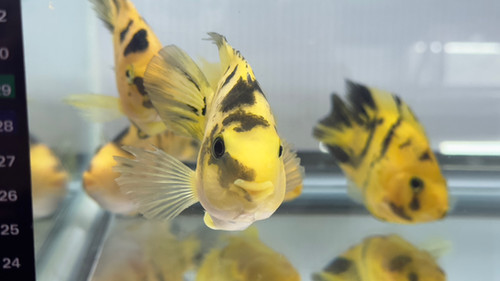
Cichlasoma var. Yellow Tiger Yellow Tiger Parrot
Exclusivité
| Qté (Stock) | Taille | Sexe | Prix unitaire (Taxes incluses) |
|---|---|---|---|
| 4" | - | 103$ |
IMPORTANT
La possession de poissons en aquarium requiert une approche éthique et responsable pour respecter les animaux. L'acquisition de poissons pour maintenance en aquarium ne doit pas se faire sur un coup de tête (achat impulsif). Il est essentiel de s'informer sur les besoins spécifiques des espèces (qualité eau, dimensions aquarium, comportement, alimentat). Seuls les poissons ayant des exigences similaires en matière de qualité d'eau devraient être maintenus ensemble dans un même aquarium.
Un peu plus d'informations...
Cichlasoma var. Yellow Tiger, also called Yellow Tiger Parrot, is a captive-bred freshwater cichlid hybrid valued for its yellow coloration and dark markings that suggest a tiger pattern. This fish combines a compact body, an active personality, and good tolerance of stable aquarium conditions. Like other freshwater parrot cichlids, it is not a naturally occurring species described by science, but a commercial selection derived from cichlid lineages. Its availability is generally intermediate, making it less common than classic red parrot varieties. It is best suited to aquarists able to provide ample space, strong filtration, and carefully chosen tankmates.
General description
Cichlasoma var. Yellow Tiger is a captive-bred aquarium hybrid sold under the name Yellow Tiger Parrot. The name Cichlasoma var. is used commercially, but does not represent a recognized scientific species. Its deep, compact body and unusual mouth resemble freshwater parrot cichlids. It requires a spacious aquarium, stable water, and effective filtration because its compact morphology can make swimming and feeding less efficient. Its behavior is usually curious and assertive, with territoriality increasing during breeding activity. This intermediate-availability variety deserves careful tankmate selection and a well-planned environment.
Geographic origin and biotope (reference country (if known): )
Cichlasoma var. Yellow Tiger has no natural geographic range because it is a captive-produced hybrid. Its reference environment is therefore a tropical freshwater aquarium with open swimming areas, shelters, and regular water movement. Practical conditions are approximately 25–29 °C with slightly acidic to neutral or mildly alkaline water. A layout using rounded rocks, sturdy roots, and durable plants is preferable to a delicate aquascape, since parrot cichlids may move substrate and uproot some plants.
Precise location and local name
Cichlasoma var. Yellow Tiger is an aquarium trade name rather than a fish associated with a collection locality. The trade name commonly used is Yellow Tiger Parrot; Yellow Tiger Parrot Cichlid may also appear in English listings. The word “parrot” refers to the head and mouth shape, while “Yellow Tiger” describes the yellow body marked with darker bands or patches. These names distinguish this variety from other commercial forms of freshwater parrot cichlids.
Appearance and physical characteristics
Cichlasoma var. Yellow Tiger has a deep, short, sturdy body, a rounded head, and the reduced mouth typical of freshwater parrot cichlids. Its coloration usually consists of a golden yellow base with irregular dark markings whose intensity can change with age, mood, and diet quality. The fins may show orange or reddish tones. Adult aquarium size commonly reaches about 20 cm, sometimes more depending on the strain and growing conditions. Its mouth shape can make large foods difficult to handle, so appropriately sized pieces are important.
General diet
Cichlasoma var. Yellow Tiger is omnivorous and generally accepts sinking or slowly sinking pellets formulated for large cichlids. A quality diet containing natural pigments may help maintain yellow coloration, but should not replace balanced nutrition. Frozen foods such as shrimp, krill, or mosquito larvae can be offered in moderation. Feed small pieces that are easy to grasp with its specialized mouth, and remove leftovers to protect water quality. Overfeeding can encourage excessive weight gain and organic pollution. Several moderate meals are preferable to one large feeding.
Essential data
- Name of original river: none; captive-bred aquarium hybrid
- Local name used: Yellow Tiger Parrot
- Origin of the scientific name: Cichlasoma is an old genus name used in the trade; var. means variety
- Full-name etymology: Cichlasoma refers to a body form reminiscent of cichlids in the genus Cichla; var. means variety; Yellow Tiger describes the yellow coloration with dark markings
- Common/vernacular names: Yellow Tiger Parrot, Yellow Tiger Parrot Cichlid, yellow tiger parrot cichlid
- Family: Cichlidae
- Subfamily: Cichlinae
- Name pronunciation: sik-lah-SO-ma var - YEL-oh TAI-ger PAIR-ut
- Discovery: captive-bred commercial variety; no associated zoological discovery
- Maximum adult size (cm): about 20
- Water temperature and pH: 25–29 °C; pH 6.5–7.5
- Appearance of the watercourse and surrounding vegetation: tropical aquarium with open areas, rocks, roots, and sturdy vegetation
- Typical tankmates: Astronotus ocellatus, Heros efasciatus, large robust loricariids
- Temperament and behavior: active, curious, and territorial, especially during breeding activity
- Water depth: middle and lower aquarium levels
- Sexual dimorphism: difficult to determine reliably; body and color differences are variable
- Bottom configuration and flow: sand or fine gravel, sturdy shelters, and moderate to strong flow
In your aquarium
To succeed with Cichlasoma var. Yellow Tiger, provide a spacious aquarium, a stable layout, and oversized filtration. Keep the water clean with regular water changes and avoid very small or delicate tankmates. A varied diet offered in small pieces, stable temperature, and well-distributed shelters will help reduce stress. Individual territorial behavior should also be monitored, since hybrids can differ considerably in temperament. With these precautions, this yellow tiger-patterned variety can become an engaging centerpiece in a community aquarium housing compatible large cichlids.
{411,661}