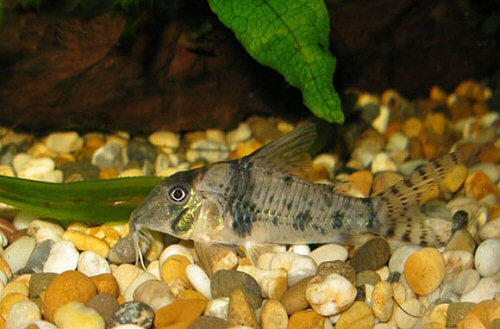
Corydoras orcesi
New Wild caught origin Exclusive
| Qty (Stock) | Size | Sex | Unit price (Tax included) |
|---|---|---|---|
| Currently Out of Stock! Contact us for more information | |||
IMPORTANT
Keeping fish in an aquarium requires an ethical and responsible approach that prioritizes animal welfare. Purchasing fish for an aquarium should never be an impulsive decision. It is essential to understand the specific needs of each species, including water quality, aquarium size, behavior, and diet. Only fish with similar water quality requirements should be kept together in the same aquarium.
A Little More Information...
Corydoras orcesi is a small armored catfish from western Ecuador, associated with the Rio Napo basin. Like several corydoras from this region, it spends most of its time near the bottom, using its barbels to explore the substrate and locate food. Its body, protected by bony plates, peaceful nature, and schooling behavior make it an interesting choice for a well-planned community aquarium. This species is less common in the trade than the most popular corydoras and deserves careful attention to water quality. A mature aquarium with gentle substrate and good oxygenation is especially appropriate for its long-term care.
General species description
Corydoras orcesi is a small, peaceful and schooling corydoras that is adapted to life near the bottom. It belongs to the family Callichthyidae and uses its barbels to gently search through the substrate. Its activity is often greatest during daylight or twilight, with periods of exploration followed by rest. It should be kept in a group of at least six individuals, since social security strongly affects its confidence and activity. A mature, well-oxygenated aquarium with open areas is preferable to an overcrowded layout. Its trade availability is intermediate: it is offered less often than common species, without necessarily being impossible to find. Like other corydoras, it may occasionally rise to the surface to take atmospheric air.
Geographical origin and biotope
Country of reference: Ecuador. Corydoras orcesi is associated with the Rio Napo basin in the eastern part of the country, within the Amazon drainage. Its natural environment consists of shallow to moderately deep tropical waterways with sand, silt and plant debris on the bottom. Roots, submerged branches and streamside vegetation provide shade and shelter. In the aquarium, this structure can be recreated with non-abrasive sand, a few pieces of wood and effective filtration, while avoiding excessively strong current. This species is collected from the wild, so gradual acclimation and careful quarantine are especially advisable. Stable, clean and well-oxygenated water should be considered a priority.
Precise location and local name
The distribution of Corydoras orcesi is linked to the Rio Napo basin in Ecuador. For aquarists, the most useful information is its Amazonian origin and its association with small tropical waterways with soft bottoms. The scientific name honors Gustavo Orcés, an important Ecuadorian ichthyologist. No specific Ecuadorian vernacular name is retained here; in the aquarium trade, the species is generally identified by its scientific name or by a translation such as “Orcés cory.” Its geographical origin supports keeping it in warm, clean, stable and well-oxygenated water rather than in an aquarium heavily loaded with organic waste.
Appearance and physical characteristics
Corydoras orcesi has the typical corydoras shape: a compact body, rounded belly, inferior mouth and sensory barbels around the mouth. Its lateral bony plates provide the characteristic protection of the family, while the pectoral and dorsal fins have stiff rays that can sting or become caught during handling. The coloration is generally subdued, with a grayish-brown to beige background and darker markings that create a contrasting appearance. As in several related species, color intensity may change with lighting, stress and general condition. A fine-mesh net is recommended because the fin spines can catch in the mesh. Adult size remains modest, reaching approximately 4 to 5 cm at most.
General diet
Corydoras orcesi is a benthic omnivore that searches for small organisms, larvae, worms, tiny crustaceans and organic debris in the substrate. In an aquarium, its diet should be based on quality sinking pellets or tablets, supplemented with frozen or live foods such as bloodworms, daphnia and brine shrimp. It should not be expected to live on leftovers from other fish or be treated as a bottom-cleaning animal. Feeding after the lights dim helps shy individuals eat properly. Several small feedings are preferable to one large meal, and the substrate should remain clean to prevent waste accumulation. A varied diet supports growth, vitality and spawning condition. Food must reach the bottom before faster tankmates consume it.
Essential data
- Native river: Rio Napo
- Local name used:
- Origin of the scientific name: The specific name honors Gustavo Orcés.
- Etymology of the full name: Corydoras comes from the Greek kory, helmet, and doras, skin or cuirass; orcesi honors Gustavo Orcés.
- Common or vernacular names: Orcés cory; Orcés corydoras
- Family: Callichthyidae
- Subfamily: Corydoradinae
- Pronunciation: co-ri-DO-rass - or-SAY-see
- Discovery: Isaäc J. H. Isbrücker and Han Nijssen, 1971
- Maximum adult size: Approximately 4 to 5 cm
- Water temperature and pH: Approximately 22 to 26 °C; pH 6.0 to 7.5
- Stream appearance and surrounding vegetation: Small tropical waterways with soft bottoms, roots, leaf litter and streamside vegetation
- Typical tankmates: Peaceful small characins, small corydoras, pencilfish, small loricariids, adult shrimp and non-predatory snails
- Temperament and behavior: Peaceful, schooling, active near the bottom and occasionally making brief trips to the surface
- Water depth: Shallow to moderately deep water
- Sexual dimorphism: Females are generally broader and more robust; differences are clearer in mature fish during breeding condition
- Bottom structure and flow: Fine sand or silt, plant debris and low to moderate current
In your aquarium
For successful care of Corydoras orcesi, provide a mature aquarium, a group of at least six fish, soft sand and stable water conditions. Efficient filtration, good oxygenation and regular water changes are essential. Avoid sharp gravel, excessive temperatures and competition for food on the bottom. Because this species is less common in the trade and is often collected from the wild, acclimation and quarantine deserve particular attention. A layout using roots, plants and open areas will allow natural behavior to be observed without limiting access to food. Gentle maintenance and consistent conditions are more important than elaborate decoration.