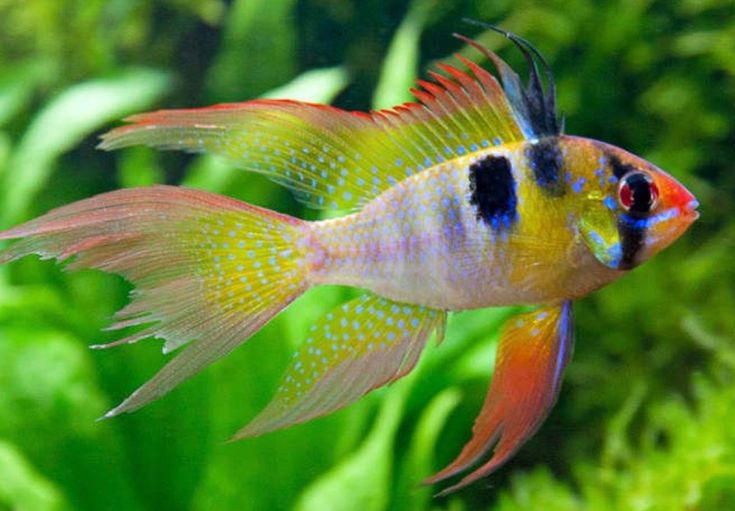
Microgeophagus ramirezi sp. Blue German Longfin
| Qty (Stock) | Size | Sex | Unit price (Tax included) |
|---|---|---|---|
| Currently Out of Stock! Contact us for more information | |||
IMPORTANT
Keeping fish in an aquarium requires an ethical and responsible approach that prioritizes animal welfare. Purchasing fish for an aquarium should never be an impulsive decision. It is essential to understand the specific needs of each species, including water quality, aquarium size, behavior, and diet. Only fish with similar water quality requirements should be kept together in the same aquarium.
A Little More Information...
Microgeophagus ramirezi sp. Blue German Longfin is a captive-bred variety of the popular German blue ram, selected for its metallic blue coloration and elongated fins. It retains the small size, territorial behavior and substrate-spawning habits of Microgeophagus ramirezi. This aquarium form is especially attractive in calm, well-planted South American aquariums maintained at a warm temperature. Despite its delicate appearance, it requires stable water, a varied diet and peaceful tank mates. Its availability is generally moderate, making it a sought-after variety without being constantly available.
General species description
Microgeophagus ramirezi sp. Blue German Longfin is a long-finned ornamental form of Microgeophagus ramirezi, a small South American cichlid valued for its colors and parental care. The “Blue German” variety shows a stronger blue coloration than the wild form, while “Longfin” refers to the selective development of elongated fins. This is not a separate scientific name, but a commercial aquarium designation. Like the base species, this fish spends much of its time in the lower part of the aquarium and searches the substrate for food. It may live as a pair, but becomes territorial during breeding. Very clean, well-oxygenated and chemically stable water is essential because captive lines often react poorly to rapid changes. This form is moderately uncommon depending on market availability.
Geographic origin and biotope
Reference countries: Venezuela and Colombia. The nominal species comes from the Orinoco basin, particularly the Llanos plains and areas associated with the Rio Apure. Its natural habitat includes lagoons, seasonal pools and small slow-moving channels, often warmed by sunlight. Water may be amber or clear, with low to moderate mineral content and a bottom made of fine sand, mud and plant debris. Roots, fallen leaves and aquatic or marginal vegetation provide shelter. Microgeophagus ramirezi sp. Blue German Longfin is nevertheless a captive-bred form and does not represent an identifiable natural population. In an aquarium, it is more useful to reproduce the calm conditions, warmth and shelter of the habitat than to pursue extremely acidic water at all costs.
Precise location and local name
The most useful geographic reference is the Llanos of the Orinoco basin, especially the Rio Apure network and its associated quiet-water habitats. Common local and commercial names include “ramirezi,” “German blue ram,” “blue ram” and “German ram.” In the aquarium trade, “Blue German Longfin” indicates a line selected for blue coloration and enlarged fins; it does not describe a collection locality. The word “German” refers to the history of captive selection, not to the species’ geographic origin. Fish sold under this name may vary in blue intensity, fin length and body shape depending on the line. Identification should therefore rely on the complete set of characters of Microgeophagus ramirezi, rather than on the commercial name alone.
Appearance and physical characteristics
The body is short, deep and laterally compressed, with a rounded head and large eyes. Microgeophagus ramirezi sp. Blue German Longfin displays electric blue to turquoise-blue coloration across the body, cheeks and fins, often with yellow on the chest and black markings around the eye and along the side. A dark lateral spot and red or orange reflections in the fins may appear depending on age, sex and emotional state. The dorsal, caudal and pelvic fins are noticeably longer than those of the short-finned form, creating an elegant but more delicate profile. Adult males are often slightly larger and show stronger fin extensions; females may develop a pinkish belly, especially when ready to spawn. Adult size generally reaches 5 to 7 cm.
General diet
Microgeophagus ramirezi sp. Blue German Longfin is a small omnivore with a carnivorous tendency that searches the substrate and picks up tiny prey. A varied diet supports growth, coloration and overall vitality. Fine frozen or live foods such as brine shrimp, mosquito larvae and bloodworms can be offered alongside quality micro-pellets designed for small cichlids. Foods must be small enough for the fish to swallow easily. It is better to provide small frequent meals than one large feeding, while removing leftovers to protect water quality. Young fish benefit especially from very small, protein-rich foods. An exclusively dry or nutritionally limited diet may reduce overall condition. Dietary variety is therefore as important as stable parameters, particularly for a long-finned captive-bred form.
Essential data
- Native river: Rio Apure, Orinoco basin
- Local name used: Ramirezi, German blue ram, blue ram
- Origin of the scientific name: Descriptive genus name and a specific name dedicated to Manuel Ramirez
- Full-name etymology: Microgeophagus means “small earth-eater”; ramirezi honors Manuel Ramirez; Blue German Longfin means “blue German long-finned”
- Common/vernacular names: German blue ram, blue ram, German ram
- Family: Cichlidae
- Subfamily: Cichlinae
- Name pronunciation: mi-cro-jee-oh-fa-gus ra-mi-reh-zee
- Discovery: George S. Myers and Robert R. Harry, 1948
- Maximum adult size: About 7 cm
- Water temperature and pH: 27 to 30 °C; pH 5.5 to 7.0
- Watercourse appearance and surrounding vegetation: Calm or slow water, sand, mud, fallen leaves, roots and marginal vegetation
- Typical tank mates: Nannostomus beckfordi, Hemigrammus bleheri, Otocinclus macrospilus and other peaceful small characins
- Temperament and behavior: Peaceful, territorial around a spawning site; kept singly or as a pair
- Water depth: Shallow areas, generally less than one metre deep
- Sexual dimorphism: Male often larger; female usually stockier with a pinkish belly when breeding
- Bottom structure and flow: Fine sand and plant debris; low to moderate current
In your aquarium
To succeed with Microgeophagus ramirezi sp. Blue German Longfin, use a mature, well-filtered aquarium furnished with fine sand, roots, plants and visual barriers. The priority is warm, stable water without waste accumulation or sudden pH changes. A pair may defend a small area while spawning, but tank mates should remain calm and avoid monopolizing the bottom. Feed varied small portions and monitor body condition. With good water quality, shelter and suitable food, this variety offers fascinating pair behavior and a vivid presence in a peaceful community aquarium.