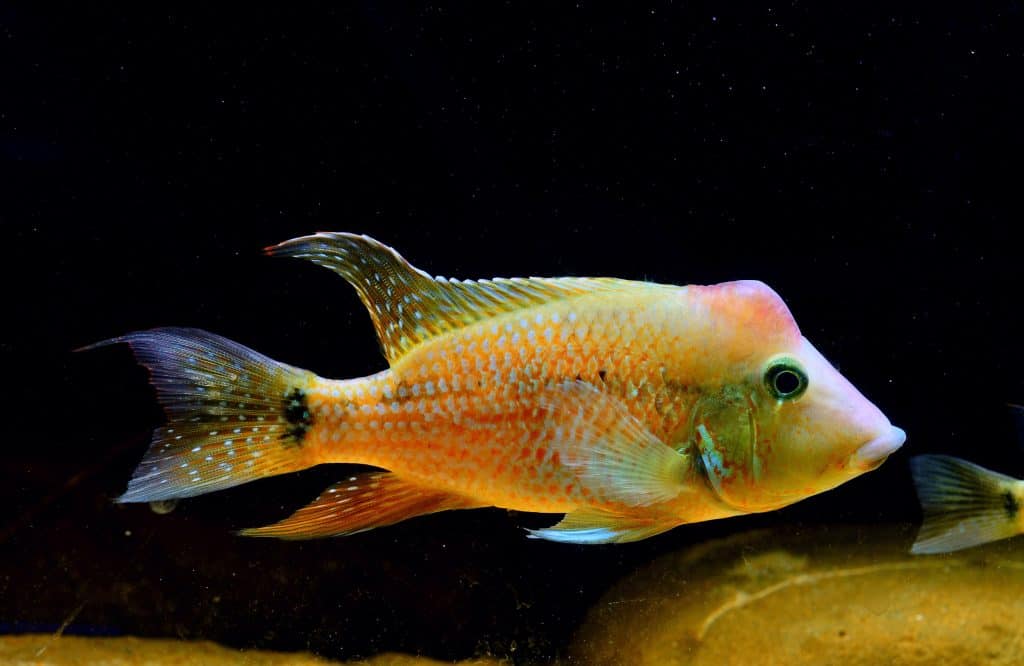
Geophagus steindachneri Red Hump Eartheater
| Qty (Stock) | Size | Sex | Unit price (Tax included) |
|---|---|---|---|
| Currently Out of Stock! Contact us for more information | |||
IMPORTANT
Keeping fish in an aquarium requires an ethical and responsible approach that prioritizes animal welfare. Purchasing fish for an aquarium should never be an impulsive decision. It is essential to understand the specific needs of each species, including water quality, aquarium size, behavior, and diet. Only fish with similar water quality requirements should be kept together in the same aquarium.
A Little More Information...
Geophagus steindachneri, known as the Red Hump Eartheater, is a South American cichlid valued for its bottom-feeding behavior and the red-orange hump that develops mainly in adult males. Native to Colombia, it inhabits the slower waters of the Magdalena basin, where it sifts sand to find small organisms and nutritious organic matter. In aquariums, this species is very common in the trade and remains peaceful when kept in a suitable setup, but it requires a fine, smooth substrate. Its group behavior, mouthbrooding reproduction and social interactions make it especially rewarding to observe. Stable water quality, open bottom space and a varied diet are central to long-term success.
General species description
Geophagus steindachneri is a medium-sized geophagus cichlid adapted to life close to the substrate. It spends much of its time taking sand into its mouth, filtering it through the gills and expelling the remaining particles. This method allows it to collect small invertebrates, larvae and organic matter. The species is generally peaceful, although males may become more territorial during breeding. It is best kept in a group in a spacious aquarium with open bottom areas. The red nuchal hump is especially pronounced in mature males and explains the English common name. Care is accessible to aquarists familiar with South American cichlids, particularly when the water is clean and well oxygenated. Moderate circulation, regular water changes and efficient filtration encourage natural behavior and strong coloration. A stable social group is usually more valuable than a heavily decorated aquarium.
Geographic origin and biotope
Country of reference: Colombia. Geophagus steindachneri is associated with the Magdalena River basin and several of its tributaries, including the Cauca, San Jorge and Sinú basins. It inhabits lowland areas where water is generally slow to moderately flowing, with banks offering shelter and areas of fine sand or soft sediment. The biotope includes river margins, secondary channels and calm areas among roots, branches and riparian vegetation. In an aquarium, it is more important to reproduce the bottom structure than to create a densely planted layout: use very fine quartz sand, a few roots, rounded stones and open swimming space. Tropical water at 24 to 28 °C, slightly acidic to neutral, is suitable. The species can tolerate some variation, but it does not respond well to waste accumulation or sudden changes in water quality.
Precise locality and local name
The known distribution of Geophagus steindachneri is in Colombia, within the Magdalena–Cauca network and nearby basins such as the San Jorge and Sinú. These rivers cross lowland and foothill regions where aquatic habitats vary with season, flow and turbidity. The local term mojarra is commonly used in Colombia for several freshwater cichlids, so it does not refer exclusively to this species. In the aquarium trade, Red Hump Eartheater is the most distinctive name. Wild populations occupy bottom-oriented habitats and exploit soft deposits rather than open midwater areas. The species is generally easy to find in the trade, which explains its classification as very common in the aquarium market.
Appearance and physical characteristics
The body of Geophagus steindachneri is deep, laterally compressed and covered with relatively large scales. The base color ranges from brownish gray to olive beige, with blue or green reflections across the head and flanks. The fins may show red, orange or blue tones, especially in males in breeding condition. Its most distinctive feature is the adult male’s red-orange forehead hump, which can become very prominent when the fish is mature and well fed. Females are usually smaller and less intensely colored. The protrusible mouth and specialized gills reflect its bottom-sifting feeding method. As in many geophagus cichlids, coloration changes with mood, social rank and the quality of the surroundings. A dark substrate, moderate lighting and a stable group often help display its natural colors. Avoid sharp gravel, which can damage the mouth and gill tissues during feeding.
General diet
In nature, Geophagus steindachneri searches for food by filtering sand and sediment. Its diet is omnivorous with a benthic emphasis and includes small crustaceans, insect larvae, worms, microscopic organisms, plant debris and organic matter. In aquariums, it accepts quality sinking pellets, frozen foods such as brine shrimp, finely chopped krill or mosquito larvae, along with small portions of plant-based foods. Food should reach the bottom so that its natural behavior is respected. A varied diet offered in small portions helps maintain good condition without polluting the substrate. Avoid oversized foods and excessive feeding. Its constant substrate sifting is normal and does not necessarily indicate that the fish is hungry. Several modest feedings are preferable to one large meal, especially in a community aquarium.
Essential data
- Native river: Magdalena River and tributaries of the Magdalena–Cauca basin
- Local name used: mojarra
- Origin of the scientific name: Geophagus steindachneri
- Full-name etymology: Geophagus means earth-eater; steindachneri honors the Austrian zoologist Franz Steindachner
- Common/vernacular names: Red Hump Eartheater; red-hump geophagus
- Family: Cichlidae
- Subfamily: Cichlinae
- Name pronunciation: gee-oh-FAY-gus - shtine-DAHK-ner-eye
- Discovery: described by Charles Tate Regan in 1912
- Maximum adult size: about 20 cm
- Water temperature and pH: 24 to 28 °C; pH 6.5 to 7.5
- Stream appearance and surrounding vegetation: slow to moderate lowland waters, wooded banks, roots, branches and riparian vegetation
- Typical tankmates: Geophagus pellegrini, Andinoacara pulcher, Caquetaia kraussii
- Temperament and behavior: peaceful to moderately territorial; actively sifts sand and does best in a group
- Water depth: shallow to intermediate areas near the bottom
- Sexual dimorphism: males are larger, develop a more pronounced nuchal hump and show stronger coloration; females are smaller
- Bottom structure and flow: sand or fine sediment with roots and woody debris; slow to moderate current
For aquarium success
To keep Geophagus steindachneri successfully, choose a long aquarium with strong filtration and very fine sand that protects its gills while it sifts. Maintain a balanced group, stable water conditions and regular water changes. Roots and open areas help reduce tension, while a varied diet supports growth, coloration and fin development. Avoid aggressive tankmates or fish that monopolize the bottom. Under these conditions, its natural behavior and mouthbrooding reproduction become especially fascinating to observe. Consistent maintenance is more important than elaborate decoration.