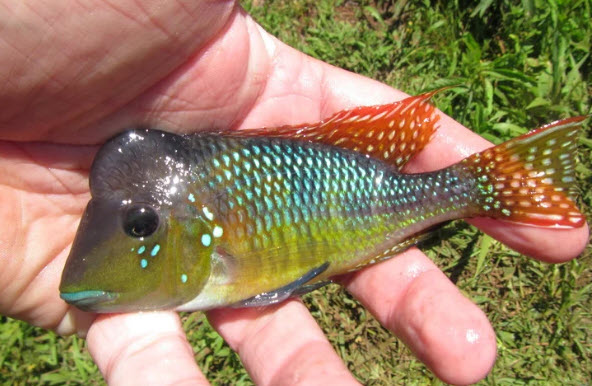
Gymnogeophagus lipokarenos Argentine Rainbow Humphead
New Wild caught origin Exclusive
| Qty (Stock) | Size | Sex | Unit price (Tax included) |
|---|---|---|---|
| 3 ½" | - | 110$ |
IMPORTANT
Keeping fish in an aquarium requires an ethical and responsible approach that prioritizes animal welfare. Purchasing fish for an aquarium should never be an impulsive decision. It is essential to understand the specific needs of each species, including water quality, aquarium size, behavior, and diet. Only fish with similar water quality requirements should be kept together in the same aquarium.
A Little More Information...
Gymnogeophagus lipokarenos, also known as Argentine Rainbow Humphead, is a South American cichlid valued for its sturdy body and well-developed nuchal hump. Native to Uruguay, this fish belongs to the Gymnogeophagus group adapted to the temperate waters of the southern cone. Its rarity in the aquarium trade makes it an appealing choice for specialized cichlid keepers. Like several earth-eating cichlids, it spends much of its time near the bottom, examining the substrate for food. A spacious aquarium, stable water conditions, and a structured layout are essential for long-term care.
General species description
Gymnogeophagus lipokarenos is a medium-sized to large geophagine cichlid recognized by its tall dorsal profile, broad head, and nuchal hump, which becomes more pronounced in mature dominant adults. The species is seldom available through the aquarium trade, increasing its appeal among specialist aquarists. It is better suited to a regional setup or a South American cichlid aquarium than to an ordinary community tank. Its behavior combines constant bottom exploration, territorial defense, and relatively nuanced social interactions. A large aquarium, effective filtration, and regular water changes support its welfare. Care should reflect its origin in Uruguay and its adaptation to seasonal changes. The description very rare mainly refers to its limited availability, not to exceptional aggression.
Geographic origin and biotope
Gymnogeophagus lipokarenos is associated with Uruguay, within the Río Uruguay basin and the waterways of the Uruguayan region. Its natural habitat consists of freshwater rivers and streams where current strength may change with the seasons. The bottom is generally made of sand, gravel, and stones, with calmer areas where the fish can sift through the substrate. Aquatic vegetation may be sparse, while the banks can provide grasses, shrubs, and occasional submerged roots. In aquaria, moderate temperatures, well-oxygenated water, and stable conditions are preferable to very warm tropical water. A layout combining a sandy area, rounded stones, and visual shelters better reflects its natural environment. This species is offered here as wild collected; careful acclimation and thorough quarantine are therefore recommended.
Precise location and local name
The geographic reference used for Gymnogeophagus lipokarenos is Uruguay, while a precise locality and a consistently used local vernacular name are not standard in the aquarium trade. In English, the name Argentine Rainbow Humphead emphasizes its hump-backed profile and rainbow-like coloration. For clarity, the scientific name should be retained on aquarium labels, together with Uruguay as the origin and the exact collection site whenever available. Despite the English name, the species is referenced here with a Uruguayan origin. This information is particularly valuable for a very rare species and helps preserve the traceability of wild populations. Accurate labeling also reduces confusion with other Gymnogeophagus species that may have similar body shapes or colors.
Appearance and physical characteristics
The body of Gymnogeophagus lipokarenos is deep and laterally compressed, with a broad head and a forehead that may develop a pronounced nuchal hump in adult males. Overall coloration may include gray, brownish, or olive tones enhanced by bluish and greenish reflections, especially when the fish is settled and in good condition. The fins can show reddish, orange, or bluish shades, although intensity varies with age, sex, mood, and lighting. As in several geophagine cichlids, the mouth is adapted for sorting substrate. Its sturdy build and nuchal hump are the most distinctive features. A dark substrate, subdued lighting, and sheltered areas can help display its metallic reflections and natural color changes.
General diet
In the wild, Gymnogeophagus lipokarenos searches for small organisms, larvae, crustaceans, worms, and organic matter in sand and gravel. Its sifting behavior involves taking substrate into the mouth, sorting edible particles, and expelling the unwanted material through the opercula. In an aquarium, provide a varied diet in small portions: quality sinking pellets, frozen foods such as brine shrimp or bloodworms, and preparations containing some plant matter. Very fatty foods should remain occasional. Several moderate feedings are preferable to overloading the bottom with one large meal. A varied diet supports growth, coloration, and reproductive condition. The priority is a varied diet combined with fine sand, which is essential for its natural sifting behavior.
Essential data
- River of origin: Río Uruguay
- Local name used: Argentine Rainbow Humphead
- Origin of the scientific name: Gymnogeophagus is the genus name; lipokarenos is the specific epithet.
- Full-name etymology: Gymnogeophagus means “naked earth-eater,” referring to the genus and its feeding behavior; lipokarenos is the specific term associated with the scientific name.
- Common/vernacular names: Argentine Rainbow Humphead
- Family: Cichlidae
- Subfamily: Cichlinae
- Name pronunciation: jim-no-jee-oh-fay-gus - li-po-ka-ree-nos
- Discovery: 2015
- Maximum adult size: approximately 15 cm
- Water temperature and pH: approximately 20 to 26 °C; near-neutral to slightly alkaline pH
- Stream appearance and surrounding vegetation: freshwater courses with sand, gravel, and stones; riparian vegetation and root shelters
- Typical tankmates: Australoheros facetus, Psalidodon anisitsi, Hoplisoma paleatus, Gymnogeophagus balzanii
- Temperament and behavior: territorial, substrate-sifting, and generally moderate outside the breeding period
- Water depth: shallow to medium-depth areas
- Sexual dimorphism: adult males are generally larger, with a nuchal hump and more developed fins
- Bottom structure and flow: sand, gravel, and stones; low to moderate current depending on the section
For greater success
Success with Gymnogeophagus lipokarenos depends on a spacious aquarium, clean water, and moderate temperatures rather than excessively warm tropical conditions. Use fine sand, stable stones, and visual barriers to reduce territorial conflict. Offer varied food in small portions and monitor water quality closely, especially with wild fish. Because this is a very rare and wild-collected species, quarantine, traceability, and purchase from a responsible source are priorities. A carefully planned population without overcrowding helps preserve natural behavior and long-term condition.
{490,500,202,1222}