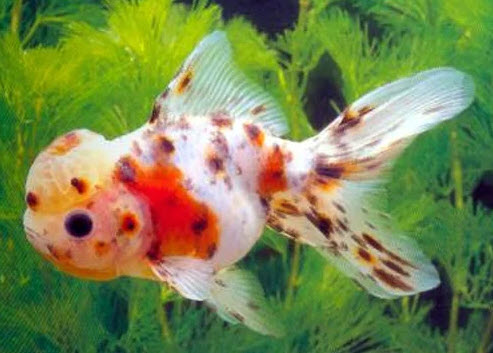
Carassius aureatus Calico Oranda
| Qté (Stock) | Taille | Sexe | Prix unitaire (Taxes incluses) |
|---|---|---|---|
| Aucun en stock en ce moment! Communiquez avec nous | |||
IMPORTANT
La possession de poissons en aquarium requiert une approche éthique et responsable pour respecter les animaux. L'acquisition de poissons pour maintenance en aquarium ne doit pas se faire sur un coup de tête (achat impulsif). Il est essentiel de s'informer sur les besoins spécifiques des espèces (qualité eau, dimensions aquarium, comportement, alimentat). Seuls les poissons ayant des exigences similaires en matière de qualité d'eau devraient être maintenus ensemble dans un même aquarium.
Un peu plus d'informations...
Introduction
The Calico Oranda is an ornamental variety of goldfish, known scientifically as Carassius auratus. Its calico pattern usually combines white, orange, red, yellow and black areas, while its fleshy head growth, called the wen, gives the Oranda its distinctive appearance. Bred in captivity, Carassius aureatus is not a wild form and is mainly kept in aquariums and ponds. It is a hardy, peaceful and fairly common fish in the aquarium trade, but its developed fins and specialized body shape require clean water, sufficient space and a well-balanced diet.
General species description
Carassius aureatus belongs to the ornamental goldfish varieties developed from domesticated populations of Carassius auratus. The Oranda is recognized primarily by its wen, a fleshy growth that develops over the head and opercula. The calico variety has a highly variable pattern: every fish may display a unique combination of white, orange, red, yellow and black. Its compact body and elegant fins make it an attractive display fish. Despite its delicate appearance, it is generally peaceful and active. Its popularity and availability place it among the fairly common goldfish varieties in the aquarium trade.
Geographic origin and habitat
The domesticated goldfish has a historical origin in China, where selective breeding has taken place for many centuries. The Calico Oranda is a captive-bred form and therefore does not correspond to one precise natural habitat. It descends from lines maintained and selected in captivity, then distributed throughout Asia and other parts of the world. In an aquarium, it benefits from stable, well-oxygenated water with low waste accumulation. A spacious aquarium or temperate pond, equipped with effective filtration and a moderate current, is preferable to a small decorative container. Hardy plants may be used, although they can be grazed or uprooted.
Precise location and local name
Carassius aureatus is not associated with a collection locality because it is a domesticated variety produced through selective breeding. Its aquarium origin is linked to goldfish lines developed in China and later bred in many countries. The most widely used trade name is Calico Oranda; the form may also be called calico Oranda goldfish. Oranda refers to the breeding form characterized by the wen, while calico describes an irregular multicolored pattern. Fish sold under this name may therefore differ considerably in color, spot distribution and head-growth development. These differences are normal within ornamental goldfish lines.
Appearance and physical characteristics
The body of Carassius aureatus is short to medium in length, deep and rounded, with a usually double caudal fin and developed fins. Its most striking feature is the fleshy head growth, which gradually covers the top of the head without obstructing the eyes or mouth. The calico coloration combines pale areas with dark patches, often accompanied by red or orange. The scales may appear metallic or nacreous. Good conformation includes steady swimming, undamaged fins and a balanced wen. Very compact individuals may be more prone to buoyancy problems and poor-water-quality stress. Careful observation helps detect changes early.
General diet
Carassius aureatus is an omnivore and should receive a varied diet offered in small portions. Sinking goldfish pellets make a useful staple because they reduce surface air intake. They can be supplemented with suitable frozen or live foods such as brine shrimp, daphnia and bloodworms, along with soft vegetables including shelled cooked peas, zucchini or blanched spinach. Food should be eaten promptly to protect water quality. Overfeeding can contribute to obesity, constipation and buoyancy problems. Regularity, variety and moderation matter more than large portions. Uneaten food should be removed rather than allowed to decay in the aquarium.
Essential data
- Name of original river: domesticated lineage, with no single source river.
- Local name used: Calico Oranda; calico Oranda goldfish.
- Origin of the scientific name: Carassius is a Latinized genus name; auratus means golden.
- Full-name etymology: Carassius identifies the goldfish genus; auratus means “golden” or “gold-covered.”
- Common/vernacular names: Calico Oranda, calico Oranda goldfish, Oranda goldfish.
- Family: Cyprinidae.
- Subfamily: Cyprininae.
- Name pronunciation: ka-ra-si-us au-ra-tus.
- Discovery: Carl Linnaeus, 1758, for the species Carassius auratus.
- Maximum adult size: about 25 cm, depending on strain, space and rearing conditions.
- Water temperature and pH: 18 to 24 °C; pH 6.8 to 8.0.
- Watercourse appearance and surrounding vegetation: calm to moderately moving water; aquatic and marginal vegetation varies.
- Typical tankmates: other varieties of Carassius auratus; Misgurnus anguillicaudatus in a large temperate aquarium.
- Temperament and behavior: peaceful, social, active and an enthusiastic bottom forager; may uproot plants.
- Water depth: variable; provide enough depth for comfortable swimming and good oxygenation.
- Sexual dimorphism: difficult to identify outside breeding condition; males may develop breeding tubercles.
- Bottom structure and flow: fine or smooth substrate, effective filtration and moderate water movement.
In your aquarium
To maintain Carassius aureatus successfully, provide a spacious aquarium, strong biological filtration and regular water changes. Keep the temperature stable, choose a substrate that cannot damage the fins and maintain enough flow for oxygenation without exhausting the fish. Pay close attention to the wen, buoyancy and appetite. A varied diet offered in small portions helps prevent digestive problems. Avoid aggressive or excessively fast tankmates. With clean water, adequate space and attentive observation, this peaceful goldfish can maintain excellent condition and striking coloration for years.
{1158,962}