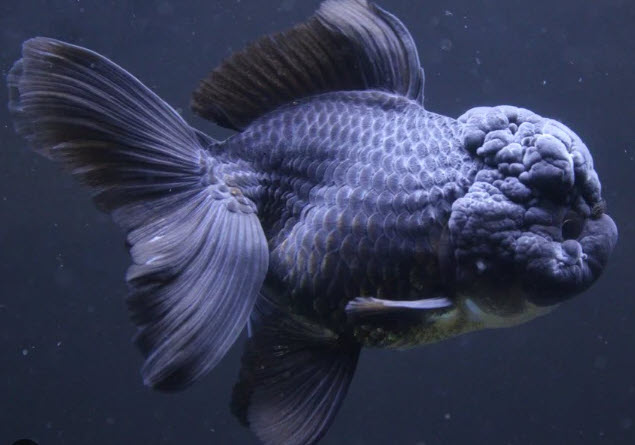
Carassius aureatus Jet Black Oranda
| Qty (Stock) | Size | Sex | Unit price (Tax included) |
|---|---|---|---|
| Currently Out of Stock! Contact us for more information | |||
IMPORTANT
Keeping fish in an aquarium requires an ethical and responsible approach that prioritizes animal welfare. Purchasing fish for an aquarium should never be an impulsive decision. It is essential to understand the specific needs of each species, including water quality, aquarium size, behavior, and diet. Only fish with similar water quality requirements should be kept together in the same aquarium.
A Little More Information...
The Jet Black Oranda is an ornamental variety of Carassius aureatus, selected for its rounded body, developed fins, and fleshy head growth known as the wen. Its entirely black coloration gives it a striking presence in a spacious, well-maintained aquarium. Like all fancy goldfish, it requires stable water, effective filtration, and a balanced diet. This variety is uncommon in the trade, although it is not considered extremely rare. It is best suited to aquarists able to maintain good water quality and avoid tank mates that are too fast or aggressive.
General description of the species
Carassius aureatus belongs to the ornamental goldfish varieties derived from the long domestication of Carassius auratus. The Jet Black Oranda is recognized by its short, deep body, slow swimming style, and wen, which gradually covers the head without normally obstructing the eyes or mouth. It is peaceful, but relatively vulnerable to feeding competition because of its body shape and fins. It should be kept in an aquarium with substantial floor space and mature biological filtration. Clean water is essential because goldfish produce a significant organic load. This variety is considered uncommon in the aquarium trade. It prefers moderate temperatures and tank mates with similar body shape and swimming speed. Excessive current can tire it and interfere with feeding. Smooth furnishings and open swimming areas are especially helpful.
Geographic origin and biotope
Carassius aureatus is not a wild population from a specific natural biotope; it is a domesticated, selectively bred variety of goldfish, with a history mainly associated with China. The reference to Indonesia relates to its availability and production in the aquarium trade rather than to a natural range. In captivity, it is produced in breeding facilities where temperature, water quality, and breeder selection are managed. Its aquarium should provide conditions generally suitable for goldfish: well-oxygenated water, open space, strong filtration, and regular maintenance. Hardy plants may be used, although adult fish can uproot or nibble them. A simple layout with smooth surfaces reduces the risk of injuries to the wen and fins. Avoiding abrupt changes in temperature and water chemistry is important for long-term health.
Precise location and local name
The Jet Black Oranda is distributed through ornamental fish breeding and is not associated with a particular river population. In Indonesia, goldfish are commonly called ikan mas koki, a name used for ornamental goldfish. The expression “ikan mas” literally means golden fish, while “koki” is associated with aquarium goldfish. In international commerce, the name Jet Black Oranda mainly describes its black coloration and Oranda body type. Availability may vary according to importers, breeders, and wen quality. Uniformly black, well-shaped specimens are generally more sought after than fish showing orange, gray, or metallic areas. Because this is a selectively bred variety, its appearance may change with age and keeping conditions. Its local trade name does not indicate a wild geographic population.
Appearance and physical characteristics
Carassius aureatus has a compact, egg-shaped body, a forked double tail, and generally long fins. Its most distinctive feature is the fleshy wen on the head, which develops around the top of the skull and cheeks. The desired coloration is uniform black, with a matte or slightly glossy finish depending on the individual and lighting. The eyes should remain unobstructed, and the mouth should function normally despite wen growth. The fins can be delicate, so sharp decorations, very strong pumps, and repeated handling should be avoided. Size and body shape vary with lineage, diet, and available space. Adults remain less streamlined than common goldfish, which limits swimming performance and their ability to reach food quickly. Smooth furnishings help prevent damage to the wen.
General diet
The Jet Black Oranda is omnivorous and benefits from a varied diet offered in small portions. The staple can consist of quality sinking pellets made for fancy goldfish, reducing surface air intake. Blanched vegetables such as shelled peas, zucchini, or spinach can be added, while frozen foods such as daphnia or brine shrimp provide extra protein. Meals should be small enough to be eaten quickly, without leaving waste on the bottom. Excessive or overly rich feeding can promote obesity and buoyancy problems. Young fish may receive several small meals, while adults should be given carefully controlled portions. Removing leftovers after a few minutes helps maintain healthy water and limits nitrogenous waste. A varied diet also supports normal growth and helps maintain body condition without overloading the filtration system.
Essential data
- Original river name:
- Local name used: ikan mas koki
- Origin of the scientific name: Latin name historically assigned to the goldfish.
- Etymology of the complete name: Carassius is the historical Latin name associated with carp; aureatus means golden or covered with gold.
- Common/vernacular names: Jet Black Oranda, black Oranda goldfish.
- Family: Cyprinidae
- Subfamily: Cyprininae
- Name pronunciation: ka-RASS-see-us ow-ray-AH-tus
- Discovery: Carl Linnaeus, 1758.
- Maximum adult size: About 30 cm for the species; Jet Black Orandas are often smaller.
- Water temperature and pH: 18 to 24 °C; pH 6.5 to 8.0.
- Watercourse appearance and surrounding vegetation: Reference to calm, vegetated environments associated with domesticated goldfish; in aquariums, use well-oxygenated water and hardy plants.
- Typical tank mates: Other fancy goldfish of similar size and swimming speed, including Oranda, Ranchu, and Fantail varieties.
- Temperament and behavior: Peaceful, sociable, slow-moving, and an opportunistic bottom forager.
- Water depth: Prefers moderate to substantial water depth with generous floor space.
- Sexual dimorphism: Difficult to determine outside the breeding season; males may develop breeding tubercles on the head and pectoral fins.
- Bottom layout and flow: Smooth sand or fine gravel; gentle to moderate flow without a strong direct current.
For greater success
To succeed with Carassius aureatus, provide a spacious aquarium, effective biological filtration, and regular water changes. A moderate temperature, stable pH, and controlled feeding matter more than a highly complex layout. Keep it with calm goldfish of similar swimming ability, then monitor wen development, breathing, and fin condition. Gentle flow, smooth surfaces, and minimal feeding competition support long-term welfare. Avoid sharp décor, sudden water changes, and fast tank mates that may prevent this slow-swimming Oranda from eating properly.
{}