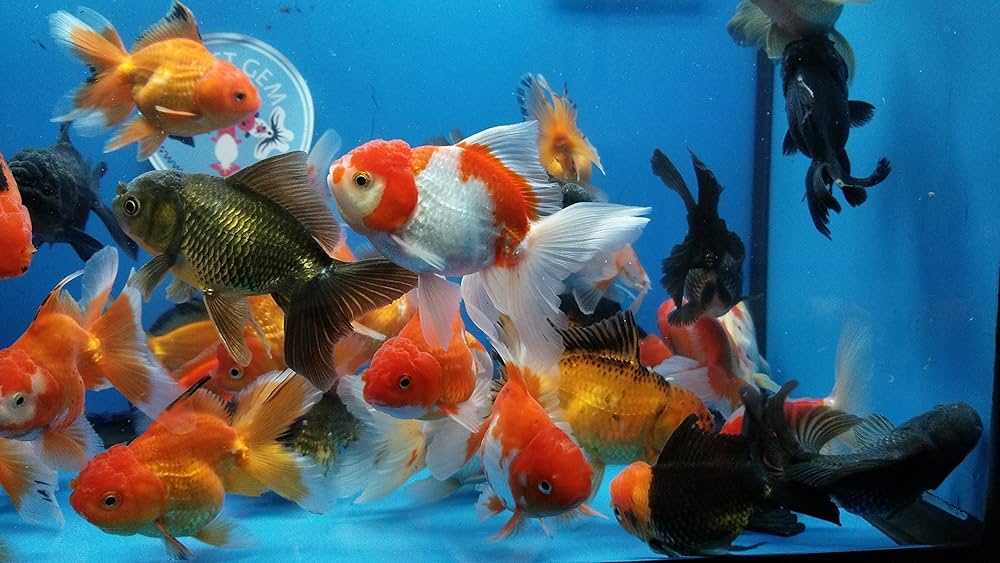
Carassius aureatus Assorted Premium Oranda
| Qté (Stock) | Taille | Sexe | Prix unitaire (Taxes incluses) |
|---|---|---|---|
| Aucun en stock en ce moment! Communiquez avec nous | |||
IMPORTANT
La possession de poissons en aquarium requiert une approche éthique et responsable pour respecter les animaux. L'acquisition de poissons pour maintenance en aquarium ne doit pas se faire sur un coup de tête (achat impulsif). Il est essentiel de s'informer sur les besoins spécifiques des espèces (qualité eau, dimensions aquarium, comportement, alimentat). Seuls les poissons ayant des exigences similaires en matière de qualité d'eau devraient être maintenus ensemble dans un même aquarium.
Un peu plus d'informations...
Carassius aureatus, also called Assorted Premium Oranda, is an ornamental form of the domesticated goldfish, Carassius aureatus. Selected for its rounded body, developed fins and fleshy head growth known as the wen, the Oranda offers a wide range of colors within one shipment. This variety is not a wild population: it comes from specialized breeding lines, including fish distributed through Southeast Asia. Despite its delicate appearance, it remains hardy when the water is clean, well oxygenated and kept at a moderate temperature. Its commercial rarity is low, so it is generally fairly easy to find through specialized aquarium retailers.
General species description
Carassius aureatus is the domesticated goldfish, a selected form developed from crucian carp lineages. Assorted Premium Oranda refers to a group of Oranda fish showing different color combinations rather than a separate scientific variety. Goldfish have been bred in Asia for centuries for their body shapes, fins and colors. The Oranda is especially recognized by its fleshy wen on the head, which develops with age and may partially cover the cheeks. It is a peaceful, freshwater, social fish that produces a significant amount of organic waste. A spacious aquarium, efficient filtration and regular water changes are therefore essential. Its compact body and long fins make it slower than common-bodied goldfish, so tank mates must be selected carefully. Fish in the same assortment can vary considerably in color, wen development and tail shape. They should be kept with other cool-water fish rather than with typical tropical community species requiring warmer conditions.
Geographical origin and habitat
The domesticated goldfish comes from lineages developed in Asia from crucian carp populations, with a long breeding history especially associated with China. The Assorted Premium Oranda is an aquarium-bred product and does not correspond to one precise natural habitat. Oranda fish sold through the trade may be bred or distributed from Indonesia, which is the geographic reference supplied for this shipment. They are suited to fresh to moderately mineralized water that is well oxygenated and low in organic waste. In nature, related wild forms use quiet or slow-moving water such as ponds, lakes, backwaters and sluggish river margins, with mud, sand or small gravel. Aquatic vegetation may be abundant, although goldfish often sift through the substrate and uproot delicate plants. In an aquarium, the main goal is to reproduce cool, clean and well-filtered water, rather than a densely planted tropical layout. Stable conditions are more important than attempting to recreate a precise river environment.
Precise locality and local name
This form is not associated with one unique wild locality. Oranda fish are domesticated ornamental varieties distributed through Asian aquarium networks, and Indonesia is the geographic reference provided for this lot. In Indonesia, goldfish are commonly called ikan mas koki, while the Oranda type is also sold under the name Oranda by specialty retailers. The word “koki” is associated with Indonesian usage for ornamental goldfish. Because this is a domesticated strain, color and body shape cannot identify a river or province of origin for each individual. Fish may be produced at different farms, then grouped and exported as an assortment. In stores, the name Assorted Premium Oranda therefore describes a commercial selection of Oranda fish with varied colors. It should not be interpreted as the name of a species or local wild population. Availability is usually good in the aquarium trade, although it may vary between retailers and seasons.
Appearance and physical characteristics
The Oranda has a short, deep body, a rounded head and usually a double caudal fin, with well-developed dorsal, anal, pectoral and pelvic fins. Its most distinctive feature is the fleshy wen, a skin growth that develops over the top of the head and around the cheeks. It should not obstruct the eyes, mouth or gill openings. In an assortment, colors may include orange, red, white, black, yellow, as well as bicolored and multicolored patterns. Scales may be metallic, matte or nacreous depending on the breeding line. Adult length depends on genetics, feeding and available space; large fish may approach 30 cm in total length, while aquarium Oranda are often smaller. Their less efficient swimming and, in some fish, reduced vision caused by wen growth require moderate water movement rather than strong currents. Compact-bodied forms may also be prone to buoyancy problems when fed an unsuitable diet. A smooth layout with open swimming space is preferable to sharp ornaments or powerful circulation.
General feeding
Goldfish are omnivores that graze and sift through the bottom for small organisms, plant matter and edible debris. For an Oranda, the staple diet should be a quality food formulated for fancy goldfish, offered in small portions that are eaten quickly. Sinking pellets or foods that hydrate well are often preferable to floating foods because they reduce air intake and make feeding easier for compact-bodied fish. The diet can be supplemented with suitable frozen or live foods such as brine shrimp or daphnia, along with tender vegetables such as shelled cooked peas, romaine lettuce or zucchini. Meals should remain moderate to limit pollution and digestive problems. A varied diet supports wen development, body condition and coloration, but very rich foods should not be overused. The priority is varied, digestible food in small portions, with uneaten material removed promptly. Feeding several modest meals is generally safer than offering one large meal, particularly for fish with rounded bodies and a history of buoyancy sensitivity.
Essential data
- Original river name: —
- Local name used: Ikan mas koki; Oranda
- Origin of the scientific name: Carassius is the genus name used for crucian carps; aureatus means golden or covered with gold.
- Etymology of the full name: Carassius refers to the crucian carp genus; aureatus is Latin for golden, referring to the golden coloration of classic forms.
- Common/vernacular names: Goldfish, fancy goldfish, Oranda, Assorted Premium Oranda, ikan mas koki
- Family: Cyprinidae
- Subfamily: Cyprininae
- Name pronunciation: ka-RA-see-us aw-re-AH-tus
- Discovery: Carl Linnaeus, 1758, under the historical name Cyprinus auratus.
- Maximum adult size: Up to about 30 cm; aquarium Oranda are often smaller.
- Water temperature and pH: Approximately 18 to 24 °C; pH around 6.8 to 8.0.
- Watercourse appearance and surrounding vegetation: Quiet or slow water, ponds, lakes and backwaters; mud, sand or gravel, with variable aquatic and marginal vegetation.
- Typical tank mates: Carassius aureatus, Cyprinus carpio, Misgurnus anguillicaudatus
- Temperament and behavior: Peaceful, social and active during feeding; sifts through the substrate and may uproot plants.
- Water depth: Shallow to moderate in quiet areas; in aquariums, prioritize floor space and a reasonable water column.
- Sexual dimorphism: Difficult to identify outside the breeding season; males may develop breeding tubercles and females may become rounder.
- Bottom structure and flow: Soft or gravelly bottom with low to moderate flow; avoid strong currents because of the fancy body shape.
In your aquarium, success depends on a spacious tank, strong biological filtration and well-oxygenated water. Keep the temperature moderate, feed small but frequent portions of digestible foods, and remove leftovers quickly. Avoid overly fast or aggressive tank mates, as well as sharp decorations that could damage the fins or wen. Regular water changes will protect water quality and reduce skin, gill and buoyancy problems. With these conditions, Carassius aureatus can remain a hardy, expressive and long-lived aquarium fish.
{1163,840,962}