Carassius aureatus
Liste de poissons Goldfish Carassius aureatus
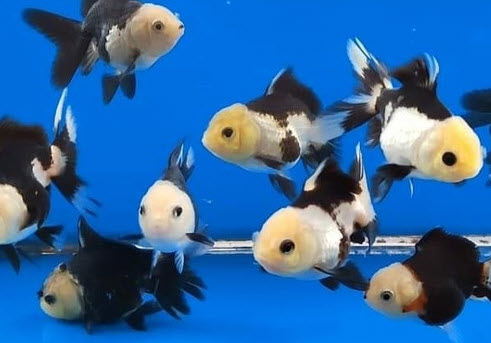
Carassius aureatus Panda Oranda
| Qté (Stock) | Taille | Sexe | Prix unitaire (Taxes incluses) |
|---|---|---|---|
| Aucun en stock en ce moment! Communiquez avec nous | |||
IMPORTANT
La possession de poissons en aquarium requiert une approche éthique et responsable pour respecter les animaux. L'acquisition de poissons pour maintenance en aquarium ne doit pas se faire sur un coup de tête (achat impulsif). Il est essentiel de s'informer sur les besoins spécifiques des espèces (qualité eau, dimensions aquarium, comportement, alimentat). Seuls les poissons ayant des exigences similaires en matière de qualité d'eau devraient être maintenus ensemble dans un même aquarium.
Un peu plus d'informations...
Carassius aureatus: overview
The Panda Oranda is an ornamental variety of goldfish, recognized by its fleshy head growth and contrasting black-and-white pattern. It belongs to the cyprinids and comes from a long history of selective breeding rather than from a distinct wild population. Its availability is moderate, since well-proportioned fish with strong contrast are less common than orange varieties. Peaceful, social and generally hardy, Carassius aureatus still requires clean water, a spacious aquarium and a balanced diet to maintain good condition. Careful selection is important because body shape, wen development and color quality can vary considerably among individuals.
General species description
Carassius aureatus is an ornamental form of Carassius aureatus, the domesticated goldfish. The name “Panda Oranda” generally describes a light-bodied fish marked with black areas and carrying a characteristic wen, or head cap, associated with the Oranda type. Like other fancy goldfish, it produces considerable waste and requires efficient filtration, regular water changes and good oxygenation. Its temperament is usually calm, but its slower swimming ability means that fast or fin-nipping tank mates should be avoided. The black-and-white pattern may change with age, lighting and maintenance conditions. This is a freshwater, social and active fish that is best kept with compatible goldfish. Its commercial rarity is intermediate: it is regularly available, but balanced specimens with attractive color and wen development are more sought after.
Geographic origin and biotope
The Panda Oranda has no natural biotope of its own because it is a domesticated variety developed from goldfish lineages originating in eastern Asia. Its ancestors are associated with calm or slow-moving environments such as ponds, canals, floodplains and quiet river margins. In aquariums, these conditions are best approximated with soft to moderately mineralized water, gentle flow and open swimming space. In Indonesia, Carassius aureatus is bred, imported and distributed within the ornamental fish trade; the country is therefore an important commercial reference rather than a wild origin for this variety. A smooth substrate, sturdy plants and stable temperature are better suited to its rounded body and delicate fins.
Precise location and local name
In the Indonesian trade, the Panda Oranda is commonly sold as ikan mas koki Oranda Panda, or simply ikan mas koki, a common expression for ornamental goldfish. “Panda” refers to its black-and-white appearance, while “Oranda” identifies the fish type and its head growth. It is mainly encountered through ornamental fish farms and aquarium distribution networks, especially among producers of fancy goldfish. For aquarists, trade names may vary between suppliers, so it is better to assess the wen, body symmetry, fin condition and swimming ability rather than relying only on the label. Fish with clear contrast and steady swimming are generally the most desirable.
Appearance and physical characteristics
The Panda Oranda has a short, compact and egg-shaped body, with developed fins and a generally split caudal fin. Its most distinctive feature is the wen, a fleshy growth on the head that may gradually cover the top of the skull without obstructing the eyes or mouth. The desired pattern combines a white or silvery base with black areas, although the intensity of the black may change during growth. The eyes should remain clear, the fins intact and the body symmetrical. An overly compressed body or an excessive wen can interfere with swimming and feeding. Adult size depends on lineage and available space; a large specimen may reach approximately 20 to 25 cm, sometimes more under exceptional conditions. Its fancy body shape makes it slower than common-bodied goldfish.
General diet
The Panda Oranda is an omnivore and should receive a varied diet suited to its mouth and sometimes slow swimming style. A base of sinking, high-quality pellets formulated for fancy goldfish helps reduce surface air intake and makes feeding easier. This can be supplemented with tender vegetables, such as cooked and shelled peas, as well as small portions of suitable frozen or live foods. Meals should be small and offered once or twice daily, with leftovers removed promptly. Overfeeding encourages obesity, digestive problems and poor water quality. A fiber-rich diet supports digestion, while rotating food sources helps maintain body condition and pattern quality. Young fish can receive smaller, more frequent portions, provided feeding remains controlled and the aquarium water stays clean.
Essential data
- Original river name: —
- Local name used: Ikan mas koki Oranda Panda
- Origin of the scientific name: Carassius aureatus is the zoological name used for the domesticated goldfish.
- Etymology of the full name: Carassius is a Latinized name associated with fishes in this group; aureatus means golden or gilded in Latin.
- Common/vernacular names: Panda Oranda, Panda Oranda goldfish, ikan mas koki Oranda Panda
- Family: Cyprinidae
- Subfamily: Cyprininae
- Name pronunciation: ka-RASS-ee-us aw-ray-AH-tus
- Discovery: Scientifically described by Carl Linnaeus in 1758.
- Maximum adult size: Approximately 20 to 25 cm
- Water temperature and pH: 18 to 24 °C; pH 6.8 to 8.0
- Watercourse appearance and surrounding vegetation: Calm or slow-moving water, ponds and canals, with aquatic and marginal vegetation.
- Typical tank mates: Other peaceful varieties of Carassius aureatus; some larger cool-water loaches may be suitable depending on aquarium size and temperature.
- Temperament and behavior: Peaceful, social, active and constantly searching the bottom; relatively slow swimmer.
- Water depth: Shallow to intermediate areas of calm habitats.
- Sexual dimorphism: Difficult to identify outside the breeding season; males may develop breeding tubercles and females may become rounder.
- Bottom structure and flow: Smooth, non-abrasive bottom with sand or rounded gravel; low to moderate flow.
- Commercial rarity: Level 2 out of 3: moderately available, with variable pattern and wen quality.
In your aquarium
To succeed with Carassius aureatus, provide a long, spacious aquarium, well-filtered water and stable parameters. Excessive flow can exhaust its swimming, while abrasive décor may damage its fins or wen. Offer small portions, monitor body condition and remove waste to maintain clean water. Calm tank mates of similar size are preferable. The essentials are gradual growth, good oxygenation and regular water changes; these practices support longevity, vitality and the contrast of the Panda pattern. Avoid overcrowding, sudden temperature shifts and diets dominated by floating foods.
{1160}