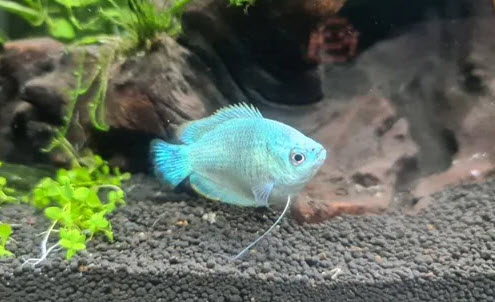
Trichogaster lalius Dwarf Blue Gourami
| Qty (Stock) | Size | Sex | Unit price (Tax included) |
|---|---|---|---|
| 1 ¾" | - | 17$ |
IMPORTANT
Keeping fish in an aquarium requires an ethical and responsible approach that prioritizes animal welfare. Purchasing fish for an aquarium should never be an impulsive decision. It is essential to understand the specific needs of each species, including water quality, aquarium size, behavior, and diet. Only fish with similar water quality requirements should be kept together in the same aquarium.
A Little More Information...
Introduction
The Trichogaster lalius, also known as Dwarf Blue Gourami, is a small labyrinth fish native to the Indian subcontinent. Its blue coloration, red-orange markings and long filament-like pelvic fins explain its popularity in the aquarium hobby. Generally peaceful in a well-arranged aquarium, it is mainly found in shallow, slow-moving water with abundant floating vegetation. Because it can breathe atmospheric air through its labyrinth organ, it benefits from a covered aquarium, stable conditions and gentle circulation. This species is widely available to aquarists, but it still requires clean water, a varied diet and calm tank mates.
General species description
The Trichogaster lalius is a small anabantoid belonging to the Osphronemidae family. It spends much of its time near the surface and alternates between gill breathing and the intake of atmospheric air through its labyrinth organ. In aquariums, it is usually calm, curious and somewhat reserved, especially when moderate lighting and plants provide cover. Males may defend a small territory, particularly during breeding, while females are generally less conspicuous. This species is suitable for a peaceful community aquarium without boisterous fish or fin nippers. Gentle flow, floating cover and clear access to the surface support its well-being. The Trichogaster lalius is very common in the aquarium trade, making it easy to obtain and widely represented by captive-bred color forms.
Geographical origin and biotope
Countries of reference: Bangladesh, India and Pakistan. The Trichogaster lalius is associated with the Ganges-Brahmaputra basin and freshwater habitats across the Bengal lowlands. It occurs in marshes, ditches, canals, flooded rice fields, ponds and small slow-flowing waterways. These habitats are often shallow, warm and densely vegetated, with water that may be lightly stained by organic matter. Heavy vegetation reduces direct light and provides shelter from predators. In an aquarium, the goal should therefore be a quiet environment rather than a fast-flowing stream: floating plants, plant clumps, roots and shaded areas are especially appropriate. Gentle filtration remains important for water quality, but excessive surface turbulence should be avoided.
Precise location and local name
Across its native range, the Trichogaster lalius is mainly associated with the wet lowlands of Bengal, including Bangladesh and eastern India, as well as adjacent areas of the Ganges basin. It is not restricted to one river type; populations also occupy agricultural canals, ponds and seasonally flooded land. In Bengali, it is commonly called Khalisha or Khalisa, depending on the transliteration. The English name Dwarf Gourami refers to its small size, while Dwarf Blue Gourami describes a blue commercial form. Aquarium stores may offer several selected color forms under similar names, so the scientific identification remains useful when distinguishing the species from captive-bred varieties.
Appearance and physical characteristics
The body of the Trichogaster lalius is short, laterally compressed and covered with small scales. The wild form usually displays alternating vertical blue-green and red-orange bands, with translucent to colorful fins. Males are generally larger and much more vividly colored than females. Its most distinctive feature is the pair of filament-like pelvic fins, which function as tactile organs in vegetation-rich water. Males often have a longer, more pointed dorsal fin. Maximum adult size is about 5 cm standard length, although observed size varies with breeding and husbandry conditions. Selected blue varieties may show fewer visible bands than the natural form, with a stronger overall blue appearance.
General diet
The Trichogaster lalius is an omnivore that benefits from a varied diet including small prey, planktonic crustaceans, insect larvae and plant matter. In an aquarium, a high-quality dry food can be used as a staple, but it should be supplemented with frozen or live foods such as brine shrimp, daphnia and mosquito larvae. Portions should remain small because excess food quickly affects water quality. Offering small live or frozen prey encourages natural hunting behavior. A varied diet also supports coloration and overall condition. Moderate feeding once or twice daily is preferable, with uneaten food removed after a few minutes. Care should be taken not to rely exclusively on one type of dry food.
Essential data
- Native river name: Ganges-Brahmaputra basin, including slow waterways, canals and wetlands.
- Local name used: Khalisha or Khalisa.
- Origin of the scientific name: The genus Trichogaster refers to the filament-like rays of the pelvic fins.
- Etymology of the full name: Trichogaster comes from the Greek trichos, meaning “hair,” and gastēr, meaning “belly”; lalius is the specific epithet.
- Common/vernacular names: Dwarf Gourami, Dwarf Blue Gourami, Blue Dwarf Gourami, Gourami nain.
- Family: Osphronemidae.
- Subfamily: Luciocephalinae.
- Name pronunciation: trik-oh-GAS-ter - LAL-ee-us.
- Discovery: Francis Buchanan-Hamilton, 1822.
- Maximum adult size: About 5 cm.
- Water temperature and pH: About 22 to 28 °C; pH 6.0 to 7.5.
- Waterway appearance and surrounding vegetation: Shallow, calm and often shaded water with abundant vegetation; floating plants, marsh grasses and bank vegetation.
- Typical tank mates: Boraras maculatus, Pangio oblonga, Aplocheilus panchax, Rasbora pauciperforata.
- Temperament and behavior: Peaceful, calm and usually shy; males may defend a territory.
- Water depth: Shallow to moderate, especially in marshes, ditches, rice fields and canals.
- Sexual dimorphism: Male more colorful and often larger, with a longer, pointed dorsal fin; female duller and rounder.
- Bottom structure and flow: Mud, silt, plant debris and fine substrate; very weak flow or stagnant water.
In your aquarium
For successful care of the Trichogaster lalius, use a mature, covered aquarium with dense planting and a calm surface for atmospheric breathing. Moderate filtration, floating plants and shaded areas help reduce stress. Keep the water warm, clean and stable rather than pursuing extreme values. Tank mates should be peaceful and non-competitive, without persistent chasing or fin nipping. A varied diet and small portions help preserve body condition and coloration. Since males may become territorial, several males should not be housed together in a small aquarium. These straightforward precautions encourage long-term acclimation and more natural behavior.
{}