Trichogaster lalius
Liste de poissons Gouramis Trichogaster lalius
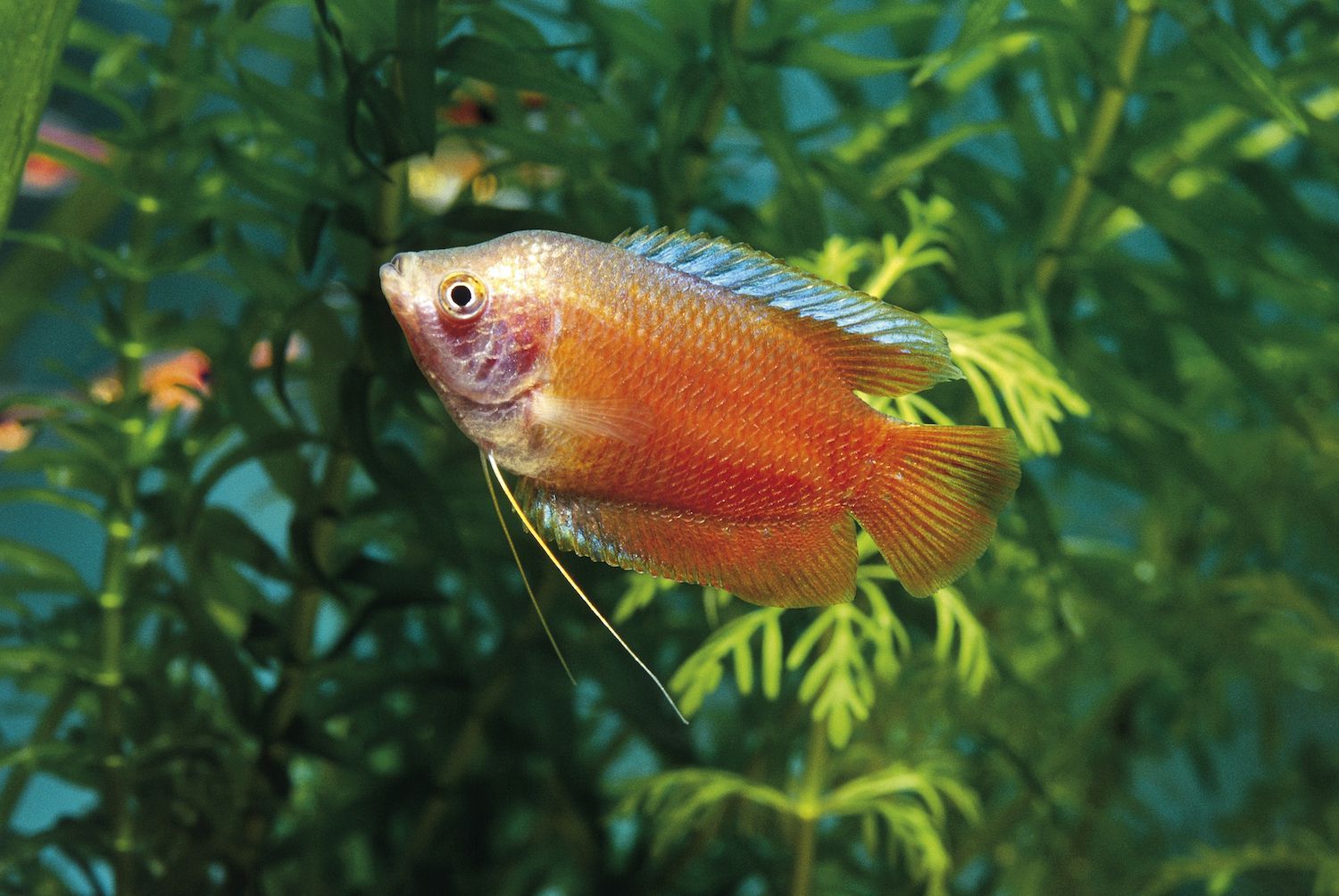
Trichogaster lalius Dwarf Fire Honey Gourami
| Qté (Stock) | Taille | Sexe | Prix unitaire (Taxes incluses) |
|---|---|---|---|
| 1 ¾" | - | 17$ |
IMPORTANT
La possession de poissons en aquarium requiert une approche éthique et responsable pour respecter les animaux. L'acquisition de poissons pour maintenance en aquarium ne doit pas se faire sur un coup de tête (achat impulsif). Il est essentiel de s'informer sur les besoins spécifiques des espèces (qualité eau, dimensions aquarium, comportement, alimentat). Seuls les poissons ayant des exigences similaires en matière de qualité d'eau devraient être maintenus ensemble dans un même aquarium.
Un peu plus d'informations...
Trichogaster lalius, also sold as the Dwarf Fire Honey Gourami, is a small labyrinth fish valued for its warm colors and peaceful behavior. This commercial form of Trichogaster lalius suits calm, heavily planted community aquariums with gentle water movement. Native to the Indian subcontinent, it inhabits slow, vegetated waters where it can breathe atmospheric air with its labyrinth organ. Successful care depends mainly on stable water, tropical temperatures, and non-aggressive tankmates. Floating cover and dense plant growth make it feel more secure. Although widely available in the aquarium trade, it still benefits from a mature setup that reflects its quiet natural habitat.
General species description
Trichogaster lalius is a small freshwater gourami from the family Osphronemidae. It spends much of its time near the surface and uses its labyrinth organ to breathe atmospheric oxygen, allowing it to live in calm waters that may contain limited dissolved oxygen. In aquariums, it is generally peaceful, reserved, and mildly territorial toward its own kind, particularly during spawning. Males may defend a small area beneath floating cover and build bubble nests. The Dwarf Fire Honey Gourami form usually shows red-orange to copper tones, often more uniform than the striped wild coloration. It is a popular species and is commonly offered through the ornamental fish trade.
Geographic origin and biotope
Reference countries: India, Bangladesh, and Pakistan, within the Ganges and Brahmaputra basins. Trichogaster lalius inhabits floodplains, canals, ponds, ditches, and slow-flowing marginal waters. These habitats are generally shallow, sheltered, and heavily colonized by aquatic or waterside plants. Water may range from clear to brownish depending on organic matter and silt. In an aquarium, recreate this setting with low water movement, moderate lighting, and dense plants reaching the surface rather than an exposed rocky layout or highly turbulent filtration. Floating plants are especially useful because they provide cover while leaving open areas for feeding and surfacing.
Precise locality and local name
The natural range is associated with the Ganges and Brahmaputra basins, particularly in northeastern India and Bangladesh; the species is also reported from the Indus basin in Pakistan. In Bangladesh, it is known by the vernacular name kholisa, with local forms such as lal kholisa. French and English trade names do not always identify a precise geographic population: Dwarf Fire Honey Gourami is mainly used to describe a captive-bred form with red, orange, or golden tones. For a community aquarium, exact locality is less important than good water quality, dense vegetation, and the absence of boisterous tankmates.
Appearance and physical characteristics
The body is oval and laterally compressed, with long, threadlike pelvic fins used as sensory filaments. Adult males of this form commonly display orange, copper-red, and honey tones, while the fins may show darker or bluish edges. Females are often duller and more silvery, although the difference depends on the strain and the fish’s condition. The mouth points forward and the pectoral fins are rounded. Adult size remains modest, at about 5 cm, making this fish suitable for a reasonably sized planted aquarium when the surface is covered and calm areas are available.
General diet
Trichogaster lalius is an omnivore and accepts a varied diet. Offer small portions of quality dry food, supplemented with frozen or live foods such as baby brine shrimp, daphnia, and mosquito larvae. Small prey encourages better feeding and stimulates natural searching behavior near the surface. Floating or slowly sinking foods are especially practical. A varied diet supports coloration and overall condition, but overfeeding should be avoided: modest meals provided regularly are better suited to its small body. Water quality is closely linked to feeding practices, so remove uneaten food and keep portions controlled. Occasional live or frozen foods can be useful enrichment.
Essential data
- Native river name: Ganges and Brahmaputra
- Local name used: Kholisa; lal kholisa
- Origin of the scientific name: The genus was created for gouramis with threadlike pelvic fins; the species was described by Francis Hamilton.
- Full-name etymology: Trichogaster comes from the Greek trichos, meaning “hair,” and gaster, meaning “belly,” referring to the threadlike pelvic fins. Lalius is the specific epithet.
- Common/vernacular names: Dwarf Gourami; Dwarf Fire Honey Gourami; Kholisa
- Family: Osphronemidae
- Subfamily: Luciocephalinae
- Name pronunciation: trik-oh-GAS-ter LA-lee-us
- Discovery: Francis Hamilton, 1822
- Maximum adult size: About 5 cm
- Water temperature and pH: 24–28 °C; pH 6.0–7.5
- Stream appearance and surrounding vegetation: Slow, shallow waters often bordered by floating plants, grasses, and dense vegetation
- Typical tankmates: Trigonostigma heteromorpha, Pangio semicincta, Boraras brigittae
- Temperament and behavior: Peaceful; males may defend a small area near a bubble nest
- Water depth: Generally shallow, often under 1 m in marginal habitats
- Sexual dimorphism: Male usually more colorful and somewhat slimmer; female more silvery and less strongly marked
- Bottom structure and flow: Mud, silt, and plant debris; low flow to nearly stagnant water
For greater success
To keep Trichogaster lalius successfully, use a mature, well-planted, covered aquarium with gentle filtration and no constant surface turbulence. Stable water at 24–28 °C, a slightly acidic to neutral pH, and floating plants will help it feel secure. Choose calm tankmates and avoid fin-nipping or very fast species. Feed sparingly and vary the diet. One male can live with peaceful community fish; multiple males require more space and visual barriers. With these conditions, this colorful gourami remains an excellent choice for a quiet tropical aquascape and will show more natural behavior when it can shelter among plants.
{779,602,877}