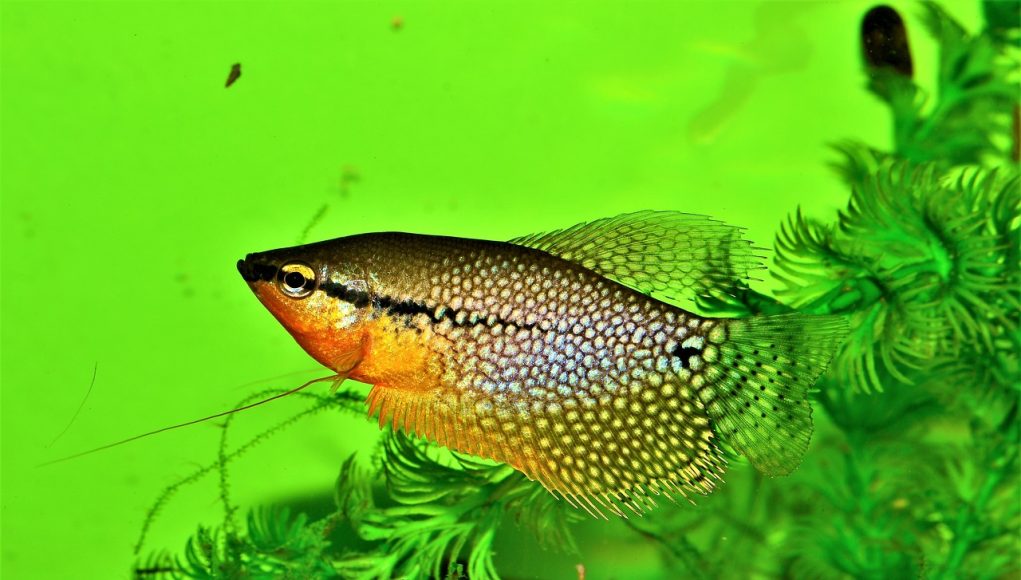
Trichopodus leerii Pearl Gourami
| Qty (Stock) | Size | Sex | Unit price (Tax included) |
|---|---|---|---|
3 en stock | 2 ½" | - | 19$ |
IMPORTANT
Keeping fish in an aquarium requires an ethical and responsible approach that prioritizes animal welfare. Purchasing fish for an aquarium should never be an impulsive decision. It is essential to understand the specific needs of each species, including water quality, aquarium size, behavior, and diet. Only fish with similar water quality requirements should be kept together in the same aquarium.
A Little More Information...
Trichopodus leerii, also called Pearl Gourami, is a popular freshwater gourami valued for its delicate appearance and peaceful behavior. Its silvery body is covered with small pearly spots, contrasting with a dark stripe that runs along the flanks. Native to Southeast Asia, it inhabits warm, quiet and often amber-colored waters in forested wetlands. This very common aquarium species is suitable for peaceful community aquariums when provided with abundant vegetation, gentle water movement and calm tankmates.
General species description
Trichopodus leerii is a peaceful labyrinth fish that is commonly kept as a pair or in a small group in a well-planted aquarium. It spends much of its time in the middle and upper levels, slowly exploring plants and sheltered areas. Like other gouramis, it has a labyrinth organ that allows it to use atmospheric air, so clear access to the surface is essential. Males may become territorial during breeding, although the species is generally gentler than several larger gouramis. It appreciates subdued lighting, floating plants and layouts that provide visual barriers. Stable, clean water and gentle filtration are more suitable than strong circulation.
Geographic origin and habitat
Countries of reference: Thailand, Malaysia, Indonesia and the island of Borneo. Trichopodus leerii inhabits swamps, peatlands, vegetated ditches, backwaters and small forest streams. These environments often contain soft, acidic water stained by tannins released from leaves and decomposing wood. The current is weak, and the surface may be partly covered by floating plants. Dense vegetation along the banks reduces direct sunlight and creates many resting areas. In an aquarium, this setting can be recreated with broad-leaved plants, roots, moderate lighting and gentle filtration.
Precise location and local name
The natural range of Trichopodus leerii includes southern Thailand, the Malay Peninsula, Sumatra and several areas of Borneo. It is associated with lowland wetlands rather than fast-flowing rivers or rocky habitats. In Malaysia and Indonesia, it is commonly called sepat mutiara, a name referring to its pearly pattern. Pearl Gourami remains the most widely used English trade name. Its presence across several Southeast Asian countries explains its familiar status in the aquarium trade, where it is generally available as a captive-bred fish.
Appearance and physical characteristics
Trichopodus leerii has a deep, laterally compressed body covered with numerous pearly white markings that resemble small pearls. A dark longitudinal stripe extends from the mouth to the base of the tail. The male’s throat and chest often become orange-red at maturity, especially during breeding. The pelvic fins are modified into long thread-like feelers used to explore the surroundings. The male’s dorsal fin is longer and more pointed, while the female’s is usually shorter and rounded. Adult size is commonly around 10 to 12 cm, with variation depending on rearing conditions.
General diet
Trichopodus leerii is an omnivore and readily accepts a varied diet. In the wild, it feeds on small invertebrates, aquatic larvae and organisms found near the surface, while also consuming some plant matter. In an aquarium, a base of quality pellets or small flakes can be supplemented with frozen or live foods such as brine shrimp, daphnia and mosquito larvae. Small portions offered once or twice daily are preferable to excessive feeding. Juveniles benefit from fine foods offered frequently. A varied diet helps maintain coloration, growth and overall condition.
Essential data
- Native river name: Kapuas
- Local name used: Sepat mutiara
- Origin of the scientific name: Trichopodus is the genus name; leerii is an honorific specific name.
- Etymology of the full name: Trichopodus comes from the Greek thrix or trichos, hair, and pous or podos, foot, referring to the thread-like pelvic fins; leerii honors the person named Leer.
- Common/vernacular names: Pearl Gourami, Pearl Gourami, sepat mutiara
- Family: Osphronemidae
- Subfamily: Trichogastrinae
- Name pronunciation: trik oh poh dous - lee air eye
- Discovery: Pieter Bleeker, 1852
- Maximum adult size: About 12 cm
- Water temperature and pH: 24 to 30 °C; pH 5.0 to 7.5
- Appearance of the watercourse and surrounding vegetation: Quiet, often amber-colored water bordered by plants, roots and dense vegetation.
- Typical tankmates: Rasboras, small peaceful tetras, calm loaches, corydoras, adult shrimp and Trigonostigma heteromorpha
- Temperament and behavior: Peaceful, shy and generally sociable; the male becomes territorial around the bubble nest.
- Water depth: Mainly in shallow water, often from 0.3 to 1.5 m.
- Sexual dimorphism: The male has a longer, pointed dorsal fin, reddish coloration on the throat and a generally slimmer profile; the female is rounder and paler.
- Bottom structure and flow: Muddy or sandy bottom, often covered with leaves and plant debris; weak current.
In your aquarium
Success with Trichopodus leerii depends on a mature, peaceful and well-planted aquarium. Provide floating plants, open access to the surface and gentle water movement. Soft to slightly acidic, stable and well-maintained water supports good coloration and natural behavior. Avoid boisterous tankmates or fin-nipping species, especially while the male is building a bubble nest. A varied diet, regular water changes and visual shelters will help this gourami remain calm and healthy.
{779}