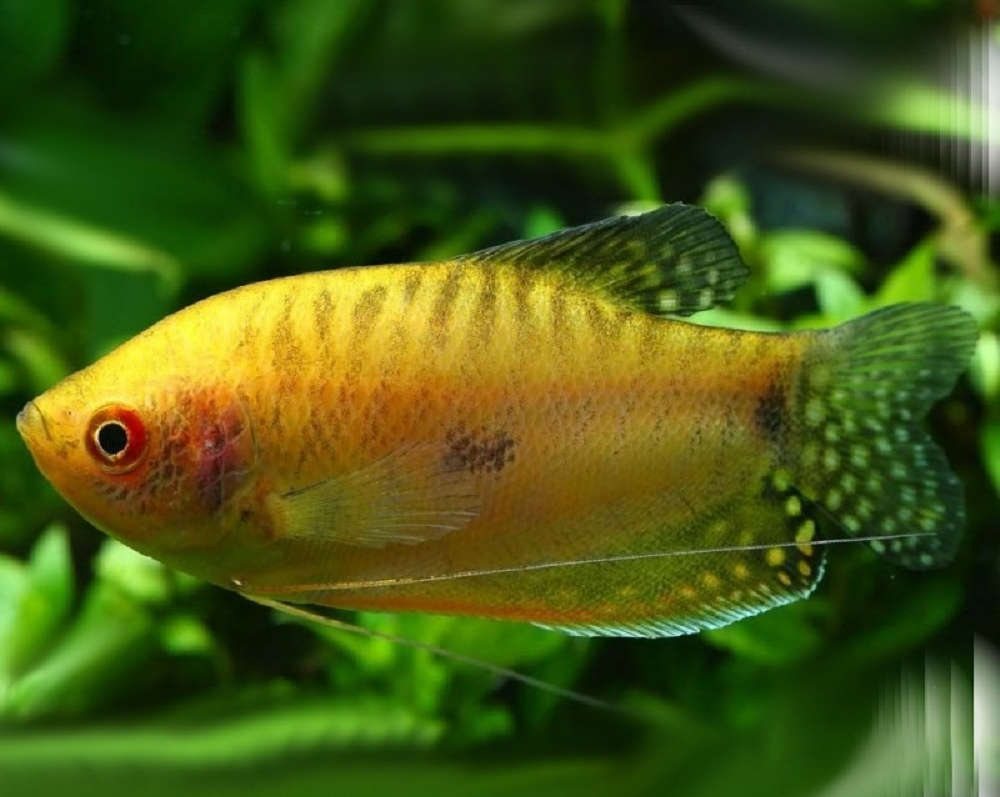
Trichopodus trichopterus var. Golden Gourami
New
| Qty (Stock) | Size | Sex | Unit price (Tax included) |
|---|---|---|---|
| 3" | - | 14$ |
IMPORTANT
Keeping fish in an aquarium requires an ethical and responsible approach that prioritizes animal welfare. Purchasing fish for an aquarium should never be an impulsive decision. It is essential to understand the specific needs of each species, including water quality, aquarium size, behavior, and diet. Only fish with similar water quality requirements should be kept together in the same aquarium.
A Little More Information...
The Trichopodus trichopterus var. is an ornamental variety of the three-spot gourami, selected for its golden-yellow coloration and peaceful appearance. Like other members of its species, it has a labyrinth organ that allows it to use atmospheric air at the surface. This feature explains its preference for warm, calm, heavily planted water. Commonly available in the aquarium trade, this form is generally considered fairly common. It suits a spacious community aquarium, provided that overly active or aggressive tank mates are avoided and that shaded areas, along with easy access to the surface, are provided.
General species description
Trichopodus trichopterus var. belongs to a widespread Southeast Asian species popular in aquariums. It is a hardy labyrinth fish able to obtain part of its oxygen directly from the air through its suprabranchial organ. The golden variety is not a separate species: it is a selectively bred form of Trichopodus trichopterus, produced through captive lines. Its behavior is usually peaceful, although males may defend a territory, especially during spawning. The species primarily inhabits slow-moving, vegetation-filled environments. In an aquarium, it benefits from stable conditions, moderate lighting and gentle circulation. Individuals usually swim through the middle and upper levels, regularly visiting the surface to breathe. Its commercial availability is high without being exceptional.
Geographical origin and habitat
Native to Southeast Asia, Trichopodus trichopterus var. is associated with areas including Thailand, Cambodia, Laos, Vietnam, Malaysia and Indonesia. In the wild, the species occurs in backwaters, marshes, rice fields, ditches and floodplains connected with the Mekong and Chao Phraya basins. These waters are often warm, shallow and slow-moving, with variable visibility. The bottom may consist of mud, silt or fine sand, sometimes covered with plant debris. Emergent and submerged vegetation is abundant, providing shelter and resting areas. In an aquarium, this setting can be recreated with dense plants, roots, floating vegetation and an open surface for air breathing.
Precise location and local name
The natural range covers broad lowland areas of Southeast Asia rather than one isolated site. Populations are associated with the Mekong and Chao Phraya systems, as well as several rivers and still-water habitats of the Malay Peninsula and Indonesian archipelago. In Thailand, the species is commonly called pla salit. In the Malay and Indonesian regions, the name sepat rawa is used for gouramis in this group. In the aquarium trade, the golden form is mainly sold as Golden Gourami. These commercial names refer to a color variety, not to a distinct geographical population.
Appearance and physical characteristics
The body of Trichopodus trichopterus var. is laterally compressed, fairly deep and covered with small scales. The golden variety has a yellow to yellow-orange base color, sometimes with brownish tones along the back and fins. In the wild form, two dark spots are typically visible on the side; they may be reduced or less contrasting in golden strains. The pelvic fins are transformed into long tactile filaments, a characteristic gourami feature. The dorsal and anal fins extend toward the rear, while the caudal fin is rounded to slightly truncated. Adult males generally develop a longer, more pointed dorsal fin. The reported maximum aquarium size is about 15 cm, although many specimens remain smaller depending on diet and available space.
General diet
Trichopodus trichopterus var. is omnivorous and benefits from a varied diet. It readily accepts quality flakes and pellets, but its diet should also include frozen or live foods such as brine shrimp, mosquito larvae and daphnia. It may consume small prey, microorganisms and some plant matter in its natural habitat. To maintain condition and coloration, offer small portions once or twice daily and remove uneaten food. Young fish benefit from more frequent meals. An overly rich or monotonous diet can encourage obesity and fading. A balanced diet containing animal proteins and plant ingredients supports growth and vitality without unnecessarily polluting the water.
Essential data
- Native river name: Mekong and Chao Phraya basins
- Local name used: Pla salit; sepat rawa
- Origin of the scientific name: Name assigned when the species was formally described
- Full-name etymology: Trichopodus means “hairy-footed,” referring to the filamentous pelvic fins; trichopterus means “hairy-finned”
- Common/vernacular names: Golden Gourami; golden three-spot gourami
- Family: Osphronemidae
- Subfamily: Luciocephalinae
- Name pronunciation: trik oh POH dus - trik OP ter us
- Discovery: Peter Simon Pallas, 1770
- Maximum adult size: About 15 cm
- Water temperature and pH: 24 to 28 °C; pH 6.0 to 8.0
- Watercourse appearance and surrounding vegetation: Warm, slow, shallow water bordered by floating, emergent and submerged plants
- Typical tank mates: Trigonostigma heteromorpha, Pangio semicincta, Crossocheilus oblongus, Puntius titteya
- Temperament and behavior: Generally peaceful; males may be territorial and quarrelsome while spawning
- Water depth: Shallow to moderate, mainly in floodplains and stagnant waters
- Sexual dimorphism: Dorsal fin generally longer and more pointed in males; females are rounder
- Bottom structure and flow: Mud, silt, fine sand and plant debris; very low flow
In your aquarium
To succeed with Trichopodus trichopterus var., provide a covered, planted aquarium with a calm, accessible surface. Keep the temperature stable, avoid strong currents and leave open spaces between plant groups. Gentle filtration, regular water changes and a varied diet support good longevity. Males may become territorial, so visual barriers and shelters help reduce tension. Choose peaceful tank mates of comparable size. With these precautions, this golden gourami remains a hardy, attractive fish suitable for many community aquariums.
{779,602,541,932}