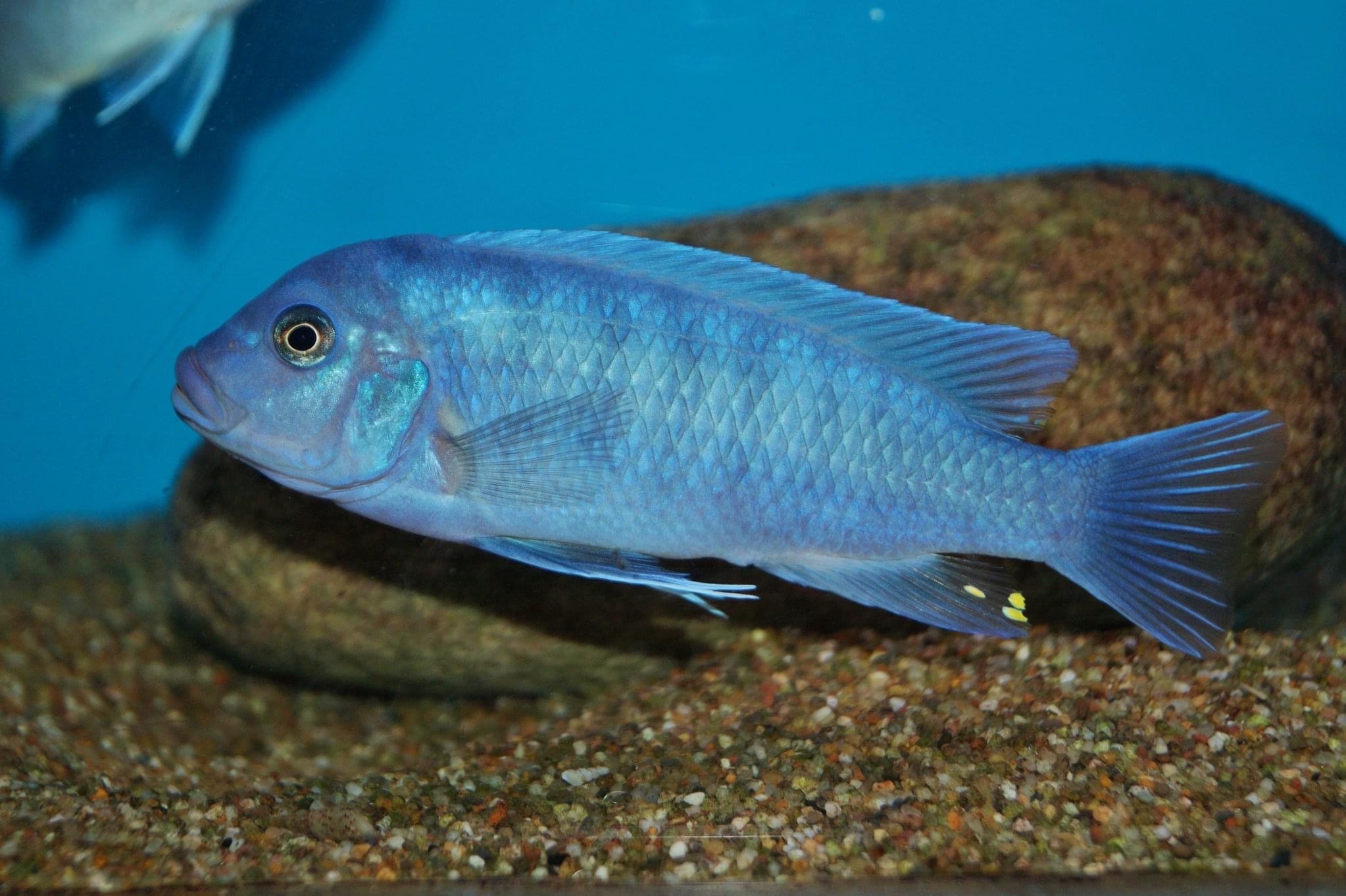
Maylandia callainos Cobalt Zebra
| Qty (Stock) | Size | Sex | Unit price (Tax included) |
|---|---|---|---|
| Currently Out of Stock! Contact us for more information | |||
IMPORTANT
Keeping fish in an aquarium requires an ethical and responsible approach that prioritizes animal welfare. Purchasing fish for an aquarium should never be an impulsive decision. It is essential to understand the specific needs of each species, including water quality, aquarium size, behavior, and diet. Only fish with similar water quality requirements should be kept together in the same aquarium.
A Little More Information...
The Cobalt Zebra, sold under the scientific name Maylandia callainos, is a small African mbuna cichlid from Lake Malawi. Its cobalt-blue coloration, sometimes marked by darker vertical bars, quickly attracts attention in an African aquarium. Like many rocky-shore inhabitants of the lake, it remains active, territorial, and fascinating to watch as it establishes its own area. Its availability in the hobby is moderate: it is less ubiquitous than some mbuna species, but remains accessible to aquarists who can provide an appropriate rock layout and stable alkaline water.
General species description
Maylandia callainos is an African cichlid belonging to the mbuna group, a collection of fishes associated with the rocky shores of Lake Malawi. Its fairly stocky body and specialized mouth allow it to search for food on stones. In the aquarium, it is constantly active, exploring surfaces, crevices, and shelters within the rockwork. The male usually defends a breeding territory, while females and subordinate individuals need refuges to reduce social pressure. This species is best kept in a dedicated mbuna aquarium with carefully planned stocking. Territorial behavior becomes stronger when space is limited or when the layout provides too few visual barriers. Good water movement, efficient filtration, and hard water support its long-term maintenance.
Geographic origin and biotope
Maylandia callainos is endemic to Lake Malawi in East Africa, particularly around the Nkhata Bay area. Country of reference: Malawi. It inhabits rocky shores and littoral rubble zones where stones create cracks, overhangs, and numerous small territories. The biotope is generally bright, clear, alkaline, and mineral-rich. Aquatic vegetation is often limited over rocky substrates; however, algae and microorganisms growing on the stones are important food resources. For an aquarium setup, a stable rockscape should therefore be prioritized over a densely planted arrangement. Water movement should remain strong enough to maintain oxygenation and cleanliness without creating a current that prevents the fish from feeding or holding position in preferred areas.
Precise location and local name
The form known as the Cobalt Zebra is associated with the rocky shores of Nkhata Bay on the western side of Lake Malawi. In the aquarium trade, locality names are often used to distinguish populations and color forms. The term mbuna, originating from a local language of the Malawi region, generally refers to rock-dwelling cichlids; it is not the specific local name of this species. Geographic populations should not be mixed carelessly, especially in breeding projects, because mbunas may hybridize in captivity. To preserve an identifiable strain, fish from the same locality should be maintained together and crosses with blue zebra fish of uncertain origin should be avoided.
Appearance and physical characteristics
Maylandia callainos has a laterally compressed body, a sturdy head, and fins suited to movement among rocks. Its most distinctive feature is its cobalt-blue coloration, which may vary in intensity according to sex, mood, social rank, and lighting conditions. Dark vertical bars may be visible, especially in certain males or geographic populations. The dorsal and anal fins may show blue highlights and egg-shaped markings that act as reproductive signals. Females and juveniles are often less strikingly colored than adult males. Although its final size is modest, its body mass and territorial behavior still require a spacious, well-structured aquarium with plenty of hiding places.
General diet
In nature, Maylandia callainos mainly grazes on periphyton covering the rocks, including algae, small organisms, and organic matter associated with this growth. In captivity, its diet should therefore be primarily plant-based. Flakes or pellets formulated for mbunas and containing spirulina or other vegetable ingredients can form the dietary foundation. Small portions of additional vegetable foods may be offered. Meals should remain moderate and regular to avoid digestive stress and unnecessary water pollution. Diets that are excessively rich in animal protein should be avoided because they do not match its feeding profile and may contribute to digestive problems in mbunas. Consistent feeding is more important than offering large quantities.
Essential data
- River of origin: None; species native to Lake Malawi
- Local name used: Mbuna, a general term for rocky cichlids from Lake Malawi
- Origin of the scientific name: Maylandia is a generic name honoring Mayland; callainos refers to the blue color
- Full-name etymology: Maylandia: honorific genus name; callainos: Greek for blue or blue-green
- Common/vernacular names: Cobalt Zebra, Cobalt Blue Zebra
- Family: Cichlidae
- Subfamily: Pseudocrenilabrinae
- Name pronunciation: may LAN dee ah call EYE noss
- Discovery: Jay R. Stauffer Jr. and Katrin Hert, 1992
- Maximum adult size: About 10 cm
- Water temperature and pH: 24 to 28 °C; pH 7.8 to 8.6
- Watercourse appearance and surrounding vegetation: Rocky lake shores, clear water, limited aquatic vegetation
- Typical tankmates: Labidochromis caeruleus, Melanochromis auratus, Pseudotropheus socolofi, Iodotropheus sprengerae, Cynotilapia afra
- Temperament and behavior: Active, territorial, and hierarchical; best maintained in a carefully structured group
- Water depth: Shallow to moderately deep rocky littoral zone
- Sexual dimorphism: Males are generally more colorful; females and juveniles are often duller
- Bottom structure and flow: Rubble and rocks with cracks and overhangs; moderate to strong circulation
In your aquarium
To succeed with Maylandia callainos, set up a spacious aquarium with many stable rocks, broken sight lines, and several shelters. Maintain hard, alkaline, very clean water and feed it mainly a vegetable-based diet. Stocking management is essential: thoughtful population planning can distribute aggression, while a bare layout or poorly composed group can intensify chasing. Avoid peaceful or delicate tankmates that cannot handle competition. Regular water changes, properly sized filtration, and close observation of subordinate individuals are the keys to success with this colorful mbuna.