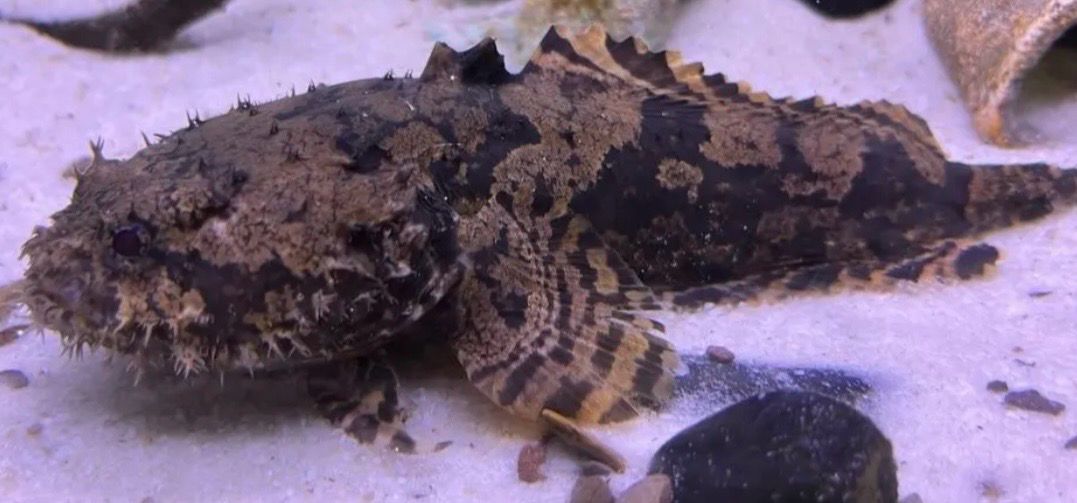
Batrachomoeus trispinosus Freshwater Lionfish
Origine sauvage Exclusivité
| Qté (Stock) | Taille | Sexe | Prix unitaire (Taxes incluses) |
|---|---|---|---|
| Aucun en stock en ce moment! Communiquez avec nous | |||
IMPORTANT
La possession de poissons en aquarium requiert une approche éthique et responsable pour respecter les animaux. L'acquisition de poissons pour maintenance en aquarium ne doit pas se faire sur un coup de tête (achat impulsif). Il est essentiel de s'informer sur les besoins spécifiques des espèces (qualité eau, dimensions aquarium, comportement, alimentat). Seuls les poissons ayant des exigences similaires en matière de qualité d'eau devraient être maintenus ensemble dans un même aquarium.
Un peu plus d'informations...
The Freshwater Lionfish, or Batrachomoeus trispinosus, is a spectacular-looking Australian bottom-dweller with a discreet lifestyle. Despite its common name, it is not a marine lionfish, but a member of the Batrachomoeidae family adapted to freshwater, brackish and coastal habitats. Its stocky body, broad head and dorsal fins armed with spiny rays give it a distinctive appearance. This rare aquarium fish, often sourced from wild collection, is best suited to experienced aquarists who can provide a large aquarium, a meat-based diet and careful handling.
General species description
Batrachomoeus trispinosus is a robust bottom-dwelling predator related to toadfishes. It usually rests on the substrate, blending into roots, leaves and debris before rapidly seizing prey that comes within range. Activity often increases at dusk and during the night. It can live in freshwater but also tolerates slightly brackish conditions, explaining its presence in habitats connected to estuaries. The dorsal spines may be venomous and require careful handling with a container rather than a conventional net. Its commercial rarity, classified here as very rare, makes it a fish for a specialized aquarium.
Geographical origin and habitat
Reference countries: Australia and Papua New Guinea. The species occurs in northern Australian coastal areas, especially in quiet waters influenced by tides. Its habitat includes streams, backwaters, lagoons and sheltered estuarine sections where water conditions may range from fresh to slightly brackish. The bottom is generally made of mud, sand or fine gravel, with considerable plant debris. Riparian vegetation provides shade and adds cover to the substrate. Fish offered in the aquarium trade are often wild-collected, making quarantine and careful acclimation particularly important.
Precise location and local name
Batrachomoeus trispinosus is associated with tropical and subtropical regions of northern Australia and New Guinea. Available records mainly connect it with freshwater and brackish habitats near the coast, rather than with one famous river. The most widely used common name is Freshwater Lionfish. It may also be described as a freshwater toadfish or freshwater lionfish, although these names can cause confusion with marine lionfish of the genus Pterois. In an aquarium setting, the scientific name should therefore be used to avoid an incorrect identification.
Appearance and physical characteristics
The body of Batrachomoeus trispinosus is short, thick and slightly compressed, with a very broad head and a mouth suited to its predatory lifestyle. Its coloration is generally brown, greyish or yellowish, with irregular markings that provide camouflage over a dark substrate. The broad pectoral fins help it brace itself on the bottom. The dorsal fin bears several spiny rays, an important feature to consider during aquarium maintenance. The eyes and broad head reinforce its toadfish-like appearance. Its compact shape, motionless posture and **defensive dorsal spines** are among its most recognizable traits.
General diet
Batrachomoeus trispinosus is an opportunistic carnivore that feeds on small fish, crustaceans and other aquatic animals small enough to swallow whole. In aquaria, it generally accepts appropriately sized meaty foods such as shrimp, fish pieces and aquatic invertebrates. Food should be varied and of good quality, while feeder goldfish should not be used as a regular diet. It hunts mainly by ambush and may remain motionless for long periods before striking quickly. Adults should be fed in moderation while their body condition is monitored. A **varied meaty diet** and the use of long feeding tongs improve both safety and conditioning.
Essential data
- Name of original river: Coastal waterways of northern Australia and New Guinea
- Local name used: Freshwater Lionfish
- Origin of the scientific name: The genus suggests a toadfish-like appearance; the species epithet refers to three spines
- Full-name etymology: Batrachomoeus approximately means “frog-like”; trispinosus means “three-spined”
- Common/vernacular names: Freshwater Lionfish; freshwater toadfish
- Family: Batrachomoeidae
- Subfamily: No commonly recognized subfamily
- Name pronunciation: ba-trak-oh-MEE-us tris-pin-OH-sus
- Discovery: Albert Karl Ludwig Gotthilf Günther, 1861
- Maximum adult size: Approximately 30 cm
- Water temperature and pH: 22 to 28 °C; approximately pH 6.5 to 8.0
- Appearance of the watercourse and surrounding vegetation: Quiet water, muddy or sandy bottoms, plant debris, roots and shaded banks
- Typical tankmates: Australian gobies, sturdy small bottom fish, tropical perch, lagoon fish and other similarly sized estuarine species
- Temperament and behaviour: Ambush predator, usually calm but able to swallow small tankmates; more active at night
- Water depth: Shallow to moderately deep sections of streams and estuaries
- Sexual dimorphism: Little externally visible difference
- Bottom structure and flow: Mud, sand, fine gravel and debris; slow to moderate flow
In your aquarium
Keeping Batrachomoeus trispinosus requires a large, well-filtered aquarium furnished with stable hiding places. A secure lid is recommended, as is slow acclimation for wild specimens. Avoid tankmates small enough to be swallowed and always handle this fish carefully because of its dorsal spines. Clean water, moderate flow and varied meaty meals are essential. Because this is a very rare species that is often wild-collected, every purchase should be carefully considered and supported by a long-term commitment. Stable conditions are more important than pursuing perfectly rigid parameters.
{}