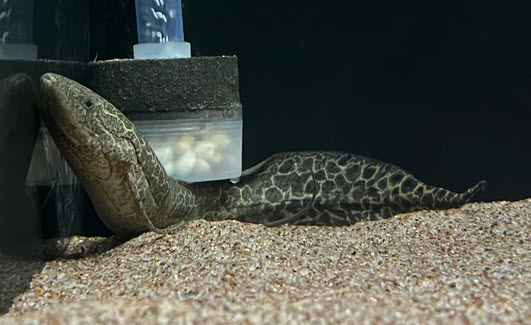
Protopterus aethiopicus Marbled Lungfish
Nouveau Origine sauvage
| Qté (Stock) | Taille | Sexe | Prix unitaire (Taxes incluses) |
|---|---|---|---|
| 12" | - | 229$ |
IMPORTANT
La possession de poissons en aquarium requiert une approche éthique et responsable pour respecter les animaux. L'acquisition de poissons pour maintenance en aquarium ne doit pas se faire sur un coup de tête (achat impulsif). Il est essentiel de s'informer sur les besoins spécifiques des espèces (qualité eau, dimensions aquarium, comportement, alimentat). Seuls les poissons ayant des exigences similaires en matière de qualité d'eau devraient être maintenus ensemble dans un même aquarium.
Un peu plus d'informations...
The Marbled Lungfish, also called the marbled lungfish, is an ancient African freshwater fish equipped with functional lungs in addition to its gills. Protopterus aethiopicus lives in the waters of East Africa, especially around large lakes and waterways connected to the Nile basin. Its elongated body, thread-like fins and air-breathing ability give it a unique appearance in aquariums. It is nevertheless a very large, predatory and demanding animal, suited only to exceptionally spacious systems and experienced fishkeepers. The specimens offered are wild collected, and this species remains moderately uncommon in the specialized aquarium trade.
General description of the species
Protopterus aethiopicus is a freshwater lungfish belonging to an ancient lineage of fishes able to breathe atmospheric air. It regularly rises to the surface to fill its lungs, allowing it to survive in warm, stagnant or oxygen-poor water. Activity is often stronger at dusk and during the night. Despite its slow appearance, it is an opportunistic predator capable of swallowing relatively large prey. Its care requires an exceptionally large aquarium, a tightly secured cover and strong filtration. Its commercial rarity is intermediate, but its adult size greatly limits its availability to ordinary aquarists.
Geographical origin and habitat
Countries of reference: Uganda, Kenya, Tanzania, South Sudan and neighbouring regions of the Nile basin. The species is associated with major East African lakes, including Lake Victoria, Lake Kyoga and Lake Albert, as well as waters connected to the White Nile. It inhabits quiet bays, swamps, floodplains and vegetated shorelines. The water may be clear or rich in suspended material, with mud, silt or sand on the bottom. Floating plants and emergent stems provide shelter and further reduce water movement.
Precise locality and local name
Populations are associated with the Nile basin, particularly the lake systems of Uganda and northern Tanzania. The local name kamongo is used in Uganda for lungfish, although names can vary between communities and regional languages. In shoreline areas, Protopterus aethiopicus is mainly linked to quiet lake margins, swamps and seasonal channels rather than strongly flowing sections. This distribution helps explain its tolerance of oxygen-poor conditions and its frequent trips to the surface.
Appearance and physical characteristics
The body of Protopterus aethiopicus is very long and cylindrical, with a flattened head, small deeply embedded scales and pectoral and pelvic fins transformed into flexible filaments. Its colour ranges from greyish brown to olive brown, with a network of darker spots and markings that gives rise to the name Marbled Lungfish. The dorsal, caudal and anal fins form one long continuous margin around the rear of the body. Young fish may show stronger contrasts. Its most important feature is the presence of functional lungs, which are essential when dissolved oxygen levels fall.
General diet
Protopterus aethiopicus is a generalist carnivore that searches for prey near the bottom and among vegetation. It consumes fish, crustaceans, molluscs, worms, aquatic insects and other small animals, while also taking dead prey when available. Its powerful mouth allows it to seize and crush substantial food items. In aquariums, it generally accepts pieces of fish, shrimp, mussels and good-quality meaty preparations. A varied diet should be offered and excess feeding avoided, since this voracious predator can quickly pollute the water. Smaller individuals consume more invertebrate prey.
Essential data
- River of origin: White Nile, within the Nile basin
- Local name used: Kamongo
- Origin of the scientific name: Name assigned by Johann Jakob Heckel when the species was described
- Etymology of the full name: Protopterus roughly means “first fin”; aethiopicus means “of Ethiopia” or “African”
- Common/vernacular names: Marbled Lungfish, African lungfish, dipneuste marbré
- Family: Protopteridae
- Subfamily: Protopterinae
- Name pronunciation: proh-TOP-teh-russ - ee-thee-OH-pih-kuss
- Discovery: Johann Jakob Heckel, 1851
- Maximum adult size: About 200 cm
- Water temperature and pH: About 24 to 30 °C; pH 6.5 to 8.5
- Watercourse appearance and surrounding vegetation: Quiet bays, swamps, often turbid water, muddy or sandy bottoms, floating plants and shoreline vegetation
- Typical tankmates: Oreochromis niloticus, Bagrus docmak, Clarias gariepinus, Lates niloticus, Mormyrus kannume, Hydrocynus forskahlii
- Temperament and behaviour: Predatory, usually solitary, shelter-oriented and most active during evening or at night
- Water depth: Shallow shoreline areas down to several metres
- Sexual dimorphism: No reliable and consistent external feature for sexing live specimens
- Bottom structure and flow: Mud, silt or sand, with low to very low current
In your aquarium
Success with Protopterus aethiopicus begins with a tank that is genuinely suitable for its adult size, rather than a setup appropriate for a juvenile. Provide a heavy, secure cover, oversized filtration, warm water and a large footprint. Avoid small fish, which will be treated as prey. A varied meaty diet, regular water changes and sturdy hiding places help reduce stress. Because the available specimens are wild collected, slow acclimation is important. This species should be kept only by aquarists able to accommodate a fish reaching two metres and its potentially long lifespan.
{}