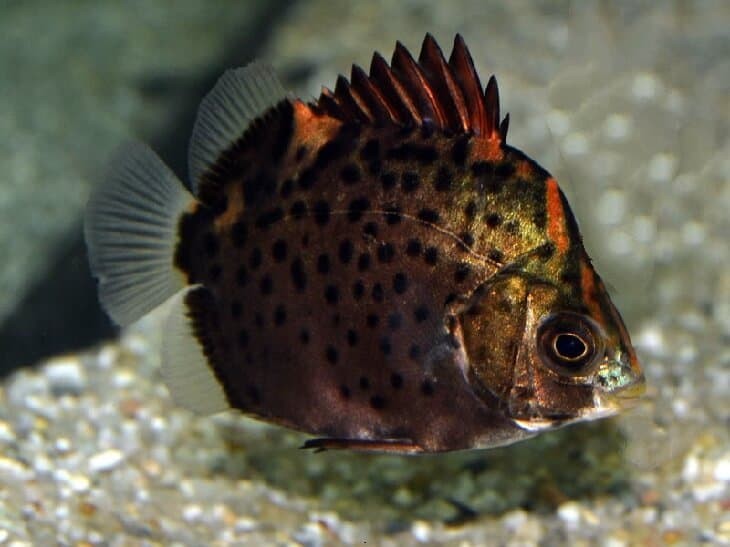
Scatophagus rubifrons Red Scat
Exclusivité
| Qté (Stock) | Taille | Sexe | Prix unitaire (Taxes incluses) |
|---|---|---|---|
| Aucun en stock en ce moment! Communiquez avec nous | |||
IMPORTANT
La possession de poissons en aquarium requiert une approche éthique et responsable pour respecter les animaux. L'acquisition de poissons pour maintenance en aquarium ne doit pas se faire sur un coup de tête (achat impulsif). Il est essentiel de s'informer sur les besoins spécifiques des espèces (qualité eau, dimensions aquarium, comportement, alimentat). Seuls les poissons ayant des exigences similaires en matière de qualité d'eau devraient être maintenus ensemble dans un même aquarium.
Un peu plus d'informations...
Scatophagus rubifrons, also called Red Scat, is an estuarine fish recognized for its deep body and reddish coloration. This member of the Scatophagidae family inhabits areas where fresh water meets seawater, especially mangrove edges and coastal channels. It can adapt to different levels of salinity, but successful care requires stable water and gradual acclimation. With its generally peaceful behavior, substantial adult size and omnivorous diet with a strong plant component, it is best suited to a spacious brackish aquarium. The Red Scat remains uncommon in the aquarium trade.
General species description
Scatophagus rubifrons is a coastal and estuarine fish belonging to the scat group, known for tolerating changes in salinity. It usually inhabits calm to moderately moving water in lagoons, estuaries and mangrove margins. Young fish may show stronger markings and can use less saline areas than adults. In an aquarium, it is active during the day and generally benefits from the presence of others of its kind, without being strongly territorial. Successful care requires a large aquarium, efficient filtration and salinity appropriate to the fish’s life stage. Long acclimation is also important whenever mineral content or salinity changes significantly.
Geographical origin and biotope
Red Scat is associated with the tropical Indo-West Pacific, where it inhabits coastal environments such as estuaries, lagoons and mangroves. It occurs in areas influenced by tides, where salinity may vary throughout the day or across seasons. The habitat often contains slightly turbid, organic-rich water, submerged roots and shallow muddy zones. Surrounding vegetation is dominated by mangroves, while seagrasses and algae may provide an important part of its food supply. In captivity, alkaline, mineral-rich water is generally more suitable than soft, acidic water.
Precise location and local name
Scatophagus rubifrons is mainly associated with tropical coastal and estuarine environments in the Indo-Pacific. It is not tied to a single freshwater river because its typical habitat consists of transition zones between marine and continental waters. The most commonly used trade name is Red Scat. In French aquarium usage, scat rouge and poisson scat rouge may also be encountered, but Red Scat remains the most practical name for identification in stores. Its availability is relatively limited compared with Scatophagus argus.
Appearance and physical characteristics
Scatophagus rubifrons has a deep, laterally compressed body covered with small scales. Its dorsal fin contains sharp spines that can cause a painful injury during handling; using a suitable net and protective gloves is therefore advisable. General coloration ranges from silvery gray to yellowish brown, with darker markings and reddish-orange tones that are especially visible on the head and fins. The reddish forehead explains the specific epithet. Adults may reach about 30 cm in total length, ruling out small aquariums. Color may fade when the fish is stressed or kept in unsuitable water.
General diet
Scatophagus rubifrons is omnivorous, but its diet has a strong plant component. In nature, it grazes on algae and consumes plant debris while also taking small invertebrates and other food found in mud or on submerged roots. In aquariums, offer quality pellets for herbivorous or omnivorous fish, supplemented with algae-based foods, spirulina and blanched vegetables such as zucchini or spinach. Small portions of frozen foods can add variety without becoming the main part of the diet. A vegetable-rich diet supports good body condition and helps reduce nutritional deficiencies.
Essential data
- Native river name: Estuarine and coastal habitat rather than one specific river.
- Local name used: Red Scat.
- Origin of the scientific name: The genus Scatophagus is associated with scats; the epithet rubifrons refers to the red forehead.
- Full-name etymology: Scatophagus means eater of refuse or excrement; rubifrons means red forehead.
- Common/vernacular names: Red Scat, red scatfish.
- Family: Scatophagidae.
- Subfamily: No commonly recognized subfamily.
- Name pronunciation: ska-TOF-uh-gus roo-bi-FRONZ.
- Discovery: Jordan and Seale, 1906.
- Maximum adult size: About 30 cm.
- Water temperature and pH: 24 to 28 °C; approximately pH 7.5 to 8.5.
- Waterway appearance and surrounding vegetation: Lagoons, estuaries and mangroves; submerged roots, algae and salt-tolerant vegetation.
- Typical tankmates: Scats of similar size, peaceful mangrove fish, estuarine gobies and other brackish-water-tolerant fish.
- Temperament and behavior: Generally peaceful, active and social; it may become nervous when kept alone or in an overly confined space.
- Water depth: Shallow to intermediate coastal areas.
- Sexual dimorphism: Not obvious in most juveniles and trade-sized adults.
- Bottom structure and current: Mud, sand or fine gravel; low to moderate flow with good oxygenation.
For greater success
To keep Scatophagus rubifrons successfully, provide a spacious, well-filtered aquarium with roots, algae-growing surfaces and open swimming areas. Salinity should be selected according to the fish’s age and previous conditions, then changed gradually. Stable water, regular plant-based feeding and patient acclimation are the main priorities. Avoid aggressive or very small tankmates, and handle the fish carefully because of its dorsal spines. With these precautions, this mangrove fish can become a hardy and interesting long-term resident, although its adult size requires a serious commitment from the aquarist.