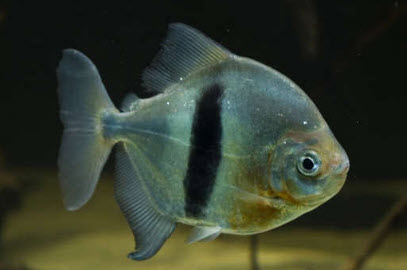
Myleus schomburgkii Black-Barred Myleus
Wild caught origin Exclusive
| Qty (Stock) | Size | Sex | Unit price (Tax included) |
|---|---|---|---|
| 4 ½" | - | 49$ |
IMPORTANT
Keeping fish in an aquarium requires an ethical and responsible approach that prioritizes animal welfare. Purchasing fish for an aquarium should never be an impulsive decision. It is essential to understand the specific needs of each species, including water quality, aquarium size, behavior, and diet. Only fish with similar water quality requirements should be kept together in the same aquarium.
A Little More Information...
The Myleus schomburgkii, also known as Black-Barred Myleus, is a large South American characid valued for its tall body, silvery reflections and strongly contrasting dark bar. Despite its resemblance to some piranhas, it is mainly herbivorous and generally peaceful with tankmates of comparable size. This species nevertheless requires a spacious aquarium, efficient filtration and warm, soft to slightly acidic water. Available specimens may be collected from the wild; its availability is intermediate, making it less common than several other silver dollars in the aquarium trade.
General species description
Myleus schomburgkii belongs to the Serrasalmidae family, a group that includes silver dollars and piranhas. Its laterally compressed, very deep body gives it an impressive presence, while its behavior is generally gregarious and active. It should be kept in a group in a long aquarium with generous swimming space. Adults become large and are not suitable for small community tanks. Hardy plants, roots and open swimming areas help reproduce part of its natural environment. Despite its relationship to piranhas, its diet is mostly plant-based and its temperament is considerably calmer.
Geographic origin and biotope
Reference countries: Guyana, Brazil and Venezuela. The species is associated with Amazonian and Guianan drainage systems, particularly the Essequibo basin. It occurs in tropical waterways, side channels and areas influenced by flooded forests. Water may be stained by tannins released from leaves and wood, although some habitats are clearer and have dense bankside vegetation. The natural setting includes submerged roots, branches, leaf litter and aquatic or marginal plants. Flow varies seasonally, with quieter areas along the banks and in sheltered sections.
Precise location and local name
The geographic reference most closely associated with the species is the Essequibo network in Guyana, along with areas of northern South America. In the aquarium trade, the English name Black-Barred Myleus is widely used because of the vertical black bar across the flank. The name Black-Barred Silver Dollar is also used by aquarists. Like several large silver dollars, Myleus schomburgkii may be sold under varying trade names; identification should therefore focus on body shape, coloration and the characteristic lateral bar.
Appearance and physical characteristics
The body is strongly compressed, very deep and covered with silvery scales that may show greenish or bluish reflections. A wide vertical black bar marks the flank, usually across the middle portion of the body. The fins may display reddish or orange shades, especially in mature fish kept in good condition. The mouth is adapted for grazing on plant material. Adult size is substantial, and the body becomes more robust with age. Wild fish may show subdued coloration when resting, then intensify their contrasts when stimulated or kept against a dark background.
General diet
Myleus schomburgkii is mainly herbivorous, with a natural diet consisting of plants, tender leaves, fallen fruit and other plant material available in flooded forests. In aquariums, regularly provide spirulina-based foods, vegetable wafers, blanched vegetables and edible leaves. Zucchini, spinach, shelled peas and green beans can add variety. A small amount of meaty food may be accepted, but it should not dominate the diet. A consistently plant-based menu supports growth, coloration and overall condition in adult fish.
Essential data
- River of origin: Essequibo
- Local name used: Black-Barred Myleus; Black-Barred Silver Dollar
- Origin of the scientific name: Myleus is the genus name; schomburgkii honors Robert Hermann Schomburgk.
- Etymology of the full name: Myleus comes from a Greek term associated with a rounded or robust form; schomburgkii is a Latinized surname honoring Schomburgk.
- Common/vernacular names: Black-Barred Myleus, Black-Barred Silver Dollar
- Family: Serrasalmidae
- Name pronunciation: MIE-lee-us shom-BURG-kee-eye
- Discovery: Achille Valenciennes, 1850
- Maximum adult size: About 40 cm
- Water temperature and pH: 24 to 28 °C; pH 5.5 to 7.5
- Waterway appearance and surrounding vegetation: Tropical waterways, side channels and flooded-forest areas with roots, branches, leaves and dense bankside vegetation.
- Typical tankmates: Metynnis hypsauchen, Myleus setiger, Geophagus altifrons, Astronotus ocellatus
- Temperament and behavior: Peaceful, active and gregarious; it may become nervous when kept alone or in an undersized aquarium.
- Sexual dimorphism: External differences are subtle; fin shape and body profile may vary in adults but are not always reliable criteria.
- Bottom structure and flow: Sandy or muddy bottom with leaf litter and plant debris; variable flow, often quieter near banks and sheltered areas.
In your aquarium
To keep Myleus schomburgkii successfully, provide a large, well-filtered aquarium, stable water conditions and a group large enough to reduce stress. Leave a long open swimming area while adding roots and durable plants. Pay close attention to organic waste, since adults produce a significant bioload. A regular plant-based diet, stable temperature and tankmates of comparable size are the foundations of long-term care. Wild-collected specimens require careful acclimation and consistently high water quality.
{788,854,636,411}