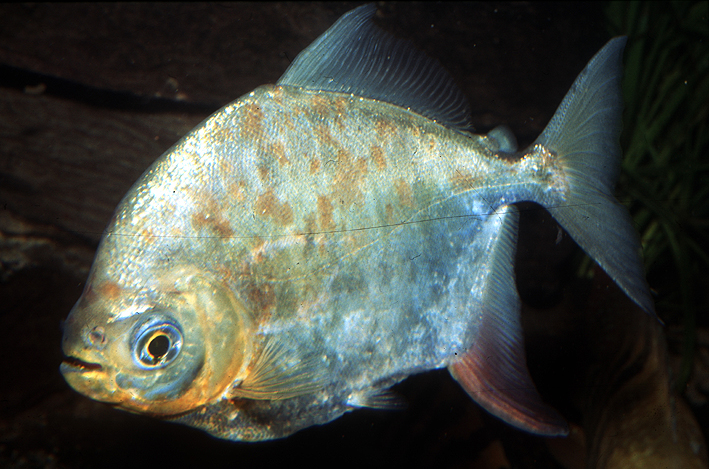
Myloplus asterias
| Qté (Stock) | Taille | Sexe | Prix unitaire (Taxes incluses) |
|---|---|---|---|
| Aucun en stock en ce moment! Communiquez avec nous | |||
IMPORTANT
La possession de poissons en aquarium requiert une approche éthique et responsable pour respecter les animaux. L'acquisition de poissons pour maintenance en aquarium ne doit pas se faire sur un coup de tête (achat impulsif). Il est essentiel de s'informer sur les besoins spécifiques des espèces (qualité eau, dimensions aquarium, comportement, alimentat). Seuls les poissons ayant des exigences similaires en matière de qualité d'eau devraient être maintenus ensemble dans un même aquarium.
Un peu plus d'informations...
Myloplus asterias is a South American characin from the group commonly known as silver dollars, valued for its disc-shaped body and metallic sheen. This mainly herbivorous fish inhabits calm to moderately flowing waters in Amazonian and Guianan drainages, where it generally moves in groups. Its compressed body, silvery coloration and dark markings give it an elegant appearance, while its adult size requires a spacious aquarium. In captivity, warm, clean and well-oxygenated water, sturdy vegetation and a varied plant-based diet are the foundations of successful care.
General species description
Myloplus asterias belongs to the family Serrasalmidae, which includes piranhas and several fish commonly called silver dollars. Despite this relationship, it is mainly a peaceful, schooling fish better suited to group living than to predation. It usually occupies the middle levels of the aquarium and spends much of its time exploring, grazing and following its companions. Keeping it requires a substantial tank because the species becomes fairly large and is an active swimmer. A layout with open swimming space, roots and sturdy plants is more suitable for its behavior than a densely packed aquarium. Its reputation as a vegetarian fish should nevertheless be qualified: juveniles and adults may accept small amounts of animal-based food, although this should not dominate the diet.
Geographic origin and biotope
Reference countries: Brazil, Guyana, Suriname and French Guiana. Myloplus asterias is associated with major drainages of northern South America, especially Amazonian and Guianan environments. It occurs in river sections, side channels and seasonally flooded areas where the water is generally warm and rich in plant material. The habitat often features brown or amber water, subdued light filtered through riverside forest and an abundance of roots, branches and plant debris. Seasonal changes in water level alter access to plants, fruits and submerged leaves. In an aquarium, efficient filtration, moderate water movement and an open swimming area reproduce the most important features of this environment without requiring a strictly biotope-specific setup.
Precise location and local name
The distribution of Myloplus asterias is linked to the Amazonian regions and the Guiana Shield, with records from several drainage systems in northern South America. Local names vary according to country and language; in the aquarium trade, it is most often sold under translated names such as starry silver dollar or spotted silver dollar. These vernacular names are not always consistent and may also be used for other closely related species in the same family. Reliable identification should therefore rely on the scientific name, body shape, arrangement of markings and stated geographic origin. In stores, young specimens may simply be sold as silver dollars, which can make it difficult to distinguish among species in the group.
Appearance and physical characteristics
The body of Myloplus asterias is deep, laterally compressed and covered with small scales that produce a silvery shine. Its shape resembles that of other silver dollars, but the species is distinguished by a combination of dark markings and metallic reflections. The fins may show yellowish, orange or reddish tones depending on age, health, diet and lighting. The dorsal and anal fins contribute to its rounded profile, while the mouth is adapted for grazing plant material. Stressed specimens may lose some of their color and appear greyer. As in several serrasalmids, proportions change as the fish grows: juveniles are more slender, while adults become noticeably deeper-bodied and more robust.
General diet
Myloplus asterias is primarily herbivorous and opportunistic. Its diet should be based on quality plant foods such as blanched lettuce or spinach, zucchini, shelled peas, algae and spirulina-based tablets. Complete pellets for herbivorous fish may be used as a supplement, provided they are alternated with fresh foods. A small occasional portion of more protein-rich food may be accepted, but it should not replace vegetables. The species may damage soft-leaved plants, so tough plants, floating vegetation or plants grown separately are preferable. A varied diet supports growth, coloration and body condition while reducing deficiencies associated with feeding only flakes or pellets.
Essential data
- Name of original river: Suriname River and neighboring drainage systems of the Guiana Shield
- Local name used: starry silver dollar; spotted silver dollar in the aquarium trade
- Origin of the scientific name: Myloplus is a historical genus name; asterias refers to the star-like or spotted appearance of the coloration
- Full-name etymology: Myloplus: Latinized genus name; asterias: “starry,” referring to the body markings
- Common/vernacular names: starry silver dollar, spotted silver dollar
- Family: Serrasalmidae
- Subfamily: Serrasalminae
- Name pronunciation: my-loh-plooss - ass-TEH-ree-ass
- Discovery: Johannes Peter Müller and Franz Hermann Troschel, 1844
- Maximum adult size: approximately 15 cm
- Water temperature and pH: 24 to 28 °C; pH 5.5 to 7.5
- Watercourse appearance and surrounding vegetation: amber to brown water, slow to moderate flow, roots, branches and dense riverside vegetation
- Typical tankmates: Metynnis hypsauchen, Myleus schomburgkii, Myloplus rubripinnis
- Temperament and behavior: schooling, generally peaceful, active and sometimes nervous when kept alone
- Water depth: middle and deeper zones of channels, side arms and flooded areas
- Sexual dimorphism: difficult to determine; mature females may be fuller-bodied, especially before spawning
- Bottom structure and flow: sandy-muddy bottom or plant debris, with slow to moderate current
In your aquarium
Success with Myloplus asterias begins with a large aquarium equipped with strong filtration and stable water conditions. Keep several individuals to encourage natural behavior and reduce nervousness. Provide plenty of swimming space, moderate current, roots and sturdy plants. Test nitrate regularly, since generous plant-based feeding can quickly increase the organic load. Offer a varied diet that is mainly vegetable-based, and avoid highly aggressive tankmates or fish small enough to be intimidated. With good water quality, a consistently tropical temperature and a properly sized group, this fish becomes an active and attractive inhabitant of a large South American community aquarium.
{788,789,433}