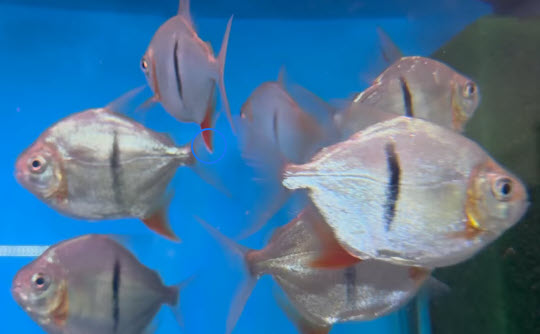
Myloplus sauron Thin-Barred Eye of Sauron
Nouveau Origine sauvage Exclusivité
| Qté (Stock) | Taille | Sexe | Prix unitaire (Taxes incluses) |
|---|---|---|---|
| 4" | - | 79$ |
IMPORTANT
La possession de poissons en aquarium requiert une approche éthique et responsable pour respecter les animaux. L'acquisition de poissons pour maintenance en aquarium ne doit pas se faire sur un coup de tête (achat impulsif). Il est essentiel de s'informer sur les besoins spécifiques des espèces (qualité eau, dimensions aquarium, comportement, alimentat). Seuls les poissons ayant des exigences similaires en matière de qualité d'eau devraient être maintenus ensemble dans un même aquarium.
Un peu plus d'informations...
Introduction
Myloplus sauron, also known as the Thin-Barred Eye of Sauron, is a South American characid recognized for its remarkable appearance. Its deep, laterally compressed body, combined with a dark marking near the eye, gives it a distinctive profile. Native to the Rio Xingu basin in Brazil, this plant-eating fish inhabits freshwater environments associated with the Amazonian forest. Its availability remains extremely limited, making it a very rare aquarium species. This profile concerns a wild-collected fish offered exclusively by Ton.Fish in Canada.
General species description
Myloplus sauron belongs to the serrasalmids, a group of South American fishes that includes several species with strongly compressed bodies and often colorful fins. It is recognized by its robust shape, large anal fin and silvery coloration marked with dark features. The English common name refers to its eye pattern, which recalls the imagery of Sauron. In an aquarium, this species should be treated as a large fish requiring substantial swimming space and efficient filtration. Its herbivorous diet and schooling behavior also influence the layout and the choice of tankmates. With a rarity rating of 3, it is best suited to experienced aquarists able to maintain stable water conditions and an appropriate group.
Geographic origin and biotope
Country of reference: Brazil. The species is associated with the Rio Xingu basin within the Amazon system. This region includes tropical waterways with rocky areas, forested banks, submerged structure and sections exposed to varying current strength. Like several herbivorous serrasalmids, Myloplus sauron likely benefits from plant material supplied by the surrounding forest and from quieter areas near the main current. In an aquarium, it is preferable to create a well-oxygenated river environment with open swimming space, roots and sturdy plants around the perimeter. Moderate current, clean water and strong oxygenation should be priorities for this wild fish.
Precise locality and local name
The geographic reference is the Rio Xingu basin in Brazil. Myloplus sauron is mainly identified by its scientific name in publications and in the specialist trade. The English vernacular name Thin-Barred Eye of Sauron highlights the narrow bar visible near the eye and the reference to Tolkien’s character. In aquarium usage, the scientific name remains the clearest choice and helps prevent confusion with other fishes in the genus Myloplus. Because the species is very rare and wild collected, its exact source should be retained with every shipment to preserve traceability and avoid mixing populations or closely related species.
Appearance and physical characteristics
The body of Myloplus sauron is deep, disk-shaped and strongly compressed laterally, a form typical of many herbivorous serrasalmids. The overall coloration is silvery, with fins that may show warm tones and a dark marking associated with the eye region. This combination is the main visual feature used to recognize the species. The anal fin is well developed, and the body becomes more imposing with age. As with other deep-bodied fishes, aquarium length is more important than excessive decoration height. A dark substrate, roots and subdued lighting can emphasize the natural contrast while providing retreat areas for newly acclimated specimens.
General diet
Myloplus sauron is primarily herbivorous and frugivorous. Its diet should be based on vegetable tablets, tender leaves, blanched vegetables and prepared foods containing a high proportion of plant matter. Small portions of zucchini, cucumber, peas or lettuce can be offered, provided leftovers are removed before they decompose. Small amounts of low-sugar fruit may be used occasionally. Foods rich in animal protein should not form the basis of the diet. A varied menu supports growth, coloration and digestive health. For a rare wild species, dietary changes should be introduced gradually to reduce stress during acclimation.
Essential data
- River of origin: Rio Xingu
- Local name used: Myloplus sauron; Thin-Barred Eye of Sauron
- Origin of the scientific name: The specific name refers to Sauron, a character from the work of J. R. R. Tolkien.
- Etymology of the full name: Myloplus is the genus name; sauron refers to Sauron and to the marking reminiscent of an eye.
- Common/vernacular names: Thin-Barred Eye of Sauron
- Family: Serrasalmidae
- Subfamily: Serrasalminae
- Pronunciation: my-lo-pluss SAWR-on
- Discovery: 2024
- Origin: Brazil, Rio Xingu basin; wild-collected species
- Availability: Exclusive at Ton.Fish in Canada
- Water temperature and pH: Stable tropical water, soft to moderately mineralized
- Stream appearance and surrounding vegetation: Forest-bordered Amazonian river with rocky areas, roots and riparian vegetation
- Typical tankmates: Myleus schomburgkii; Myloplus rubripinnis; Metynnis hypsauchen
- Temperament and behavior: Generally schooling and active; best kept in a group with extensive swimming space.
- Water depth: River zones and side areas with variable depth
- Sexual dimorphism: Subtle in juveniles; it may become more apparent in mature adults through body shape and fin development.
- Bottom structure and flow: Sandy or gravel substrate, roots and stones; moderate to strong flow with well-oxygenated water
In your aquarium
Success with Myloplus sauron depends on a large aquarium, stable tropical water and filtration able to handle a plant-rich diet. Keep it in a group when the aquarium volume allows, provide moderate current and use sturdy or protected plants. Because it is a very rare wild-collected species, acclimation should be gradual and water quality should be monitored carefully. Its exclusive availability through Ton.Fish in Canada makes it a fish best reserved for aquarists prepared to meet its long-term requirements.
{789,433,788}