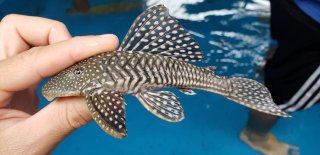
Hypostomus sertanejo Sertanejo Saifin Pleco
Origine sauvage Exclusivité
| Qté (Stock) | Taille | Sexe | Prix unitaire (Taxes incluses) |
|---|---|---|---|
| 5" | - | 125$ |
IMPORTANT
La possession de poissons en aquarium requiert une approche éthique et responsable pour respecter les animaux. L'acquisition de poissons pour maintenance en aquarium ne doit pas se faire sur un coup de tête (achat impulsif). Il est essentiel de s'informer sur les besoins spécifiques des espèces (qualité eau, dimensions aquarium, comportement, alimentat). Seuls les poissons ayant des exigences similaires en matière de qualité d'eau devraient être maintenus ensemble dans un même aquarium.
Un peu plus d'informations...
Hypostomus sertanejo: a very rare sailfin pleco
Hypostomus sertanejo, also known as the Sertanejo Sailfin Pleco, is a loricariid catfish from Brazil. This species remains highly sought after because of its exceptional rarity in the aquarium trade. Like other Hypostomus, it has a sucker mouth adapted for grazing surfaces and a body protected by bony plates. Its sturdy shape, large dorsal fin and natural coloration give it a strong presence in a large aquarium. The specimens offered are collected from the wild and are available exclusively from Ton.Fish in Canada.
General species description
Hypostomus sertanejo is a bottom-dwelling pleco in the family Loricariidae, subfamily Hypostominae. It spends much of its time on rocks, wood and substrate, where it searches for biofilm and organic debris. Its profile resembles that of large sailfin plecos, with a high dorsal fin and a powerful body. Its behavior is generally discreet, especially during daylight, becoming more active after the aquarium lights go out. Its very limited availability makes it a fish best suited to experienced aquarists.
Geographic origin and biotope
Country of reference: Brazil. The species is associated with the rio São Francisco basin, in freshwater habitats combining rocky sections, flowing water and calmer areas. The natural habitat of Hypostomus generally includes hard surfaces covered with algae and biofilm, along with shelter between stones and pieces of wood. In an aquarium, this means well-oxygenated water, efficient filtration and a layout offering plenty of hiding places. Wild fish should receive gradual acclimation and consistently stable water quality.
Precise location and local name
Hypostomus sertanejo is associated with the rio São Francisco basin in Brazil. The name “sertanejo” refers to the Brazilian sertão, a large inland region associated with dry landscapes and seasonal waterways. The name most commonly used in the aquarium trade is Sertanejo Sailfin Pleco. In French, it may be called the sertanejo sailfin pleco. This trade name should not be confused with the many other Hypostomus sold under generic names such as “common pleco.”
Appearance and physical characteristics
The body of Hypostomus sertanejo is elongated, sturdy and covered with bony plates. Its ventral sucker mouth allows it to attach to surfaces and rasp food deposits. The sail-like dorsal fin is one of its most notable features. Overall coloration is subdued, generally brownish or grayish, with a spotted or speckled pattern that helps the fish blend into the bottom. As in several plecos, the pectoral and dorsal fins help stabilize the fish in flowing water.
General diet
Hypostomus sertanejo is primarily a grazer with omnivorous tendencies. Its diet should be based on vegetable-based wafers, spirulina tablets and blanched vegetables such as zucchini, cucumber or peas. Natural wood is also useful in the aquarium because it provides grazing surfaces and encourages natural foraging. A small amount of protein-rich food may supplement the diet, but should not dominate it. Feed this pleco after the lights go out to reduce competition with daytime fish.
Essential data
- River of origin: Rio São Francisco
- Local name used: Sertanejo Sailfin Pleco
- Origin of the scientific name: Hypostomus is the genus name; sertanejo refers to the species’ association with inland Brazil.
- Etymology of the full name: Hypostomus comes from Greek and roughly means “under the mouth”; sertanejo is a Portuguese term associated with people from the sertão.
- Common/vernacular names: Sertanejo Sailfin Pleco; sertanejo sailfin pleco
- Family: Loricariidae
- Subfamily: Hypostominae
- Name pronunciation: hy-po-sto-mus ser-ta-NAY-oh
- Discovery: A recently described species resulting from taxonomic work on fishes of the São Francisco basin.
- Water temperature and pH: 24 to 28 °C; near-neutral pH, approximately 6.5 to 7.5
- Stream appearance and surrounding vegetation: rocky sections and flowing areas, with riparian vegetation adapted to Brazil’s inland climate
- Typical tankmates: peaceful midwater fish, small characins, calm cichlids and other non-territorial bottom fish
- Temperament and behavior: generally peaceful and discreet, most active at dusk or night; may defend a hiding place
- Sexual dimorphism: difficult to see in juveniles; adults may show differences in body width and odontode development
- Bottom layout and flow: sand or fine gravel, rocks, wood and moderate to strong flow with good oxygenation
In your aquarium
Success with Hypostomus sertanejo depends on a spacious aquarium, powerful filtration and highly oxygenated water. Provide roots, caves and grazing surfaces while avoiding overcrowding on the bottom. Because this is a very rare, wild-collected fish, careful acclimation, quarantine and regular feeding are especially important. It is best reserved for aquarists who can maintain stable parameters and meet the needs of a large sailfin pleco.
{1127}