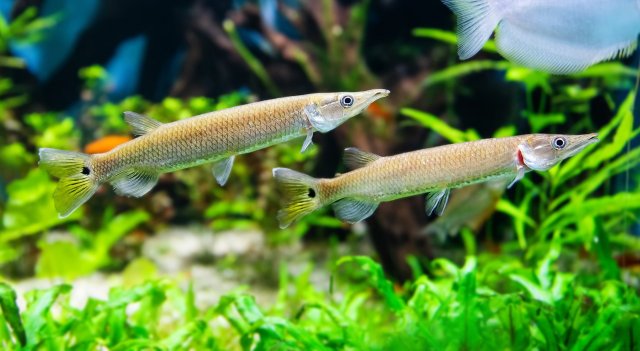
Ctenolucius hujeta Hujeta Gar
| Qty (Stock) | Size | Sex | Unit price (Tax included) |
|---|---|---|---|
| Currently Out of Stock! Contact us for more information | |||
IMPORTANT
Keeping fish in an aquarium requires an ethical and responsible approach that prioritizes animal welfare. Purchasing fish for an aquarium should never be an impulsive decision. It is essential to understand the specific needs of each species, including water quality, aquarium size, behavior, and diet. Only fish with similar water quality requirements should be kept together in the same aquarium.
A Little More Information...
The Ctenolucius hujeta, also known as Hujeta Gar, is a freshwater predatory characiform from South America, valued for its streamlined shape and surface-hunting behavior. Its silvery body, elongated snout, and marked caudal fin give it a distinctive appearance, while its upturned mouth reflects its adaptation to catching small fish. Despite its English name, which recalls the true gars, it belongs to the family Ctenoluciidae, not Lepisosteidae. In an aquarium, it mainly requires ample swimming space, a tightly fitted lid, and tankmates of comparable size. This species is better suited to a spacious South American community aquarium than to a small setup. It is generally available through the ornamental fish trade and is considered a very common aquarium species.
General description
The Ctenolucius hujeta is a fast, streamlined fish associated mainly with the upper part of the water column. It spends much of its time near the surface, where its body shape and upturned mouth help it make short attacks on passing prey. It is an opportunistic predator that may become nervous in a tank that is too small or heavily stocked. Its care is better suited to a spacious South American biotope-style aquarium than to a compact community tank. Young specimens are often sold at small sizes, but their adult length and growth should be considered before purchase. Wild populations are broadly distributed within their range, matching its status as a very common species in the specialized aquarium trade. Good oxygenation, clean water, and a long aquarium are priorities for long-term success.
Geographic origin and biotope
The Ctenolucius hujeta is native to Colombia, especially the Río Magdalena basin and connected lowland river areas. It occurs in tropical freshwater habitats where quiet zones, vegetated margins, and side channels provide ambush positions near the surface. Current is generally slow to moderate, with seasonal changes caused by rainfall and river levels. Riparian vegetation can provide shade and overhead cover, while branches, roots, and floating plants break up open sightlines. In an aquarium, stable tropical water ranging from slightly acidic to neutral is appropriate. A broad open swimming area should still be maintained rather than filling the entire tank with dense decoration. Dim lighting filtered by floating plants can reduce skittishness and help reproduce the feel of its natural habitat. The species is mainly a surface and margin fish, not a bottom dweller.
Precise location and local name
Within Colombia, the Ctenolucius hujeta is associated with the Magdalena basin, a large network that includes the main river and several tributaries flowing through Andean and Caribbean regions. Aquarium literature most often uses the names Hujeta Gar, Hujeta, and Freshwater Gar, although the latter can be confused with the true gars of North America. In Colombia, the local name agujeta is used for elongated, pointed-snouted fishes and suits this species well. Vernacular names may vary between regions and should not replace scientific identification. For aquarists, Ctenolucius hujeta remains the most precise reference. This fish is not associated with the bottom; it mainly occupies quiet margins and the surface of waterways, often close to plant cover, roots, or woody debris.
Appearance and physical characteristics
The Ctenolucius hujeta has a long, slender, silvery body, with a grayish-green back and reflective flanks. Its most striking feature is its elongated snout, ending in an upturned mouth adapted for capturing prey at the surface. The fins are usually translucent and may show yellow or orange tones, while the caudal fin often displays a dark mark at its base, especially in well-conditioned specimens. The lateral line is clearly visible and the body is covered with small scales. Adults may reach approximately 25 cm in total length, depending on growing conditions and the reference used. Its general shape resembles a small pike, but the species is a South American characiform. A secure lid is essential because this fast fish may jump when startled or during feeding pursuits.
General diet
In the wild, the Ctenolucius hujeta is a mainly piscivorous predator that catches small fish and other available aquatic prey. In aquariums, acclimated specimens often accept meaty foods such as shrimp, worms, pieces of fish, and suitable frozen preparations. Feeder fish are not necessary and may introduce parasites or pathogens; quality frozen food is generally safer. Food items should be appropriately sized for the mouth and offered in moderate portions to prevent overfeeding and water pollution. Juveniles may receive small meaty meals several times a week, while adults can be fed at wider intervals. Tankmates must be monitored because any fish small enough to swallow may become prey. A varied carnivorous diet supports good condition, but plant matter is not the foundation of this species’ nutrition.
Essential data
- Native river: Río Magdalena
- Local name: Agujeta
- Origin of the scientific name: Ctenolucius is a genus name built from Greek and Latin roots; hujeta retains the vernacular name associated with the fish.
- Full-name etymology: Ctenolucius combines ktenos, meaning “comb,” and lucius, meaning “pike”; hujeta is a vernacular name.
- Common/vernacular names: Hujeta Gar, Freshwater Gar, Hujeta, Agujeta
- Family: Ctenoluciidae
- Subfamily: Ctenoluciinae
- Name pronunciation: ten-oh-LOO-see-us hoo-HEH-tah
- Discovery: Achille Valenciennes, 1850
- Maximum adult size: Approximately 25 cm
- Water temperature and pH: 22 to 28 °C; pH 6.0 to 7.5
- Waterway appearance and surrounding vegetation: Tropical slow to moderately flowing water, shaded margins, riparian vegetation, roots, and floating plants
- Typical tankmates: South American fish of similar size that are peaceful and not easily swallowed; avoid small fish
- Temperament and behavior: Active predator, generally peaceful toward tankmates too large to swallow; mostly swims near the surface
- Water depth: Mainly the upper layer and shallow margins
- Sexual dimorphism: Females are often heavier-bodied and fuller-bellied; juveniles are harder to sex
- Bottom structure and flow: Soft or sandy-muddy substrate, plant debris, and slow to moderate current
For greater success
To keep the Ctenolucius hujeta successfully, provide a long aquarium with a large open swimming area and a tightly secured lid. Efficient filtration, well-oxygenated water, and regular water changes support healthy growth. Floating plants and shaded sections can make the fish feel more secure, but the layout should not obstruct its movements. Choose tankmates large enough not to be viewed as prey and avoid very slow fish or species with long, delicate fins. A varied carnivorous diet, offered in moderation, helps maintain condition without overloading the water. Since this species can reach about 25 cm, its long-term space requirements should be planned before purchase. With suitable room, stable parameters, and appropriate companions, this surface predator becomes a striking and relatively manageable aquarium fish.