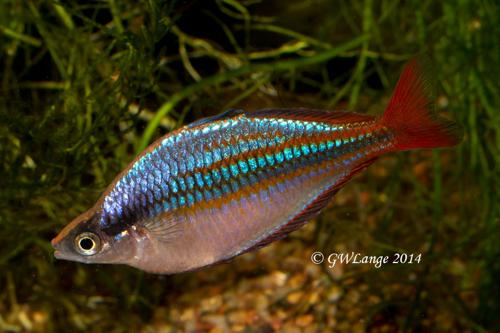
Melanotaenia rubrivittata Red Laser Wapoga Rainbow
New
| Qty (Stock) | Size | Sex | Unit price (Tax included) |
|---|---|---|---|
14 en stock | 3" | - | 33$ |
IMPORTANT
Keeping fish in an aquarium requires an ethical and responsible approach that prioritizes animal welfare. Purchasing fish for an aquarium should never be an impulsive decision. It is essential to understand the specific needs of each species, including water quality, aquarium size, behavior, and diet. Only fish with similar water quality requirements should be kept together in the same aquarium.
A Little More Information...
Introduction
Melanotaenia rubrivittata, also called the Red Laser Wapoga Rainbow, is a freshwater rainbowfish from Indonesian New Guinea. Its iridescent body and distinctive red longitudinal stripe give it a striking appearance under aquarium lighting. Like many rainbowfish, it benefits from group living, clean water, and plenty of open swimming space. Its availability remains fairly limited, making it a sought-after species for aquarists interested in precise geographic forms and less commonly offered rainbowfish.
General species description
Melanotaenia rubrivittata is a freshwater fish in the family Melanotaeniidae, related to other New Guinean rainbowfish. It is recognized by its elongated body, active swimming style, and coloration, which becomes stronger when the fish are kept in a group and maintained under good conditions. The trade name Red Laser Wapoga Rainbow refers to its visible red stripe along the flanks. This is a schooling fish that generally uses the middle and upper areas of the aquarium. A mature, well-oxygenated tank with good swimming length is preferable to a small, crowded setup. Its rarity level 2 means it is less frequently available than more common rainbowfish species.
Geographic origin and habitat
Country of reference: Indonesia, Papua Province. Melanotaenia rubrivittata comes from the basin of the Wapoga River in northern western New Guinea. Its habitat is associated with tropical streams where water flows regularly, including shallow sections, wooded banks, and bottoms made of gravel, sand, or small stones. Riverside vegetation provides shade and creates changing light conditions over the water. In the aquarium, this origin suggests a preference for stable, clear, well-oxygenated water and a layout with a large open swimming area. Plants, roots, and a few stones can provide shelter without filling the entire tank.
Precise location and local name
The reference locality of Melanotaenia rubrivittata is in the Wapoga River basin of Indonesian Papua, on the island of New Guinea. The most widely used trade or aquarium name is Red Laser Wapoga Rainbow. This name highlights both the river of origin and the red stripe that characterizes the fish. Rainbowfish can vary in color depending on population, health, diet, social status, and lighting. It is therefore best to keep this strain separate from other Melanotaenia in order to preserve its geographic identity and avoid hybridization. For Canadian aquarists, including those in Quebec, this precise origin is an important detail to check when purchasing specimens.
Appearance and physical characteristics
Melanotaenia rubrivittata has a fusiform, laterally compressed body suited to sustained swimming in flowing water. The flanks show metallic colors ranging from blue-green to silvery gray, with a longitudinal red band that is especially noticeable in males displaying. The fins may also show red or orange tones. Adult males are generally more colorful and have more developed fins than females. Coloration is strongly influenced by lighting, the aquarium layout, social hierarchy, and water quality. Keeping the fish in a group often produces the best colors and allows natural courtship displays to be observed. The maximum adult size generally used for aquarium planning is about 10 cm.
General diet
As an omnivore with an insect-eating tendency, Melanotaenia rubrivittata accepts a varied diet of flakes, small pellets, frozen foods, and appropriately sized live foods. Suitable choices include brine shrimp, daphnia, mosquito larvae, and small aquatic insects. A quality dry food can be used as a practical staple, but it should be supplemented with protein-rich foods and a small plant-based component. It is better to offer small meals several times a day, especially to young fish, rather than one large feeding. Food should be small enough to swallow easily and should be consumed quickly to protect water quality. A varied diet supports growth, vitality, and the expression of the red coloration.
Essential data
- Name of the original river: Wapoga River
- Local name used: Red Laser Wapoga Rainbow
- Origin of the scientific name: a descriptive genus name and an epithet referring to a red stripe
- Etymology of the full name: Melanotaenia means “with a black band”; rubrivittata means “provided with a red band”
- Common/vernacular names: Red Laser Wapoga Rainbow, Wapoga Red Laser Rainbowfish
- Family: Melanotaeniidae
- Subfamily: Melanotaeniinae
- Pronunciation: meh-lan-oh-TAY-nee-ah roo-brih-vit-TAH-tah
- Discovery: Gerald R. Allen, Michael P. Unmack, and Renny K. Hadiaty, 2015
- Maximum adult size: about 10 cm
- Water temperature and pH: approximately 24–28 °C; pH 7.0–8.0
- Stream appearance and surrounding vegetation: clear flowing water, shallow sections, gravel or stones, and dense tropical vegetation along the banks
- Typical tankmates: Chilatherina alleni
- Temperament and behavior: peaceful, active, and schooling; males display to one another
- Water depth: shallow to moderately deep sections
- Sexual dimorphism: males are usually more colorful, often larger, and have more developed fins; females are subtler
- Bottom structure and flow: sand, gravel, and small stones with a regular moderate current
In your aquarium
To succeed with Melanotaenia rubrivittata, provide a long, covered aquarium with good filtration and a group of several individuals. Clean, stable, well-oxygenated water is essential, along with a varied diet and small regular feedings. Leave a broad open swimming area in the center, then place plants or roots along the sides to create shelter. Avoid aggressive tankmates or fish that are too slow during feeding. Keeping the strain separate and monitoring water parameters will encourage stronger coloration and more natural behavior.
{737}