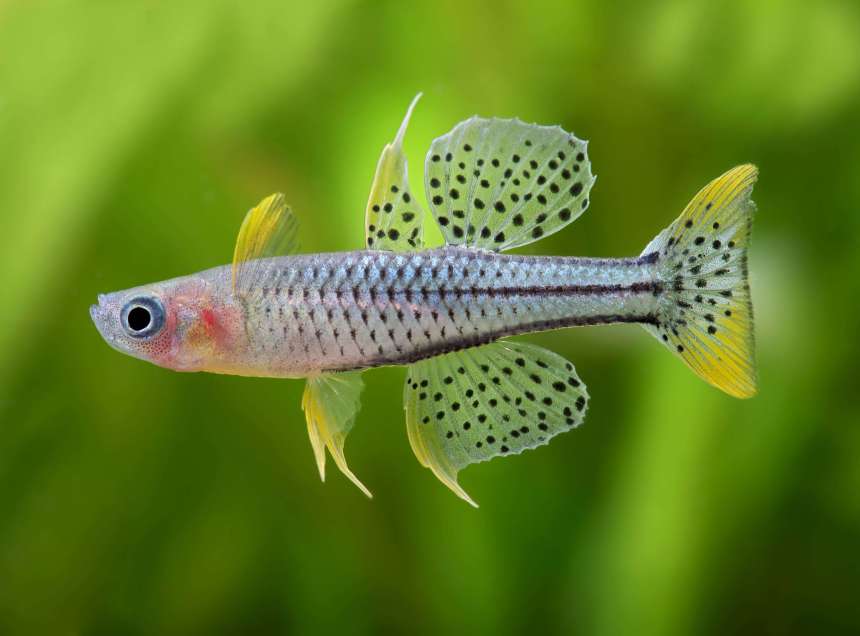
Pseudomugil gertrudae Aru Spotted Blue-Eye Rainbow
| Qty (Stock) | Size | Sex | Unit price (Tax included) |
|---|---|---|---|
| Currently Out of Stock! Contact us for more information | |||
IMPORTANT
Keeping fish in an aquarium requires an ethical and responsible approach that prioritizes animal welfare. Purchasing fish for an aquarium should never be an impulsive decision. It is essential to understand the specific needs of each species, including water quality, aquarium size, behavior, and diet. Only fish with similar water quality requirements should be kept together in the same aquarium.
A Little More Information...
The Pseudomugil gertrudae Aru, also known as the Spotted Blue-Eye Rainbow, is a small rainbowfish from the Aru Islands of Indonesia. Its delicate body, translucent fins and clearly visible dark spots give it a distinctive appearance. Peaceful and active, it does best in a mature aquarium with warm, clean and well-oxygenated water. This form is generally accessible to aquarists and suits calm community aquariums. Its small size and open-water behavior make it an appealing choice for planted nano or small aquariums. Keeping it in a group allows its natural social behavior and male displays to be observed more easily.
General species description
The Pseudomugil gertrudae Aru is one of the small blue-eye rainbowfish in the genus Pseudomugil. It lives near the surface and in quiet sections of small streams, where it moves in groups among aquatic and marginal vegetation. Its behavior is lively but non-aggressive, and males regularly display by spreading their fins in front of females. A group with more females than males is a practical choice for community aquariums. A tightly fitting cover is recommended because this fish may jump when startled. Stable water conditions, gentle circulation and open swimming space near the surface all contribute to its well-being.
Geographic origin and habitat
Country of reference: Indonesia. The Aru form is associated with the Aru Islands, in the Moluccas. Its natural environment consists of small lowland freshwater habitats, including quiet channels, swampy areas and places affected by seasonal rainfall. The water is generally warm and slow-moving, with abundant vegetation along the margins and in shallow sections. In an aquarium, the goal is therefore to recreate a calm, planted and well-oxygenated environment rather than a fast current. Gentle surface movement is useful, but strong flow can make feeding and swimming unnecessarily difficult.
Precise location and local name
The name Aru refers to the Aru Islands archipelago, located southwest of New Guinea in eastern Indonesia. This designation is mainly used in aquarium trade and distribution references to distinguish this population from forms originating in other regions. No specific local vernacular name is used here. In aquarium circles, the English names Spotted Blue-Eye Rainbow and Blue-Eye Rainbow are the most useful names for identifying this small fish. The locality name should be retained when possible because it helps distinguish regional forms.
Appearance and physical characteristics
The Pseudomugil gertrudae Aru has a slender, slightly laterally compressed body, usually silver to pale yellow depending on lighting and condition. Small dark markings appear along the flanks and contrast with the metallic reflections. The eyes show the characteristic blue reflection of blue-eyes, while the translucent fins may display yellow, orange or black tones. Males are more colorful and have more developed fins, especially during courtship displays. Females are usually less colorful and somewhat deeper-bodied. Adult size remains small, making this fish well suited to a planted aquarium with gentle circulation and a clear area near the surface.
General diet
In nature, this fish feeds mainly on very small prey available in the water column and near the surface. In an aquarium, it accepts fine dry foods, but a varied diet greatly improves condition and coloration. Offer small amounts of crushed flakes, micro pellets and regular portions of frozen or live foods such as baby brine shrimp, cyclops and small daphnia. Its small mouth requires appropriately sized particles. Light meals once or twice daily are preferable to a large feeding, while removing leftovers helps prevent unnecessary organic pollution. Feeding near the surface also allows the fish to display its natural feeding behavior.
Essential data
- Native river name:
- Local name used: Spotted Blue-Eye Rainbow; Blue-Eye Rainbow
- Origin of the scientific name: The genus Pseudomugil was established for small fishes that superficially resemble mullets of the genus Mugil.
- Etymology of the full name: Pseudo means false or resembling; Mugil refers to the mullet genus; gertrudae honors Gertrude.
- Common/vernacular names: Spotted Blue-Eye Rainbow; Blue-Eye Rainbow
- Family: Pseudomugilidae
- Subfamily:
- Name pronunciation: soo-doh-MOO-gil ger-TROO-dee-ee
- Discovery: Max Carl Wilhelm Weber, 1911
- Maximum adult size: About 4 cm
- Water temperature and pH: 24 to 28 °C; pH 6.5 to 7.5
- Stream appearance and surrounding vegetation: Small, quiet and shallow warm-water habitats bordered by dense vegetation and plant debris.
- Typical tankmates: Iriatherina werneri, Pseudomugil luminatus, Pseudomugil signifer, Melanotaenia australis
- Temperament and behavior: Peaceful, schooling and active near the surface; males display to one another without marked aggression.
- Water depth: Shallow to moderate, especially along margins and in small channels.
- Sexual dimorphism: Males are more colorful, with larger and more contrasting fins; females are duller and often rounder-bodied.
- Bottom structure and flow: Mud, fine sand and plant debris; low to moderate flow.
In your aquarium
Success with the Pseudomugil gertrudae Aru depends on keeping a suitable group, warm water and filtration without excessive turbulence. A planted layout, shaded areas and open surface space allow natural behavior to develop. Use a secure cover and provide particles small enough for its mouth. Peaceful tankmates of similar size are essential. Regular water changes, good oxygenation and consistent water quality will help this small fish maintain its vitality and coloration. Avoid overcrowding, sudden parameter changes and overly forceful circulation, especially in smaller aquariums.
{232,1238,1239,880}