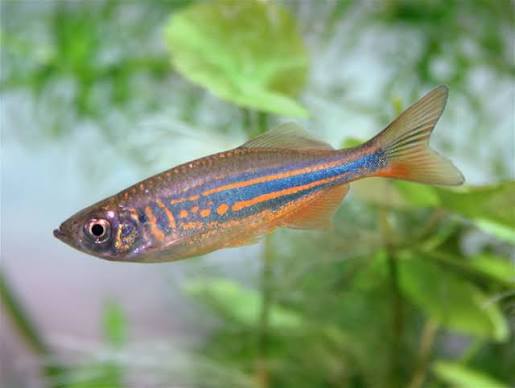
Devario aequipinnatus Giant Danio
| Qty (Stock) | Size | Sex | Unit price (Tax included) |
|---|---|---|---|
| 1 ¾" | - | 10$ |
IMPORTANT
Keeping fish in an aquarium requires an ethical and responsible approach that prioritizes animal welfare. Purchasing fish for an aquarium should never be an impulsive decision. It is essential to understand the specific needs of each species, including water quality, aquarium size, behavior, and diet. Only fish with similar water quality requirements should be kept together in the same aquarium.
A Little More Information...
Devario aequipinnatus, also known as the Giant Danio, is an active and hardy Asian fish suited to spacious community aquariums. Recognized by its slender body, bluish sheen, and golden markings, it spends most of its time in the upper and middle levels of the aquarium. This schooling species should be kept in a group to encourage natural behavior and reduce nervousness. It appreciates well-oxygenated water, moderate current, and a long aquarium that provides plenty of swimming room.
General description of the species
Devario aequipinnatus is a medium-sized danionid that is lively and constantly active. It mainly uses the upper and middle levels of the aquarium, where it forms dynamic groups. Its temperament is generally peaceful with fish of similar size, although its energy may disturb very calm or slow species. A group of at least six individuals helps distribute chasing and reduces stress. Good filtration, strong oxygenation, and a sufficiently long aquarium are important because this fish is a fast swimmer. It is widely available in the aquarium trade, giving it a status of very common fish. It can suit beginners when the aquarium is large enough and water conditions remain stable.
Geographical origin and biotope
Countries of reference: India, Nepal, Bhutan, Bangladesh, and Myanmar. The species mainly inhabits river basins in South and Southeast Asia, including clear, cool, well-oxygenated streams and river sections. The Teesta River is among the basins associated with its distribution. Its habitat often has a gravel or pebble bottom, current zones, and vegetated banks. Vegetation is usually denser along the margins and in areas where the current slows, while the channel remains open for swimming. In an aquarium, these conditions can be approximated with visible water movement, open swimming areas, and sturdy plants. Moderate temperatures are preferable to very warm tropical water.
Precise location and local name
Devario aequipinnatus is associated with waterways in the Himalayan region and northern parts of the Indian subcontinent, particularly within the Ganges and Brahmaputra basins, as well as neighboring areas of Myanmar. It occurs in foothill streams and flowing rivers, rather than stagnant waters. The most widespread common name in aquaria is Giant Danio. Vernacular names can vary according to language and region, and no single local name has become standard in international aquarium trade. For identification, the scientific name therefore remains the most practical reference.
Appearance and physical characteristics
The body of Devario aequipinnatus is elongated, streamlined, and adapted for sustained swimming. The flanks display steel-blue to blue-green tones crossed by longitudinal golden or yellowish markings. The fins are generally translucent and may show yellow or blue highlights. The mouth faces forward and slightly upward, matching its habit of taking small prey near the surface. Adults reach approximately 10 cm in aquaria, giving them a more substantial appearance than the zebra danio. Coloration becomes stronger when the fish is well fed, kept in a group, and maintained in good water quality. Open swimming space makes it easier to observe its rapid bursts of speed and social interactions.
General diet
Devario aequipinnatus is an omnivore and readily accepts a varied diet. In aquaria, offer quality dry foods such as flakes or small floating pellets, regularly supplemented with frozen or live foods. Mosquito larvae, brine shrimp, daphnia, and cyclops are useful choices for encouraging natural hunting behavior. Some plant matter can be supplied indirectly through complete foods containing algal or vegetable ingredients. Feed small portions that are consumed quickly, ideally once or twice daily. Food should be small enough to swallow easily. A varied diet supports vitality and coloration, while overfeeding quickly pollutes the water and can lead to excessive fat deposits.
Essential data
- River of origin: Teesta River
- Local name used: Giant Danio
- Origin of the scientific name: Devario is a genus name with South Asian vernacular roots; aequipinnatus refers to fins of comparable size.
- Full-name etymology: Devario is a generic name; aequipinnatus means equal-finned or similarly finned.
- Common/vernacular names: Giant Danio, giant danio
- Family: Danionidae
- Subfamily: Danioninae
- Name pronunciation: deh-VAIR-ee-oh - ee-kwee-PIN-ah-tus
- Discovery: Francis Hamilton, 1822
- Maximum adult size: About 10 cm
- Water temperature and pH: 20 to 26 °C; pH 6.5 to 8.0
- Appearance of the watercourse and surrounding vegetation: Clear, well-oxygenated streams and rivers with pebbles, gravel, current, and vegetated banks.
- Typical tankmates: Brachydanio rerio, Tanichthys albonubes, Pethia conchonius, Puntigrus tetrazona
- Temperament and behavior: Peaceful, highly active, schooling, and fast-swimming.
- Water depth: Generally shallow to moderate in flowing sections.
- Sexual dimorphism: Adult females are often fuller-bodied; males tend to be slimmer.
- Bottom structure and flow: Gravel or pebbles, open areas, and moderate to strong flow.
For greater success
Success with Devario aequipinnatus depends mainly on a long, covered, well-circulated aquarium. Keep it in a group, provide open swimming space, and avoid slow tankmates or fish with very long fins. Clean, stable, well-oxygenated water maintained around 20 to 26 °C supports its natural activity. Plants along the sides and back provide cover without blocking water movement. With a varied diet and small portions, this schooling swimmer remains colorful, energetic, and easy to observe.
{938,996,1093,951}