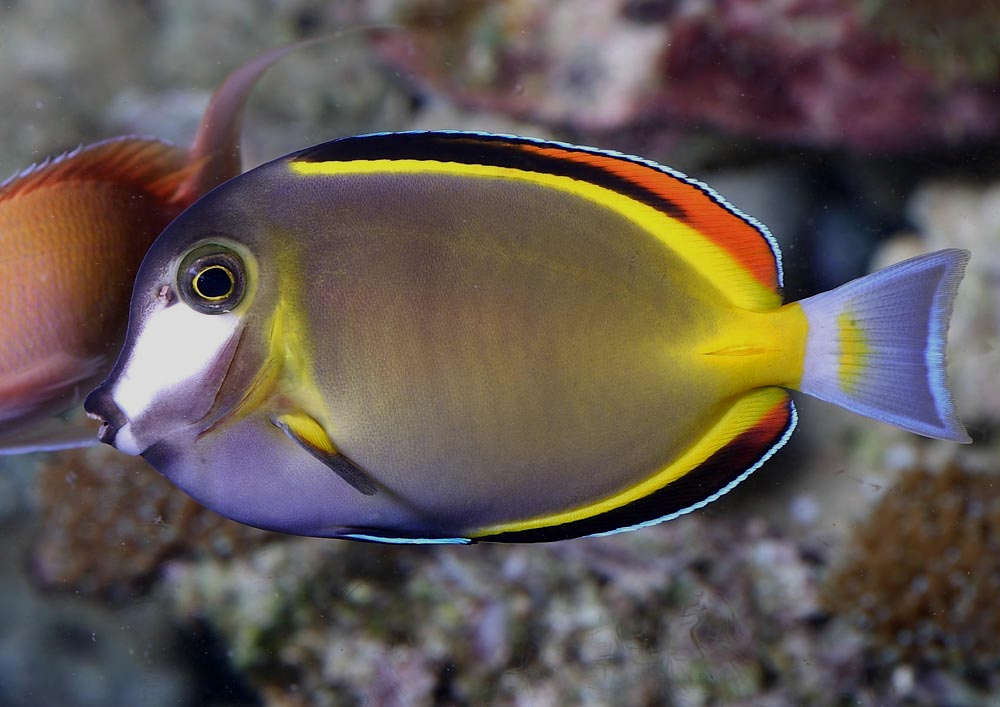
Acanthurus japonicus Powder Brown Tang
Wild caught origin
| Qté (Stock) | Taille | Sexe | Prix unitaire (Taxes incluses) |
|---|---|---|---|
| Aucun en stock en ce moment! Communiquez avec nous | |||
IMPORTANT
La possession de poissons en aquarium requiert une approche éthique et responsable pour respecter les animaux. L'acquisition de poissons pour maintenance en aquarium ne doit pas se faire sur un coup de tête (achat impulsif). Il est essentiel de s'informer sur les besoins spécifiques des espèces (qualité eau, dimensions aquarium, comportement, alimentat). Seuls les poissons ayant des exigences similaires en matière de qualité d'eau devraient être maintenus ensemble dans un même aquarium.
Un peu plus d'informations...
Acanthurus japonicus, also known as the Powder Brown Tang, is an Indo-Pacific surgeonfish valued for its elegant shape and brownish-gray coloration. This fish actively grazes algae growing on reef rocks and therefore contributes to the balance of coral habitats. Its care nevertheless requires a mature, spacious, and highly oxygenated marine aquarium. The species is collected from the wild in the aquarium trade. Very common throughout its natural range, it can still be sensitive to shipping, rapid parameter changes, and a shortage of suitable vegetable food.
General species description
Acanthurus japonicus is a surgeonfish in the family Acanthuridae, associated with coral reefs and coastal rocky areas. Its laterally compressed body, continuous dorsal fin, and caudal peduncle equipped with an erectile scalpel are typical features of the group. Active during the day, it constantly moves across available surfaces while searching for biofilm and algae. In an aquarium, it needs a long swimming area and well-colonized live rock. Although very common in the trade and in nature, it is not suited to a small community tank. Efficient filtration, excellent water movement, and careful acclimation help it adjust successfully.
Geographic origin and habitat
The species comes from the western Indo-Pacific, including southern Japan, Taiwan, the Philippines, Indonesia, and areas of the Great Barrier Reef. It inhabits outer reef slopes, reef flats, and lagoons exposed to regular water movement. Its habitat consists of shallow coral reefs, rocky outcrops, and calcareous surfaces covered with algae. Reference countries: Japan, Taiwan, the Philippines, Indonesia, and Australia. The water is warm, clear, alkaline, and highly mineralized. In an aquarium, stability is more important than extreme readings: maintain a constant tropical temperature, stable marine pH, consistent salinity, and low nitrogenous waste.
Precise locality and local name
Acanthurus japonicus occurs on coastal and island reefs in the western Pacific, particularly around the Ryukyu Islands, Taiwan, the Philippines, and the Indonesian archipelago. It is not associated with a river because it is a strictly marine species. Individuals generally occupy reef areas where encrusting algae and biological film are abundant. The name Powder Brown Tang is mainly used in the international aquarium trade. The French expression chirurgien brun poudre is also encountered, although vernacular names may vary between regions. This species is common in the aquarium trade, while specimens are primarily offered as wild-collected fish.
Appearance and physical characteristics
The body of Acanthurus japonicus is oval, deep, and strongly compressed, with an overall brown-gray to purplish-brown coloration. The head has a contrasting pale area, while the throat and chest may appear whitish. The dorsal and anal fins often show bluish margins, and the caudal peduncle carries the defensive blade typical of surgeonfish. Its terminal mouth is adapted for grazing hard surfaces. Its understated coloration, highlighted by blue and white markings, helps distinguish it from related species such as the Powder Blue Tang. Maximum adult length is about 21 cm. The sexes are difficult to distinguish visually, especially in isolated specimens.
General diet
Acanthurus japonicus is primarily herbivorous, feeding mainly on filamentous algae, biofilm, and plant matter covering rocks. In an aquarium, offer nori sheets, quality algae-based preparations, and vegetable foods every day. Several small feedings better imitate its natural behavior than one large meal. Frozen foods can supplement the diet but should not replace the vegetable foundation. A fiber-rich diet containing suitable pigments helps maintain body condition and coloration. The presence of live rock covered with microalgae encourages natural grazing. Competition for food with other herbivores must be monitored carefully.
Essential data
- Original river name: Not applicable; marine species
- Local name used: Powder Brown Tang
- Origin of the scientific name: A genus name built from Greek roots; a geographic species epithet
- Full-name etymology: Acanthurus means thorn-tailed; japonicus means from Japan
- Common/vernacular names: Powder Brown Tang; brown powder surgeonfish
- Family: Acanthuridae
- Subfamily: Acanthurinae
- Name pronunciation: ah can THUR us - jah PON ih kus
- Discovery: Schmidt, 1931
- Maximum adult size: About 21 cm
- Water temperature and pH: 24 to 28 °C; pH 8.1 to 8.4
- Waterway appearance and surrounding vegetation: Not applicable; coral reefs and algae-covered rock
- Typical tankmates: Chromis viridis, Pseudanthias squamipinnis, Gobiodon okinawae, Valenciennea puellaris, Cirrhilabrus lubbocki
- Temperament and behavior: Active and territorial toward similar surgeonfish, generally peaceful with other fish
- Water depth: Approximately 1 to 25 m
- Sexual dimorphism: No reliable, easily observed external differences
- Bottom structure and flow: Rocky and coral substrate; moderate to strong water movement
In your aquarium
To succeed with Acanthurus japonicus, choose a mature, spacious, and well-circulated marine aquarium with plenty of rockwork and grazing surfaces. Quarantine on arrival can help reduce problems associated with shipping and acclimation. Provide varied vegetable foods every day and monitor water quality closely. Avoid keeping several highly similar surgeonfish in a limited volume, since territorial behavior may intensify. Stable salinity, pH, and temperature remain essential. With adequate swimming space and regular algae-based feeding, this active fish can become a long-lived and striking aquarium resident.