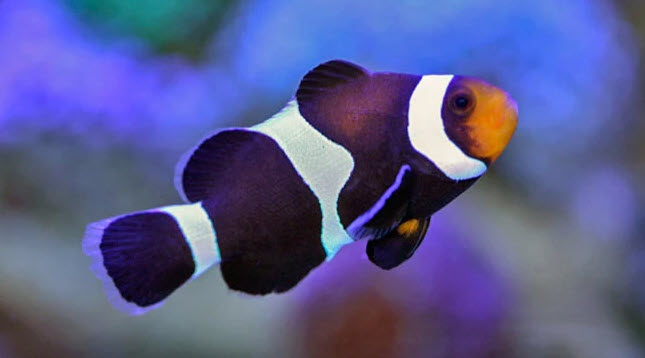
Amphiprion ocellaris Mocha Clownfish
| Qté (Stock) | Taille | Sexe | Prix unitaire (Taxes incluses) |
|---|---|---|---|
| 1 ¾" | - | 40$ |
IMPORTANT
La possession de poissons en aquarium requiert une approche éthique et responsable pour respecter les animaux. L'acquisition de poissons pour maintenance en aquarium ne doit pas se faire sur un coup de tête (achat impulsif). Il est essentiel de s'informer sur les besoins spécifiques des espèces (qualité eau, dimensions aquarium, comportement, alimentat). Seuls les poissons ayant des exigences similaires en matière de qualité d'eau devraient être maintenus ensemble dans un même aquarium.
Un peu plus d'informations...
Introduction
The Mocha Clownfish is a captive-bred color form of Amphiprion ocellaris, the popular three-band clownfish. Recognizable by its very dark brown body, white bars, and orange face, it provides strong contrast in a marine aquarium. Like other clownfish, it may establish a close relationship with a host anemone and actively defend its territory. This variety remains fairly accessible in the aquarium trade, while still requiring stable, well-oxygenated, properly maintained water. A formed pair may also reproduce in captivity when conditions are suitable. Its manageable size and generally adaptable nature make it a practical choice for many mature reef aquariums.
General description of the species
Amphiprion ocellaris is a small marine clownfish from the family Pomacentridae. The species usually lives as a pair or in a small group associated with a host anemone. A strict hierarchy develops within the group: the largest female dominates, followed by the breeding male and nonbreeding individuals. The Mocha Clownfish is a selected color form of Amphiprion ocellaris, not a separate species. It suits peaceful reef aquariums, although it can become territorial around its shelter, particularly after pairing. Its popularity is high and availability is generally good, placing it among the relatively common clownfish in the aquarium trade.
Geographic origin and biotope
Amphiprion ocellaris originates in the western Indo-Pacific, including the Philippines, Indonesia, Malaysia, Thailand, Taiwan, the Ryukyu Islands, and the Great Barrier Reef. Reference countries: Australia, Indonesia, the Philippines, Malaysia, Thailand, Taiwan, and Japan. It inhabits coral reefs, lagoons, and shallow reef slopes, usually near host anemones. The substrate consists of coral, calcareous rubble, and rock, with low to moderate flow depending on exposure. The water is warm, clear, and well circulated, while marine plant growth is limited; shelter is mainly provided by corals and anemones.
Precise location and local name
Within its natural range, Amphiprion ocellaris is found on coastal reefs and in lagoons across the Indo-Australian Archipelago, extending to northeastern Australia and the islands of the western Pacific. It is not associated with a freshwater river, but with marine reef habitats where anemones provide shelter. Local names vary by country and language; in the international aquarium trade, clownfish and Mocha Clownfish are the most commonly used names. Natural populations generally occupy shallow areas with good light and abundant shelter rather than open sandy zones.
Appearance and physical characteristics
The body of Amphiprion ocellaris is compact, oval, and laterally compressed. The Mocha form usually has a chocolate-brown to nearly black background, an orange head, orange-tinted fins, and three vertical white bars. Color intensity can vary with age, strain, and rearing conditions. The bars are separated by dark areas, creating strong contrast. The pectoral and caudal fins are rounded, suited to short movements among the tentacles of an anemone. As in other clownfish, Amphiprion ocellaris is a protandrous hermaphrodite: young fish begin life as males, and the largest individual in a group may change into a female.
General diet
Amphiprion ocellaris is an omnivore and normally accepts a broad range of aquarium foods. Its diet should combine frozen or prepared marine foods such as mysis, enriched brine shrimp, finely chopped krill, and quality pellets. A small portion of foods containing plant ingredients can complement the diet. Offer small portions once or twice daily and remove leftovers to protect water quality. Juveniles and newly introduced fish benefit from frequent, varied meals. In nature, the species consumes zooplankton, small crustaceans, and food fragments captured around its host.
Essential data
- River of origin: None; a marine reef species.
- Local name used: Clownfish.
- Origin of the scientific name: A Greek and Latin name describing the fish’s form and markings.
- Etymology of the full name: Amphiprion comes from the Greek amphi, on both sides, and prion, saw; ocellaris comes from the Latin ocellus, little eye, referring to eye-like markings.
- Common/vernacular names: Three-band clownfish, clownfish, Mocha Clownfish.
- Family: Pomacentridae
- Subfamily: Amphiprioninae
- Name pronunciation: am-fee-PRY-on - oh-sell-AIR-iss
- Discovery: Georges Cuvier, 1830.
- Maximum adult size: About 11 cm.
- Water temperature and pH: 24 to 28 °C; pH 8.1 to 8.4.
- Waterway appearance and surrounding vegetation: Clear marine reefs and lagoons with corals, rocks, and anemones; no riparian vegetation.
- Typical tankmates: Amphiprion percula, Premnas biaculeatus, Chromis viridis, Gobiodon okinawae, Pseudocheilinus hexataenia, Lysmata amboinensis.
- Temperament and behavior: Active, territorial around its shelter, and generally peaceful outside that area; lives as a pair or in a hierarchical group.
- Water depth: Approximately 1 to 15 m.
- Sexual dimorphism: The adult female is larger than the male; sex is difficult to determine reliably in juveniles.
- Bottom structure and flow: Rocky and coral substrate with calcareous rubble; low to moderate flow, with good overall circulation.
In your aquarium
For successful care of Amphiprion ocellaris, use a mature marine aquarium, efficient filtration, and water parameters that remain stable. An anemone is not essential because the fish may adopt a coral, rock, or another shelter, but any anemone requires suitable lighting and protection from pumps. Choose peaceful tankmates and provide hiding places. The most important point is stable salinity, temperature, and pH, supported by varied, regular feeding. A formed pair may defend its territory strongly, especially during spawning. Routine maintenance and careful observation will help keep this adaptable clownfish healthy over the long term.
{1190,1143}