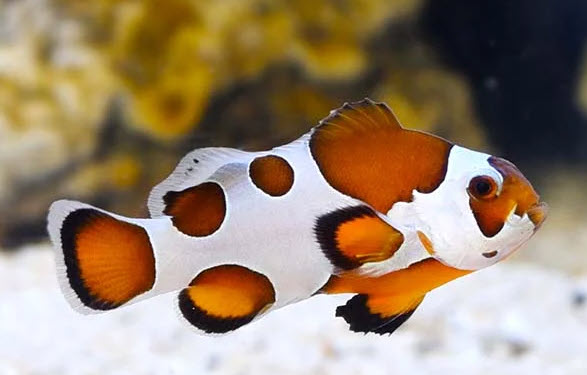
Amphiprion ocellaris Da Vinci / Gladiator Clownfish
| Qté (Stock) | Taille | Sexe | Prix unitaire (Taxes incluses) |
|---|---|---|---|
| 2" | - | 49$ |
IMPORTANT
La possession de poissons en aquarium requiert une approche éthique et responsable pour respecter les animaux. L'acquisition de poissons pour maintenance en aquarium ne doit pas se faire sur un coup de tête (achat impulsif). Il est essentiel de s'informer sur les besoins spécifiques des espèces (qualité eau, dimensions aquarium, comportement, alimentat). Seuls les poissons ayant des exigences similaires en matière de qualité d'eau devraient être maintenus ensemble dans un même aquarium.
Un peu plus d'informations...
Amphiprion ocellaris is a small marine clownfish valued for its bold colors, hardy nature, and engaging behavior. The names Da Vinci and Gladiator Clownfish refer to a captive-bred color form with irregular white markings of Amphiprion ocellaris. Like other members of the Pomacentridae, it lives on Indo-Pacific coral reefs and may form a close relationship with certain sea anemones. Successful care requires stable saltwater, effective filtration, and a rockwork layout with shelter. This variety is fairly sought after in the aquarium trade while remaining generally suitable for prepared beginners. Its marine requirements should still be respected from the start.
General species description
Amphiprion ocellaris belongs to the subfamily Amphiprioninae, within the Pomacentridae. The species is commonly known as the three-banded clownfish or false percula clownfish. It inhabits shallow reefs and rocky areas associated with sea anemones. In an aquarium, a pair may occupy a small section of the rockwork and defend its shelter consistently. Da Vinci is a designer form of Amphiprion ocellaris with broken or irregular white bands compared with the classic pattern. Despite its distinctive appearance, it retains the species’ normal needs, territorial behavior, and reproductive biology. Its popularity comes from its strong adaptability to marine aquarium life when water quality and tank maturity are appropriate.
Geographic origin and biotope
Reference countries: Australia, Papua New Guinea, the Philippines, Indonesia, southern Japan, the Solomon Islands, Vanuatu, Fiji, and nearby Indo-Pacific regions. Amphiprion ocellaris lives in lagoons, reef slopes, and shallow coral flats, usually close to a host anemone. The natural habitat has warm, clear, highly oxygenated water, with rocks, dead coral, crevices, and sometimes dense anemone growth. Its usual depth lies within the illuminated reef zone, where it experiences moderate to strong water movement. In captivity, the goal is to reproduce this stability rather than imitate a freshwater stream or river environment. Open swimming space, secure rockwork, and gentle circulation around the entire aquarium are useful for long-term care.
Precise distribution and local name
The species is distributed across a broad portion of the western and central Indo-Pacific, including the Great Barrier Reef, northern Australia, New Guinea, the Philippines, eastern Indonesia, Melanesia, and some Pacific islands. Its most common English names are false percula clownfish and clownfish. Da Vinci Clownfish and Gladiator Clownfish are trade names used for captive-bred patterns. These names do not represent a separate geographic population, but rather a selectively bred white-marking pattern seen in aquarium-raised individuals. Local common names can vary between regions and languages, so the scientific name remains the clearest way to identify the species. The trade names are useful for describing the appearance offered to aquarists.
Appearance and physical characteristics
The classic form has a bright orange body with three white bands edged in black: one behind the head, one across the middle of the body, and one near the caudal peduncle. The fins are generally orange, with darker margins that vary among individuals. In the Da Vinci or Gladiator form, the white bands are irregular, fragmented, or partly fused, giving each fish a distinctive pattern. The body is compact and laterally compressed, with a small mouth and fins suited to movement among reef structures. Maximum adult size is about 11 cm, with females usually becoming larger than males. Color intensity can vary with age, mood, lighting, diet, and general condition. The pattern itself normally remains the key feature distinguishing this captive-bred variety.
General diet
Amphiprion ocellaris is an omnivore that feeds in nature on small crustaceans, zooplankton, worms, algae, and food particles captured around its anemone. In aquaria, it usually accepts quality marine pellets, frozen foods such as mysis and brine shrimp, and small marine-based preparations. A varied diet supports growth, coloration, and reproductive condition. Offer small portions once or twice daily, removing excess food to protect water quality. Adults may also graze occasionally on algae or pick particles from the rockwork. Vitamin- and fatty-acid-enriched foods can be useful for fish being conditioned for spawning. Variety is more valuable than feeding a large amount of one food, particularly in a mature reef aquarium with established microbial life.
Essential data
- River of origin: Not applicable; marine species.
- Local name used: Clownfish, false percula clownfish.
- Origin of the scientific name: Amphiprion is the genus name assigned to clownfishes; ocellaris is the specific epithet.
- Full-name etymology: Amphiprion comes from Greek amphi, meaning on both sides or double, and priōn, meaning saw, referring to the dentition; ocellaris comes from Latin ocellus, meaning small eye or ocellus.
- Common/vernacular names: Da Vinci Clownfish, Gladiator Clownfish, false percula clownfish, clownfish.
- Family: Pomacentridae
- Subfamily: Amphiprioninae
- Name pronunciation: am-fi-pri-on oh-sel-lair-is
- Discovery: Georges Cuvier, 1830.
- Maximum adult size: About 11 cm.
- Water temperature and pH: 24 to 27 °C; pH 8.1 to 8.4.
- Appearance of the watercourse and surrounding vegetation: Not applicable; coral reefs, rocks, corals, and sea anemones.
- Typical tankmates: Chromis xanthura, Lysmata amboinensis, Salarias fasciatus, Zebrasoma scopas, Nemateleotris magnifica.
- Temperament and behavior: Peaceful toward similar-sized species, but territorial around its shelter; lives as a pair and may accept a host anemone.
- Water depth: Generally in shallow reef areas, often from 1 to 15 m.
- Sexual dimorphism: Females are usually larger; the species is protandrous hermaphroditic, with the largest individual becoming female.
- Bottom structure and flow: Rocky or coral substrate with crevices and anemones; moderate to strong, well-oxygenated flow.
In your aquarium
Success depends mainly on stable saltwater, good oxygenation, and structured rockwork with secure hiding places. A host anemone is not required to keep Amphiprion ocellaris, but it may enrich natural behavior if the aquarium is mature and well lit. Avoid aggressive tankmates and watch for territorial behavior from an established pair. A varied marine diet, small regular meals, and consistent water changes support long-term health. As with any reef fish, stable pH, salinity, and temperature are more important than rapid corrections. The Da Vinci selection should be maintained as a captive-bred variety of the common clownfish, with careful attention to acclimation and quarantine.
{1199,1143,1167,1233,1188}