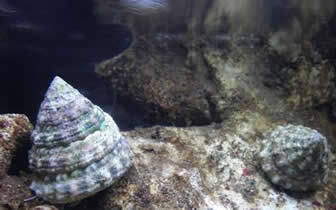
Astraea tecta Astraea Turbo Snail
| Qté (Stock) | Taille | Sexe | Prix unitaire (Taxes incluses) |
|---|---|---|---|
| 1" | - | 6$ |
IMPORTANT
La possession de poissons en aquarium requiert une approche éthique et responsable pour respecter les animaux. L'acquisition de poissons pour maintenance en aquarium ne doit pas se faire sur un coup de tête (achat impulsif). Il est essentiel de s'informer sur les besoins spécifiques des espèces (qualité eau, dimensions aquarium, comportement, alimentat). Seuls les poissons ayant des exigences similaires en matière de qualité d'eau devraient être maintenus ensemble dans un même aquarium.
Un peu plus d'informations...
Astraea tecta, also known as the Astraea Turbo Snail, is a marine snail valued in reef aquariums for its grazing activity. This species moves across rocks and glass while searching for microalgae and biofilm, helping keep the aquarium cleaner. Its sturdy, conical shell, often marked with small spines, gives it a distinctive appearance. It is suited to mature marine aquariums, but it requires stable water, careful acclimation, and a regular supply of natural food. This peaceful gastropod is commonly offered to marine aquarists and is best maintained with compatible fish and invertebrates that will not prey on it.
General species description
Astraea tecta is a marine gastropod belonging to the Turbinidae family. It is a benthic animal that slowly travels over rocks, hard substrate, and aquarium glass. Activity is often more noticeable after the lights have dimmed, although it may graze during the day. In a mature reef aquarium, it functions as an algae grazer rather than as a universal cleaner. The species is generally peaceful and can be kept with compatible invertebrates and non-predatory fish. It is considered very common in the marine aquarium trade.
Geographic origin and biotope
Astraea tecta is native to the tropical western Atlantic, including the Caribbean Sea, the Bahamas, southern Florida, and the Gulf of Mexico. It inhabits rocky coastal areas, reef flats, and locations associated with coral reefs. These habitats provide hard surfaces covered with algae, diatoms, and biofilm, which are important food resources. In captivity, similar conditions are created in a mature reef aquarium with suitable lighting and live rock or biologically colonized rock.
Precise location and local name
This species is associated with shallow marine habitats in the Caribbean Sea, the Bahamas, southern Florida, and the Gulf of Mexico. No single local name is used throughout its entire range. In the aquarium trade, it is mainly sold as the Astraea Turbo Snail, Caribbean Turbo Snail, or star snail. Vernacular names may vary between countries, suppliers, and aquarium communities.
Appearance and physical characteristics
The shell of Astraea tecta is thick and conical, with several whorls and a relatively broad base. Coloration is generally grayish brown to beige, sometimes with darker shades or irregular markings. Nodules and spines may decorate the spire, giving the animal its characteristic star-like outline. Its muscular foot allows it to hold firmly to hard surfaces. The shell may reach approximately 5 cm in diameter, depending on age and growing conditions. As in many marine snails, the shell provides important protection from predators.
General diet
Astraea tecta is mainly herbivorous and consumes film algae, diatoms, and biofilm growing on rocks and glass. It may also graze on thin encrusting algae, but its effectiveness depends on the amount of naturally available food. In a new or overly clean aquarium, it may not find enough to eat. Supplemental algae wafers or marine algae sheets can be offered when needed, with uneaten portions removed. Additional feeding is especially useful in aquariums with limited natural algae growth.
Essential data
- Native river: Not applicable; marine species.
- Local name used: Astraea Turbo Snail, Caribbean Turbo Snail, star snail.
- Origin of the scientific name: Genus name and Latin specific epithet.
- Full-name etymology: Astraea refers to Astraia, a figure from Greek mythology; tecta means covered or protected in Latin.
- Common/vernacular names: Astraea Turbo Snail, Caribbean Turbo Snail, star snail.
- Family: Turbinidae
- Subfamily: Turbininae
- Name pronunciation: ass-tray-ah tek-tah
- Discovery: James Lightfoot, 1786.
- Maximum adult size: Approximately 5 cm shell diameter.
- Water temperature and pH: 24 to 28 °C; pH 8.1 to 8.4.
- Watercourse appearance and surrounding vegetation: Not applicable; rocky coastlines, reef flats, and surfaces covered with marine algae.
- Typical tankmates: Peaceful reef fish, shrimp, non-predatory crabs, corals, and other compatible invertebrates.
- Temperament and behavior: Peaceful, slow-moving, and primarily active while searching for biofilm and algae.
- Water depth: Shallow coastal areas and reef habitats.
- Sexual dimorphism: No reliable external features are generally used in aquarium keeping.
- Bottom structure and flow: Rocks, hard substrate, and reef surfaces; moderate to strong marine water movement.
In your aquarium
To keep Astraea tecta successfully, provide a mature marine aquarium with colonized rockwork and stable water chemistry. Acclimation should be gradual, and the snail should not be left upside down if it cannot right itself. Pay close attention to algae availability and avoid fish or invertebrates that may overturn, attack, or eat it. Appropriate calcium and alkalinity levels help maintain shell condition. With enough food and a peaceful environment, this small grazer remains a useful and interesting member of the home reef aquarium.
{}