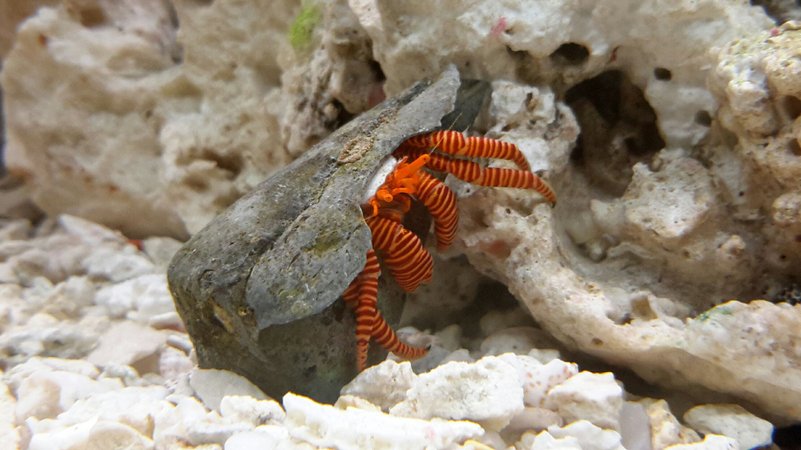
Ciliopagurus strigatus Halloween Hermit Crab
| Qté (Stock) | Taille | Sexe | Prix unitaire (Taxes incluses) |
|---|---|---|---|
| 1 ¾" | - | 25$ |
IMPORTANT
La possession de poissons en aquarium requiert une approche éthique et responsable pour respecter les animaux. L'acquisition de poissons pour maintenance en aquarium ne doit pas se faire sur un coup de tête (achat impulsif). Il est essentiel de s'informer sur les besoins spécifiques des espèces (qualité eau, dimensions aquarium, comportement, alimentat). Seuls les poissons ayant des exigences similaires en matière de qualité d'eau devraient être maintenus ensemble dans un même aquarium.
Un peu plus d'informations...
The Halloween Hermit Crab is a striking marine crustacean from tropical regions of the Indo-Pacific. Its body displays alternating orange, red, white, and dark brown bands that give it an immediately recognizable appearance. Ciliopagurus strigatus lives inside an empty gastropod shell, changing shells as it grows, and acts as a useful scavenger and detritivore in a reef aquarium. This species remains relatively accessible, but it requires stable saltwater, spare shells, and a layout with suitable shelters. It is best suited to a mature reef aquarium with good circulation and no aggressive predators.
General species description
Ciliopagurus strigatus is a small marine hermit crab in the family Diogenidae, with a soft abdomen housed inside an abandoned shell. Like other hermit crabs, it protects this vulnerable body section by gradually selecting larger shells. Its activity is mainly crepuscular and nocturnal, although it may move during the day when searching for food or a better shell. It travels across substrate, rockwork, and coral rubble, using its claws to handle food and challenge rivals. Its behavior is generally peaceful toward fish and corals, but it may compete with other hermit crabs for shells and hiding places. In the aquarium trade, it is less common than small cleaning hermits, although it is regularly offered by specialized marine suppliers.
Geographic origin and biotope
Reference countries: Australia, Japan, Indonesia, the Philippines, Papua New Guinea, New Caledonia, French Polynesia, and several Indian Ocean archipelagos. Ciliopagurus strigatus inhabits tropical coral reefs, lagoons, reef flats, and outer slopes where empty shells, coral fragments, and calcareous rubble accumulate. The habitat is marine, well oxygenated, and regularly exposed to water movement. It frequents rocky areas with crevices, as well as sandy or gravelly sections where it can search through organic material. Light may be intense on reef flats, while individuals also find shaded shelter beneath rocks and corals. In aquaria, the goal is therefore a stable reef layout rather than a simple tank containing sand alone.
Precise location and local name
The species is widely distributed across the tropical Indo-Pacific, particularly around reef islands and coastal areas of the Indian Ocean and the western and central Pacific. It is not associated with a freshwater river, but with coastal marine habitats where gastropod shells are available. The most widely used trade name is Halloween Hermit Crab; the English name Striped Hermit Crab is also used. The French aquarium name “bernard-l’ermite d’Halloween” refers to its contrasting bands. Trade names may vary between countries and suppliers, but the scientific name Ciliopagurus strigatus helps prevent confusion with other orange-and-black hermit crabs.
Appearance and physical characteristics
The most remarkable feature of Ciliopagurus strigatus is its pattern of orange, red, white, and dark brown bands, visible on the legs and claws. Its eyes are carried on stalks, while its long antennae help it explore the surroundings. The right claw is usually larger than the left, a common arrangement among hermit crabs in the family Diogenidae. Its abdomen lacks a complete rigid shell and remains hidden inside a gastropod shell. Apparent size therefore depends on both the individual and the shell it occupies; the crab may look larger when carrying a bulky shell. Its jointed appendages allow it to climb rocks, right itself, and defend the shell opening. It should never be handled by the legs or claws.
General diet
Ciliopagurus strigatus is an opportunistic omnivore and active detritivore. In a mature aquarium, it grazes on algal films and organic debris on the rocks while also consuming accessible food leftovers. Its diet can be supplemented with small portions of mussel, shrimp, marine fish, krill, pellets, or frozen foods intended for marine invertebrates. A varied diet helps reduce competition and maintain condition, especially in very clean aquariums where natural food is limited. Feed small portions and remove excess food to protect water quality. Because it can consume animal matter, it contributes to cleaning the layout, but it does not replace water changes or routine aquarium maintenance.
Essential data
- Native river name: none; marine reef species
- Local name used: Halloween Hermit Crab; Striped Hermit Crab
- Origin of the scientific name: zoological name formed from the genus Ciliopagurus and the specific epithet strigatus
- Meaning of the full name: Ciliopagurus combines cili-, referring to cilia, and pagurus, hermit crab; strigatus means striped or marked with bands
- Common/vernacular names: Halloween Hermit Crab; Striped Hermit Crab
- Family: Diogenidae
- Subfamily: Diogeninae
- Name pronunciation: sil-ee-oh-PAG-you-rus strig-AH-tus
- Discovery: Johann Friedrich Wilhelm Herbst, 1804
- Maximum adult size: about 5 cm for the animal, depending on the occupied shell
- Water temperature and pH: 24 to 28 °C; marine pH of 8.1 to 8.4
- Appearance of the watercourse and surrounding vegetation: reefs, lagoons, and marine reef flats; algae, seagrass, and coastal vegetation depending on the site
- Typical tankmates: Astraea tecta, Trochus histrio, Nassarius vibex, Lysmata amboinensis, Mespilia globulus, and Salarias fasciatus
- Temperament and behavior: generally peaceful, mainly active at night; possible competition for shells
- Water depth: shallow reef to subtidal areas
- Sexual dimorphism: difficult to distinguish externally; differences are mainly associated with reproductive structures
- Bottom structure and flow: rock, sand, gravel, and coral rubble; moderate to strong marine circulation
In your aquarium
To succeed with Ciliopagurus strigatus, provide a mature reef aquarium, stable saltwater, and a layout made of live rock or porous reef rock. Offer several empty shells in different sizes and shapes, since available housing reduces conflict. Regular supplemental feeding, good circulation, and the absence of predatory fish are essential. Also monitor interactions with other hermit crabs and snails; a hungry individual may become more opportunistic. With these precautions, this colorful crustacean makes an effective cleanup assistant and a highly attractive addition to a well-established marine aquarium.
{1167}