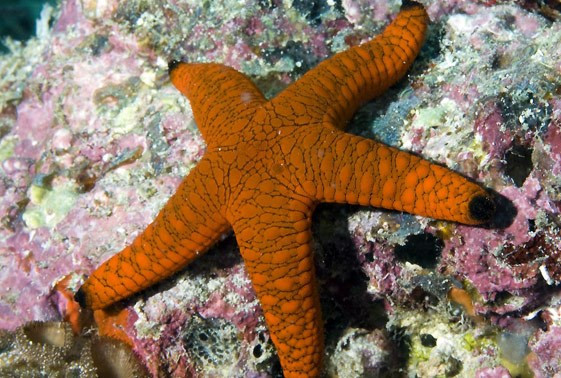
Fromia indica Black Tip Fromia Starfish
Wild caught origin
| Qty (Stock) | Size | Sex | Unit price (Tax included) |
|---|---|---|---|
| Currently Out of Stock! Contact us for more information | |||
IMPORTANT
Keeping fish in an aquarium requires an ethical and responsible approach that prioritizes animal welfare. Purchasing fish for an aquarium should never be an impulsive decision. It is essential to understand the specific needs of each species, including water quality, aquarium size, behavior, and diet. Only fish with similar water quality requirements should be kept together in the same aquarium.
A Little More Information...
Fromia indica
The Fromia indica, also called the Black Tip Fromia Starfish, is a tropical sea star from the family Goniasteridae. It is recognized by its generally pentagonal body, short arms, and dark or blackish arm tips, which contrast with a red, orange, or reddish-brown coloration. This species lives on Indo-Pacific reefs, moving slowly across rocks and surfaces covered with biofilm. Collected from the wild for the aquarium trade, it requires a mature, stable marine aquarium with well-established natural resources. Its availability is moderate, making it less common than some of the more frequently offered sea stars.
General species description
Fromia indica is a benthic sea star associated with tropical reef environments. Its flattened body has a central disc from which five relatively short and sturdy arms usually extend. It moves with numerous tube feet, small tubular structures located beneath the arms. Like many reef sea stars, it is sensitive to rapid changes in salinity, temperature, and water quality. In an aquarium, it should be introduced only into a fully mature system that produces natural biofilm and microorganisms. Drip acclimation is recommended because echinoderms tolerate sudden osmotic changes poorly.
Geographical origin and biotope
Fromia indica comes from the tropical Indo-Pacific, including areas associated with the Indian Ocean and the tropical regions of the western Pacific. It inhabits coral reefs, reef flats, outer slopes, and rocky substrates covered with algae, sponges, and biofilm. In nature, it remains on hard surfaces where it can move and find food. Countries and territories associated with its range include the coasts of India, Sri Lanka, Indonesia, the Philippines, and tropical Australia. A reef aquarium with live rock, shaded areas, and well-colonized surfaces suits its needs better than a sterile setup.
Precise location and local name
This sea star has been reported from several reef regions of the Indian Ocean and western Pacific, although its distribution may vary among references and observed populations. In the aquarium trade, it is most often sold under the English name Black Tip Fromia Starfish, while Fromia indica remains its scientific name. It is not a freshwater species and therefore has no river of origin. Specimens offered in the trade are generally collected from the wild; their condition on arrival can vary according to transport time and acclimation quality.
Appearance and physical characteristics
The body of Fromia indica is often orange-red, brick red, or reddish brown, with a slightly granular surface. Its five arms are broad at the base and end in darker tips, sometimes nearly black, which explains its common name. The underside bears the tube feet used for movement and handling food particles. Size depends on age and growth conditions; an adult diameter of approximately 10 to 12 cm is generally expected. Color may become less intense in a weakened animal or one kept in an aquarium with insufficient natural resources.
General diet
Fromia indica grazes and collects resources found on reef surfaces. Its diet includes biofilm, microorganisms, deposited organic material, and possibly small organisms associated with live rock. It is not a specialized predator of fish or corals, but it may explore surfaces occupied by sponges and other sessile organisms. In a new or overly clean aquarium, natural food can quickly become scarce. Mature live rock should therefore be maintained and, when needed, small amounts of fine marine food can be placed near the animal without compromising water quality.
Essential data
- Name of river of origin: Not applicable; this is a marine reef species.
- Local name used: Black Tip Fromia Starfish.
- Origin of the scientific name: Fromia is the genus name; indica refers to India or the Indian region.
- Etymology of the full name: Fromia, genus name; indica, meaning “from India” or associated with India.
- Common/vernacular names: Black Tip Fromia Starfish; black-tip Fromia sea star.
- Family: Goniasteridae.
- Name pronunciation: froh-mee-ah in-di-ka.
- Discovery: Édouard Perrier, 1869.
- Maximum adult size: Approximately 12 cm in diameter.
- Water temperature and pH: 24 to 28 °C; pH 8.1 to 8.4.
- Watercourse appearance and surrounding vegetation: Rocky and coral marine reefs with algae, sponges, and biofilm.
- Typical tankmates: Amphiprion ocellaris, Acanthurus guttatus, Labroides dimidiatus, small gobies, and reef scavengers.
- Temperament and behavior: Peaceful, slow-moving, and mainly nocturnal; travels across rocks while searching for food.
- Water depth: Approximately 1 to 30 m in reef habitats.
- Sexual dimorphism: No reliable external feature allows the sexes to be distinguished.
- Bottom configuration and flow: Hard substrate, rocks, and corals; moderate to strong circulation without a harsh direct jet.
In your aquarium
To maintain Fromia indica successfully, use a mature marine aquarium with stable salinity, good oxygenation, and minimal parameter fluctuations. Avoid rapid acclimation, handling the animal in air, and recently established systems. A reasonable population of scavengers, live rock, and varied water movement supports natural feeding. Salinity stability and access to biofilm are more important than heavy feeding. Because the species is collected from the wild and remains moderately available, select an intact, active specimen with strong coloration.
{1172,1228,1189}