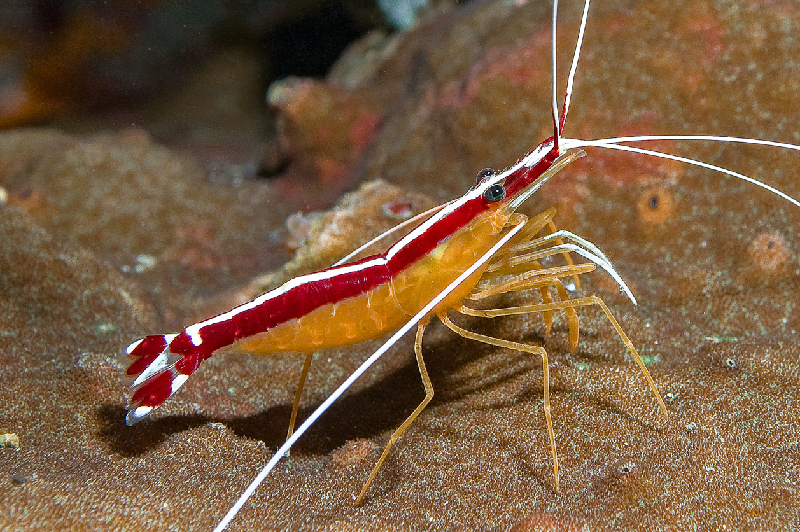
Lysmata amboinensis Skunk Cleaner Shrimp
Wild caught origin
| Qty (Stock) | Size | Sex | Unit price (Tax included) |
|---|---|---|---|
| Currently Out of Stock! Contact us for more information | |||
IMPORTANT
Keeping fish in an aquarium requires an ethical and responsible approach that prioritizes animal welfare. Purchasing fish for an aquarium should never be an impulsive decision. It is essential to understand the specific needs of each species, including water quality, aquarium size, behavior, and diet. Only fish with similar water quality requirements should be kept together in the same aquarium.
A Little More Information...
Lysmata amboinensis, also known as Skunk Cleaner Shrimp, is an iconic marine shrimp in reef aquariums. Its translucent body, crossed by a wide white dorsal stripe edged in red, makes it easy to recognize. It is best known for its cleaning behavior: it establishes stations where fish visit to have parasites, excess mucus, and debris removed. Peaceful, active, and relatively common in the aquarium trade, it is suited to mature marine aquariums with hiding places, stable water, and a varied diet. This species is presented here as collected from the wild.
General species description
Lysmata amboinensis is a small cleaner shrimp belonging to the Lysmatidae family. It lives on reefs and rocky substrates, attracting fish with the movement of its long white antennae. At a cleaning station, it may climb onto a fish and remove superficial organisms or particles from the skin and around the mouth. This service does not replace proper quarantine for new fish, but it is a fascinating natural behavior. The species is peaceful with fish and corals, although very small crustaceans may sometimes be vulnerable. Its popularity and availability make it a fairly common species in reef aquariums.
Geographic origin and biotope
This shrimp comes from the tropical Indo-Pacific, including the Red Sea, the Indian Ocean, and island regions of the western and central Pacific. It inhabits coral reefs, reef slopes, rocky crevices, and areas where fish gather. Its natural habitat provides clear, well-oxygenated seawater with constant movement. In an aquarium, regular circulation should therefore be provided without creating current strong enough to interfere with feeding. Natural reefs generally contain complex relief formed by live rock and cavities, with little higher vegetation; algae and attached organisms mainly cover illuminated surfaces.
Precise location and local name
It occurs in several parts of the Indo-Pacific, from the eastern African coasts and Red Sea to the Pacific archipelagos. Its specific epithet refers to Ambon, Indonesia, a region associated with its scientific description. No single local name is used throughout its range; in the trade and among aquarists, it is mainly known as Skunk Cleaner Shrimp, White-Banded Cleaner Shrimp, or reef cleaner shrimp. It may live alone or as a pair, although compatibility depends on available space and the behavior of other animals.
Appearance and physical characteristics
Lysmata amboinensis has a slender, translucent body with a broad longitudinal white line along the back, separating two red areas. Its antennae are very long and mobile, mostly white, while the legs and several appendages show red-and-white contrasts. Adults generally reach about 5 to 6 cm in total length. Like other shrimp, it has an exoskeleton that must be shed during moulting. After moulting, it quickly seeks shelter to avoid predators. Its strongly contrasting appearance and antenna movements help signal its presence to visiting fish.
General diet
In nature, Lysmata amboinensis consumes ectoparasites, mucus, and superficial tissues or debris collected while cleaning, as well as small organisms and food particles. In an aquarium, supplemental feeding is necessary because host fish may not always provide enough nutrition. Offer small portions of marine meaty foods, such as mysis, brine shrimp, finely chopped frozen foods, or preparations made for invertebrates. Regular feeding is preferable, with food placed near its hiding area. A varied diet and adequate trace elements support normal moulting, while copper and fish medications can be highly toxic.
Essential data
- River of origin: None: marine species.
- Local name used: Cleaner shrimp, White-Banded Cleaner Shrimp.
- Origin of the scientific name: Lysmata is the genus name; amboinensis refers to Ambon, Indonesia.
- Etymology of the full name: Lysmata: a genus name of Greek origin; amboinensis: “from Ambon.”
- Common/vernacular names: Skunk Cleaner Shrimp, reef cleaner shrimp, White-Banded Cleaner Shrimp.
- Family: Lysmatidae
- Subfamily: Lysmatinae
- Name pronunciation: liz-MAT-ah am-boy-NEN-sis
- Discovery: Johannes Govertus de Man, 1888.
- Maximum adult size: About 6 cm.
- Water temperature and pH: 24 to 28 °C; pH 8.1 to 8.4.
- Watercourse appearance and surrounding vegetation: Rocky and coral marine reefs with clear, well-circulated water; little higher vegetation, with algae and attached organisms.
- Typical tankmates: Amphiprion ocellaris, Acanthurus japonicus, Labroides dimidiatus.
- Temperament and behavior: Peaceful; establishes cleaning stations and may live alone or as a pair.
- Water depth: Mainly in shallow to moderately deep reef areas.
- Sexual dimorphism: Simultaneous hermaphroditism; individuals can function as male or female depending on the partner.
- Bottom structure and flow: Rock, coral, crevices, and cavities; regular, well-oxygenated marine circulation.
In your aquarium
To successfully keep Lysmata amboinensis, provide a mature marine aquarium with rocky hiding places, stable salinity, and efficient filtration. Avoid copper-based medications completely and make sure predatory fish cannot consume it. Slow acclimation, regular meaty foods, and moderate circulation support adaptation. The shrimp may clean some fish, but it never replaces proper quarantine or parameter control. Since it is generally available, choose an active, intact, well-fed specimen and observe its behavior during the first few weeks.
{1172,1229,1189}