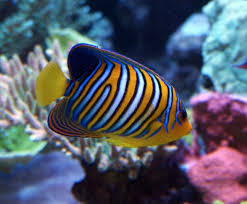
Pygoplites diacanthus Orange Belly Regal Angelfish
Wild caught origin
| Qty (Stock) | Size | Sex | Unit price (Tax included) |
|---|---|---|---|
| Currently Out of Stock! Contact us for more information | |||
IMPORTANT
Keeping fish in an aquarium requires an ethical and responsible approach that prioritizes animal welfare. Purchasing fish for an aquarium should never be an impulsive decision. It is essential to understand the specific needs of each species, including water quality, aquarium size, behavior, and diet. Only fish with similar water quality requirements should be kept together in the same aquarium.
A Little More Information...
Pygoplites diacanthus, also known as Orange Belly Regal Angelfish, is a striking marine angelfish from the family Pomacanthidae. Recognized by its blue, white, yellow and orange bands, it inhabits coral reefs throughout the Indo-Pacific. This wild-collected species is commonly seen in lagoons and reef slopes, where it feeds on small prey and organisms living on the substrate. Very common across its natural range, it is nevertheless demanding in captivity: a mature aquarium, spacious surroundings and abundant cover help support acclimation and regular feeding.
General description
Pygoplites diacanthus is a reef-associated marine angelfish from the Indo-Pacific. Its laterally compressed body and continuous dorsal fin allow precise movement between rocks and coral colonies. The species is very common in the wild, although it requires more care than several hardier angelfish. Individuals generally live alone or as a pair and defend a feeding area. In an aquarium, they may become territorial toward fish with a similar shape or coloration. Abundant live rock and a complex aquascape are especially useful because they provide grazing surfaces, shelter and visual barriers. The species is active throughout the day and benefits from a stable, well-oxygenated marine environment.
Geographic origin and habitat
The species has a broad distribution throughout the Indo-Pacific, from the Red Sea and eastern Africa to French Polynesia, including the Maldives, Philippines, Indonesia, Papua New Guinea, the Great Barrier Reef and southern Japan. It inhabits coral reefs, lagoons and reef drop-offs, usually in clear, well-oxygenated water. It occurs from shallow areas to several dozen metres in depth. Its natural habitat includes rock, coral colonies and crevices, with water movement ranging from gentle to strong depending on exposure to currents. This is a wild-collected species, as indicated by the wild designation. The surrounding environment is marine and does not include riverbank vegetation.
Precise location and local name
Pygoplites diacanthus is not a river species; its natural range covers tropical marine habitats in the Indian and Pacific oceans. Recognized regions include the Red Sea, Indonesia, the Philippines, northern Australia, Micronesia and Polynesia. In the English-speaking aquarium trade, the names Regal Angelfish, Royal Angelfish and Orange Belly Regal Angelfish are used. Local names may differ between island groups. In general aquarium literature, Regal Angelfish is the most widely used English name. The species is associated with reef faces, lagoons and sheltered coral areas where it can retreat quickly into crevices.
Appearance and physical characteristics
The body of Pygoplites diacanthus displays a spectacular pattern of vertical electric-blue, white, yellow and orange bands. The head is marked with fine blue lines, while the throat and belly often show yellow to orange tones, which inspired the trade name Orange Belly. The dorsal and anal fins are extended, creating a tall and elegant profile. A strong spine is present on the gill cover, as in other angelfish. Maximum adult size is approximately 25 cm. Juveniles have a different, highly contrasting pattern that gradually changes as they grow into the adult coloration. Color intensity is influenced by health, diet, social conditions and aquarium quality.
General diet
In the wild, Pygoplites diacanthus searches reef surfaces for small invertebrates, sponges, tunicates and other organisms attached to or living on the substrate. In captivity, provide a varied diet containing marine preparations, frozen foods based on crustaceans, chopped mollusks and foods enriched with vegetable matter. Sheets of marine algae can supplement the diet but should not replace animal-based foods. Newly imported individuals may be reluctant to feed; offering small portions several times a day and maintaining an aquarium rich in live rock can encourage grazing. Consistent feeding is essential for successful dietary acclimation and long-term condition.
Essential data
- Name of the original river: Marine species; no river of origin.
- Local name used: Regal Angelfish, Royal Angelfish, Orange Belly Regal Angelfish.
- Origin of the scientific name: Genus Pygoplites and specific epithet diacanthus.
- Full-name etymology: Pygoplites comes from the Greek pygē, meaning “rump” or “rear part,” and hoplites, meaning “armed fighter”; diacanthus means “two-spined.”
- Common/vernacular names: Regal Angelfish, Royal Angelfish, Orange Belly Regal Angelfish.
- Family: Pomacanthidae.
- Subfamily: Pomacanthinae.
- Name pronunciation: pie-go-PLIE-teez - die-a-KAN-thus
- Discovery: Marcus Elieser Bloch, 1787.
- Maximum adult size: About 25 cm.
- Water temperature and pH: 24 to 28 °C; marine pH of 8.1 to 8.4.
- Appearance of the watercourse and surrounding vegetation: Rocky and coral reefs, with no riparian vegetation; algae and attached organisms grow on the substrate.
- Typical tankmates: Acanthurus guttatus, Acanthurus japonicus, Acanthurus leucosternon, Acanthurus triostegus, Centropyge flavissima, Labroides dimidiatus.
- Temperament and behaviour: Active and territorial toward similar angelfish; usually solitary or found as a pair.
- Water depth: Approximately 1 to 45 m.
- Sexual dimorphism: Limited and difficult to distinguish visually.
- Bottom structure and flow: Rocks, corals, crevices and variable current, often with strong oxygenation.
In your aquarium
Success with Pygoplites diacanthus depends on a mature, spacious marine aquarium with abundant hiding places and lighting suited to a reef aquascape. Because this is a wild-collected fish, gradual acclimation and close observation of feeding are recommended. Offer several small meals each day, maintain stable water chemistry and provide live rock for grazing. Compatibility should be assessed carefully, especially when other angelfish are present. A calm, clean aquarium with plenty of structure greatly improves the chances of keeping this colorful and active species in good condition over the long term.
{1228,1229,1230,1192,1231,1189}