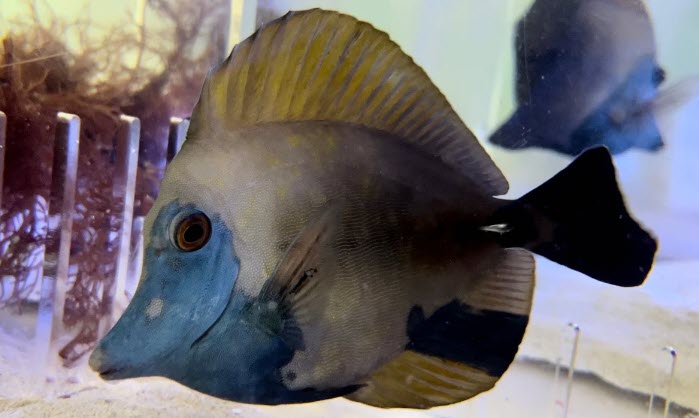
Zebrasoma scopas var. Koi Tang (Blue Face Scopas)
New Wild caught origin
| Qty (Stock) | Size | Sex | Unit price (Tax included) |
|---|---|---|---|
| Currently Out of Stock! Contact us for more information | |||
IMPORTANT
Keeping fish in an aquarium requires an ethical and responsible approach that prioritizes animal welfare. Purchasing fish for an aquarium should never be an impulsive decision. It is essential to understand the specific needs of each species, including water quality, aquarium size, behavior, and diet. Only fish with similar water quality requirements should be kept together in the same aquarium.
A Little More Information...
Zebrasoma scopas var. is a sought-after variety of the surgeonfish Zebrasoma scopas, sold in the aquarium trade as Koi Tang and Blue Face Scopas. Its contrasting coloration, usually combining a golden-brown body with bluish facial tones and yellow accents, immediately attracts attention in a marine aquarium. Like other surgeonfish, it has a sharp caudal spine and plays an important role in grazing algae. This variety remains very rare in the market. The specimen presented here is wild collected and requires careful acclimation, excellent water quality, and a mature marine aquarium. A stable environment and frequent vegetable-based feeding are essential for long-term success.
General species description
Zebrasoma scopas var. belongs to the surgeonfish genus Zebrasoma. It is active, hardy once acclimated, and constantly occupied with grazing surfaces covered with algae. It is best suited to a large marine aquarium with strong oxygenation and live rock providing shelter and grazing areas. Despite its elegant appearance, it may defend a territory against other surgeonfish with a similar body shape. The Koi Tang is especially valued for its unusual coloration, but its trade name does not replace the scientific identification Zebrasoma scopas. A stable environment, frequent vegetable feeding, and gradual acclimation are important for reducing stress and maintaining good condition.
Geographic origin and habitat
The species occurs throughout the tropical Indo-Pacific, including reef areas of the Indian Ocean and western Pacific, reaching island regions of French Polynesia. Countries and territories associated with its natural range include Australia, Indonesia, Japan, New Caledonia, the Philippines, Fiji, Tonga, Vanuatu, and French Polynesia. It inhabits shallow coral reefs, reef slopes, and areas rich in algae, where water movement provides strong oxygenation. Its natural environment includes corals, rocky blocks, and illuminated hard surfaces exposed to regular water movement. In an aquarium, this combination of shelter, open swimming space, and grazing surfaces is more important than decoration alone.
Precise location and local name
Zebrasoma scopas is widely distributed across Indo-Pacific reefs, including western Pacific archipelagos and tropical coasts of the Indian Ocean. Local names vary according to region and language. In the aquarium trade, the most common names are Koi Tang, Blue Face Scopas, and Scopas Tang. The French term for surgeonfish refers to the caudal blade used during territorial interactions and defence. This variety is offered only occasionally and is considered a very rare marine fish in the trade. Because it is wild collected, quarantine and close observation of feeding behaviour are strongly recommended before adding it to a community aquarium.
Appearance and physical characteristics
Zebrasoma scopas var. has a laterally compressed, deep body and an elongated snout typical of Zebrasoma. The basic coloration is generally olive-brown to golden-brown, often enhanced by yellow tones and darker markings. The Koi Tang variety is distinguished by a bluish face and contrasting colours reminiscent of koi carp patterns. The dorsal and anal fins are well developed, giving the fish a disc-like profile. An erectile spine on each side of the caudal peduncle is its principal defensive structure. Adult size may reach approximately 20 cm. Colour intensity can change with mood, lighting, nutritional condition, and stress level.
General diet
In nature, Zebrasoma scopas var. mainly grazes algae and the plant film growing on rocks. In an aquarium, its diet should remain primarily vegetable-based: nori sheets, dried seaweed, marine preparations containing spirulina, and enriched frozen foods can be offered in rotation. Regular feeding helps maintain body condition and reduce nutritional deficiencies. Small portions offered several times daily are preferable to one large meal. Meaty foods may supplement the diet, but should not become its foundation. A mature aquarium with live rock also provides natural grazing opportunities. A proper diet supports stress resistance and helps prevent weight loss after transport.
Essential data
- River of origin: None — marine species
- Local name used: Koi Tang; Blue Face Scopas
- Origin of the scientific name: The genus Zebrasoma was established for fishes with a zebra-like body pattern; the species was described as scopas
- Meaning of the full name: Zebrasoma means zebra body; scopas means broom or brush, referring to the fish’s overall appearance and markings
- Common/vernacular names: Koi Tang, Blue Face Scopas, Scopas Tang, Scopas surgeonfish
- Family: Acanthuridae
- Subfamily: Acanthurinae
- Name pronunciation: zee-brah-SOH-mah SKOH-pahs
- Discovery: Georges Cuvier, 1829
- Maximum adult size: About 20 cm
- Water temperature and pH: 24 to 28 °C; pH 8.1 to 8.4
- Water body appearance and surrounding vegetation: Clear rocky and coral marine reefs with benthic algae and steady water movement
- Typical tankmates: Amphiprion ocellaris, Labroides dimidiatus, Salarias fasciatus, Chromis xanthura
- Temperament and behaviour: Active, territorial, and generally peaceful with dissimilar species; may be aggressive toward other surgeonfish
- Water depth: Shallow to intermediate reef areas, generally from 1 to 30 m
- Sexual dimorphism: Females are often larger; external differences are difficult to identify reliably
- Bottom structure and flow: Rocks, corals, and hard surfaces colonized by algae; moderate to strong water movement
In your aquarium
To maintain Zebrasoma scopas var. successfully, provide a mature, spacious, well-filtered aquarium with plenty of live rock and efficient water movement. Offer seaweed daily, monitor body weight, and avoid keeping several territorial surgeonfish in a limited volume. Because this specimen is wild collected and very rare, quarantine, slow acclimation, and close observation of feeding are strongly recommended. Stable salinity, temperature, and pH should remain the top priorities.
{1172,1189,1167,1199,1234}