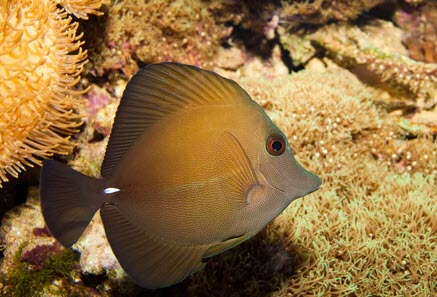
Zebrasoma scopas Scopas Tang
Origine sauvage
| Qté (Stock) | Taille | Sexe | Prix unitaire (Taxes incluses) |
|---|---|---|---|
| Aucun en stock en ce moment! Communiquez avec nous | |||
IMPORTANT
La possession de poissons en aquarium requiert une approche éthique et responsable pour respecter les animaux. L'acquisition de poissons pour maintenance en aquarium ne doit pas se faire sur un coup de tête (achat impulsif). Il est essentiel de s'informer sur les besoins spécifiques des espèces (qualité eau, dimensions aquarium, comportement, alimentat). Seuls les poissons ayant des exigences similaires en matière de qualité d'eau devraient être maintenus ensemble dans un même aquarium.
Un peu plus d'informations...
The Zebrasoma scopas, also known as the Scopas Tang, is an Indo-Pacific marine surgeonfish valued for its graceful shape and its role as a reef herbivore. Its grayish-brown, finely striped body gives it a subdued but highly distinctive appearance. This species remains fairly common in the aquarium trade, and available specimens are often collected from the wild. Active, territorial, and constantly searching for algae, it is best suited to spacious reef aquariums where water quality, oxygenation, and a regular vegetable-based diet are maintained carefully.
General species description
Zebrasoma scopas is a marine fish in the family Acanthuridae, commonly known as the surgeonfish family. It inhabits coral and rocky reefs in the Indo-Pacific, where it grazes algae growing on rocks and other hard surfaces. Like other surgeonfish, it has a sharp caudal spine used for defense. Its behavior is energetic, and its grazing activity can help limit algae accumulation in a reef environment. The species is a grazing herbivore, so a dependable daily supply of vegetable food is required in captivity.
Geographic origin and biotope
Reference countries: Madagascar, Tanzania, Kenya, Mozambique, Seychelles, Maldives, Sri Lanka, India, Indonesia, the Philippines, Japan, Australia, New Caledonia, Fiji, and French Polynesia. Zebrasoma scopas occupies coral reefs and rocky reef flats, usually in well-lit areas with steady water movement. It occurs on reef slopes, lagoon margins, and sections where algae grow over rock. The biotope consists of rockwork, corals, crevices, and grazing surfaces, with little directly associated terrestrial vegetation. In an aquarium, this structure should be recreated with stable live rock and plenty of available grazing areas.
Precise location and local name
Its range extends from the tropical Indian Ocean to French Polynesia, across Indonesia, the Philippines, southern Japan, and northern Australia. The species also occurs around numerous islands and archipelagos in the western Pacific. The most widely used trade name is Scopas Tang; Brown Tang and Two-tone Tang are also used in English. In French aquarium literature, Chirurgien scopas and Tang scopas are common names. This fish is not associated with a river of origin because it is a strictly marine species.
Appearance and physical characteristics
The body is oval, laterally compressed, and relatively deep, with an elongated snout suited to grazing. Coloration ranges from yellowish brown to olive gray and is often covered with fine vertical and wavy lines that become more visible at close range. The head is generally darker, while the tail may show yellow tones. The caudal spine is the typical defensive feature of surgeonfish. Adults reach approximately 20 cm, sometimes slightly more depending on the source and conditions. Open swimming space, stable rockwork, and excellent water movement are important for its welfare.
General diet
In the wild, Zebrasoma scopas mainly grazes on filamentous algae and algal film growing over rocks. In an aquarium, its diet should include sheets of nori, marine vegetable preparations, and enriched foods designed for herbivorous fish. Small portions offered regularly support stable digestion and reduce excessive searching behavior. Frozen foods may supplement the diet but should not replace its vegetable foundation. A varied diet helps support coloration, growth, and overall resilience in this active fish.
Essential data
- Original river name: —
- Local name used: Scopas Tang
- Origin of the scientific name: Zebrasoma refers to a zebra-like pattern combined with the body; scopas refers to a broom or brush, likely relating to the striped appearance.
- Etymology of the full name: Zebrasoma approximately means zebra body; scopas means broom or brush.
- Common/vernacular names: Scopas Tang, Brown Tang, Two-tone Tang, Chirurgien scopas, Tang scopas
- Family: Acanthuridae
- Subfamily: Acanthurinae
- Name pronunciation: zee-bruh-SOH-muh SKOH-pahs
- Discovery: Georges Cuvier, 1829
- Maximum adult size: approximately 20 cm
- Water temperature and pH: 24 to 28 °C; pH 8.1 to 8.4
- Stream appearance and surrounding vegetation: rocky and coral marine reefs; algae attached to hard substrates
- Typical tankmates: Acanthurus triostegus, Siganus vulpinus, Salarias fasciatus, Amphiprion ocellaris, Labroides dimidiatus
- Temperament and behavior: active, territorial toward similarly shaped fish, generally peaceful with other species
- Water depth: approximately 1 to 40 m
- Sexual dimorphism: difficult to identify visually; external differences are limited
- Bottom structure and flow: rocks, corals, crevices, and algal surfaces; moderate to strong water movement
For greater success
To keep Zebrasoma scopas successfully, provide a mature and spacious marine aquarium with rockwork offering shelter and grazing areas. A frequent vegetable-based diet, effective filtration, and strong water movement are essential. Introduce it with compatible tankmates and watch for territorial behavior, especially toward other surgeonfish. Because specimens are often collected from the wild, careful acclimation and quarantine are recommended practices. Stable pH, temperature, and salinity will support long-term adjustment and help this active reef fish remain healthy.
{1192,1185,1167,1172,1189}