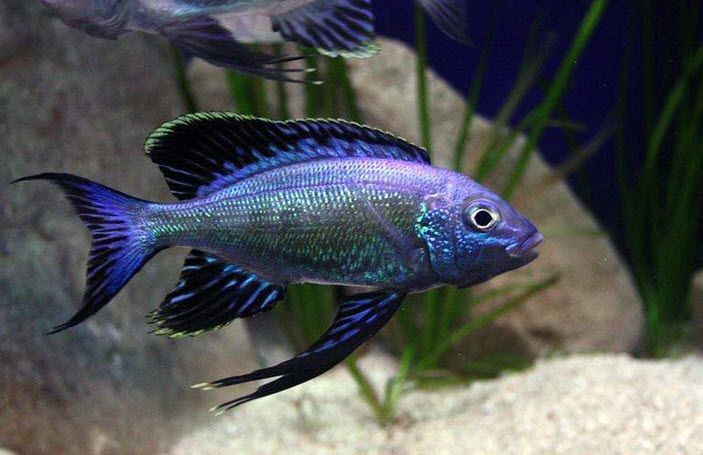
Cyathopharynx furcifer
New
| Qty (Stock) | Size | Sex | Unit price (Tax included) |
|---|---|---|---|
10 en stock | 2 ¾" | - | 89$ |
IMPORTANT
Keeping fish in an aquarium requires an ethical and responsible approach that prioritizes animal welfare. Purchasing fish for an aquarium should never be an impulsive decision. It is essential to understand the specific needs of each species, including water quality, aquarium size, behavior, and diet. Only fish with similar water quality requirements should be kept together in the same aquarium.
A Little More Information...
Cyathopharynx furcifer is a cichlid endemic to Lake Tanganyika in East Africa, valued for its elongated dorsal and anal fins and the elaborate courtship displays of mature males. It mainly inhabits transition areas between sandy bottoms and rocky outcrops, where males establish breeding sites. Its aquarium care requires alkaline, hard and well-oxygenated water, along with a spacious setup. With an intermediate level of rarity in the aquarium trade, this cichlid is best suited to experienced aquarists who want to recreate a typical Tanganyikan environment.
General species description
Cyathopharynx furcifer is a large haplochromine cichlid specialized for open habitats in Lake Tanganyika. It generally lives above sandy or sandy-detrital bottoms, close to rocky areas that provide landmarks and shelter. Mature males become especially impressive during breeding: they occupy and defend a territory, then shape a sandy structure used during courtship. Females are maternal mouthbrooders and protect their clutch inside the mouth. The species is usually peaceful toward similarly sized tank mates, although territoriality increases strongly during spawning. Its availability remains moderate and irregular depending on specialized shipments.
Geographic origin and biotope
Countries of reference: Tanzania, the Democratic Republic of the Congo and Zambia, around Lake Tanganyika. This is a lake species and is not associated with a particular freshwater river. Its biotope consists of open littoral areas where sandy beaches, boulder fields and rocky escarpments meet. The water is clear, mineral-rich and strongly alkaline, with good circulation generated by lake movements. Aquatic vegetation is generally scarce or scattered; the habitat is shaped mainly by rocks, sand and organic matter deposited among the reliefs. In an aquarium, a rocky layout with a broad sandy area is more appropriate than a densely planted tank.
Precise location and local name
Cyathopharynx furcifer occurs in several sectors of Lake Tanganyika, especially along the Tanzanian, Congolese and Zambian shores. Populations may show differences in coloration according to their origin, making it important to keep geographically identified stock and avoid mixing localities. The most widely used trade name is Featherfin cichlid, referring to the males’ filamentous fins. In French-speaking aquarium circles, it is commonly called “cichlidé à nageoires plumeuses.” A single African vernacular name is not consistently used throughout the general aquarium literature.
Appearance and physical characteristics
The body of Cyathopharynx furcifer is elongated, fairly deep and laterally compressed, with a terminal mouth adapted for picking food from surfaces and the bottom. The base coloration ranges from silvery gray to golden brown, while breeding males may develop stronger contrasts on the head, body and fins. Its most distinctive feature is the presence of elongated dorsal and anal fin rays, creating a feather-like appearance. The caudal fin is deeply forked, which inspired the species name. Females are usually smaller and less colorful than males. Maximum adult size approaches 20 cm in males, while females are generally more modest in size.
General diet
In nature, Cyathopharynx furcifer browses and picks at organisms and particles found on the substrate, while also consuming small invertebrates and plant or detrital material. Its diet is therefore mainly omnivorous with a detritivorous tendency, rather than strictly predatory. In an aquarium, provide a varied diet based on quality Tanganyikan cichlid pellets, spirulina, vegetable matter and small frozen foods. Meals should remain moderate to prevent obesity and water-quality problems. An excessive intake of animal protein may upset digestion; regularity and variety matter more than large portions.
Essential data
- River of origin: Lake Tanganyika; a lake-dwelling species
- Local name used: Featherfin cichlid; cichlidé à nageoires plumeuses
- Origin of the scientific name: A name formed from Greek and Latin terms describing the throat and the forked caudal fin
- Full-name etymology: Cyathopharynx combines cyathus, cup, and pharynx, throat; furcifer means fork-bearing or forked, referring to the caudal fin
- Common/vernacular names: Featherfin cichlid, cichlidé à nageoires plumeuses
- Family: Cichlidae
- Subfamily: Pseudocrenilabrinae
- Name pronunciation: sigh-ath-oh-FAR-inks FUR-si-fer
- Discovery: George Albert Boulenger, 1898
- Maximum adult size: About 20 cm
- Water temperature and pH: 24 to 28 °C; pH 8.0 to 9.0
- Appearance of the watercourse and surrounding vegetation: Clear, highly mineralized lake water with sand, rocks and sparse aquatic vegetation
- Typical tank mates: Ophtalmotilapia ventralis Kasanga, Cyprichromis leptosoma Utinta, Oreochromis tanganicae
- Temperament and behavior: Peaceful to moderately territorial; males court and defend sandy breeding sites
- Water depth: Approximately 10 to 30 m
- Sexual dimorphism: Male larger and more colorful, with more developed dorsal and anal fins; female duller
- Bottom structure and flow: Sand, gravel and rocks; open water with regular lake circulation
In your aquarium
For successful care, provide a spacious aquarium, a broad area of fine sand and firmly arranged rocks that do not block swimming space. Stable, hard and alkaline water, efficient filtration and regular water changes are essential. Keep a balanced group and monitor territory formation, especially during breeding. Avoid tank mates that are much smaller or significantly more aggressive. A varied, plant-rich diet helps maintain good condition. With a suitable layout and consistent water quality, Cyathopharynx furcifer becomes an active, elegant and fascinating Tanganyikan cichlid to observe.
{786,1272,734}