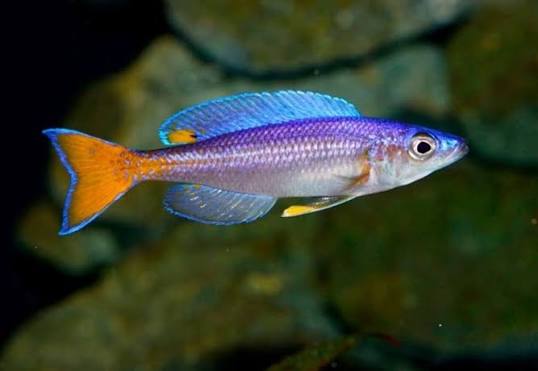
Cyprichromis leptosoma Utinta
| Qty (Stock) | Size | Sex | Unit price (Tax included) |
|---|---|---|---|
| Currently Out of Stock! Contact us for more information | |||
IMPORTANT
Keeping fish in an aquarium requires an ethical and responsible approach that prioritizes animal welfare. Purchasing fish for an aquarium should never be an impulsive decision. It is essential to understand the specific needs of each species, including water quality, aquarium size, behavior, and diet. Only fish with similar water quality requirements should be kept together in the same aquarium.
A Little More Information...
Cyprichromis leptosoma Utinta is a geographic form of cichlid from Lake Tanganyika, valued for its slender body, open-water movements, and contrasting colors. Unlike many Tanganyikan cichlids, it does not spend most of its time on the substrate: it lives in groups in the pelagic zone and captures small planktonic prey. Successful care depends mainly on a spacious aquarium, alkaline mineral-rich water, and a sufficiently large group. Adult males usually develop the brightest colors, while females remain more subdued. Its active schooling behavior makes it especially interesting in a long aquarium with generous open swimming space.
General description
Cyprichromis leptosoma Utinta belongs to the pelagic cichlids of Lake Tanganyika. It forms active schools that move above rocky areas, often away from the bottom. Its social behavior is important: a group that is too small may become nervous and lose some of its natural activity. In an aquarium, it is best kept as a group of several individuals, with more females than males. Males defend small spaces in the water column, particularly during courtship, but the species is generally less territorial than cichlids that occupy rocks or shells directly. Reproduction involves maternal mouthbrooding. The female carries the eggs and young in her mouth, one of the species’ most remarkable biological features. A long aquarium with good circulation makes it possible to observe its constant movements and social organization. Stable water quality and adequate swimming room are more important than a densely packed rockscape.
Geographic origin and biotope
Reference country: Tanzania, on the eastern shore of Lake Tanganyika, in the Utinta area. This population lives in a large tectonic lake with clear, highly alkaline water rich in dissolved minerals. The habitat is dominated by an open water column above rocky areas, rather than by a densely planted soft bottom. Light is generally strong in shallow water, while individuals may also use deeper levels depending on conditions and food availability. For aquarium keeping, a temperature of about 24 to 28 °C, an alkaline pH around 8.0 to 9.0, and high hardness suit the lake environment. Efficient filtration, strong oxygenation, and regular water changes are essential. The decoration may combine stable rocks with broad open areas, while avoiding a tank filled entirely with obstacles.
Precise location and local name
The name “Utinta” refers to a locality of Lake Tanganyika associated with this geographic form. In the aquarium trade, it is generally called Cyprichromis leptosoma Utinta, or simply “Utinta.” This designation helps preserve the geographic origin of the strain and distinguish it from other forms of Cyprichromis leptosoma collected in different parts of the lake. The population is associated with the Tanzanian shore, in the northeastern part of Tanganyika. In aquariums, keeping this name is useful when a group is maintained separately from other geographic populations, helping avoid mixing and supporting reproduction with a clear identity. This is a lake fish, not a species associated with a flowing freshwater river. Its natural environment is instead characterized by a large lake, clear water, and continual movement through the pelagic zone.
Appearance and physical characteristics
The body of Cyprichromis leptosoma Utinta is slim, elongated, and laterally compressed, with a relatively small head and a forward-facing mouth. This shape is adapted to open-water life and the rapid capture of small organisms. The dorsal and anal fins are elongated; in males, they may be highlighted by blue, yellow, or orange tones depending on the individual’s condition and population. Coloration changes with sex, age, social status, and lighting. Adult males are usually the most colorful, while females show more silvery and less contrasting tones. The slender profile and open-water swimming style distinguish it from many rocky cichlids of Lake Tanganyika. The maximum size generally reported is about 12 cm, with males sometimes becoming larger than females. Pale coloration may appear in a stressed or newly introduced fish. Good lighting and a calm social group help males display their natural colors.
General diet
In nature, Cyprichromis leptosoma Utinta mainly feeds on small planktonic organisms captured in the water column. In aquariums, it accepts fine floating foods, quality cichlid preparations, small pellets, and suitable frozen foods. A varied diet based on small protein-rich particles supports growth and overall condition. It is better to offer small portions several times a day than one large meal, since the species naturally feeds on scattered prey. Food should be fine enough to swallow easily, especially for young females or subordinate fish. Baby brine shrimp, finely sized krill, and other planktonic foods can supplement the diet. Overfeeding should be avoided, and uneaten food should be removed because water quality is critical in an aquarium containing active fish. A balanced diet also helps brooding females maintain their condition. Feeding several times daily allows all members of the group to eat without excessive competition.
Essential data
- Native river name: None; a lake species from Lake Tanganyika
- Local name used: Utinta; Cyprichromis leptosoma Utinta
- Origin of the scientific name: Cyprichromis is the genus name; leptosoma is the specific epithet
- Complete name etymology: Cypri refers to carp, chromis means color or fish, and leptosoma means slender-bodied; Utinta refers to the locality of origin
- Common/vernacular names: Cyprichromis leptosoma Utinta; slender-bodied cyprichromis
- Family: Cichlidae
- Subfamily: Pseudocrenilabrinae
- Name pronunciation: sip-rih-KROH-miss lep-toh-SOH-ma oo-TIN-ta
- Discovery: George Albert Boulenger, 1898
- Maximum adult size: About 12 cm
- Water temperature and pH: 24 to 28 °C; pH 8.0 to 9.0
- Waterbody appearance and surrounding vegetation: Large clear alkaline lake, rocky areas, and open water; aquatic vegetation not dominant
- Typical tankmates: Neolamprologus brichardi, Synodontis petricola, Cyphotilapia frontosa
- Temperament and behavior: Gregarious, active, and generally peaceful; males display in the water column
- Water depth: Pelagic zone above rocky areas, from the surface to considerable depths
- Sexual dimorphism: Males are more colorful and often larger; females are more silvery and subdued
- Bottom structure and flow: Rocky or sandy bottom depending on the area; significant water movement and circulation
In your aquarium
To keep Cyprichromis leptosoma Utinta successfully, provide a long, well-oxygenated aquarium with broad open swimming areas. Keep it in a group, with a majority of females, in stable alkaline and mineral-rich water. Strong filtration, regular water changes, and fine foods offered in small portions support good health. Avoid aggressive tankmates and very large fish that could intimidate it. Natural breeding is encouraged by a mature group and a calm environment. Keeping only one geographic population per aquarium also helps preserve the identity of the Utinta form. Stable maintenance is more valuable than elaborate decoration for this active pelagic cichlid.
{337,347,595}