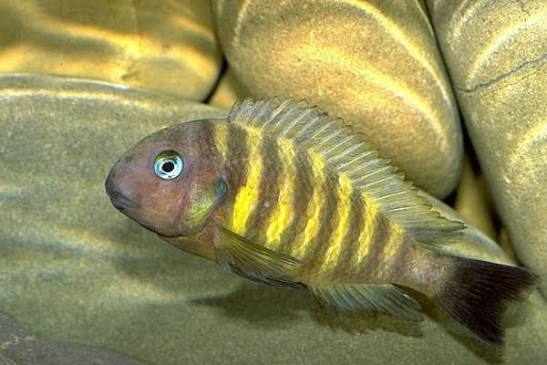
Tropheus brichardi Bumble Bee
| Qty (Stock) | Size | Sex | Unit price (Tax included) |
|---|---|---|---|
| 1 ½" | - | 29$ |
IMPORTANT
Keeping fish in an aquarium requires an ethical and responsible approach that prioritizes animal welfare. Purchasing fish for an aquarium should never be an impulsive decision. It is essential to understand the specific needs of each species, including water quality, aquarium size, behavior, and diet. Only fish with similar water quality requirements should be kept together in the same aquarium.
A Little More Information...
Introduction
Tropheus brichardi, also called Bumble Bee, is an emblematic African cichlid from Lake Tanganyika. Its stocky body, dark bands and golden highlights give it a distinctive appearance in the aquarium. Like other Tropheus, it mainly grazes the algae film covering rocks and has strongly developed social behavior. This species is best suited to a rocky Tanganyika-style aquarium with powerful filtration, alkaline water and stable parameters. Its territorial nature and specialized diet nevertheless require careful planning, appropriate food and a properly structured group. Good husbandry is essential for maintaining both its colors and long-term health.
General description
Tropheus brichardi is a schooling cichlid from Lake Tanganyika that is closely associated with rocky shorelines. It lives in groups, with individuals defending small feeding areas that are especially rich in algae. In an aquarium, keeping a group is preferable to maintaining an isolated pair, as this helps distribute social interactions and aggression. Behavior can become intense in a poorly arranged aquarium or when the group is too small. The species is considered very common in the aquarium trade. It requires alkaline, hard and very stable water, along with a layout providing many visual barriers and retreats.
Geographical origin and biotope
Reference countries: Tanzania and Burundi. Tropheus brichardi comes from Lake Tanganyika in East Africa, where it inhabits rocky shorelines. Its biotope consists of submerged boulders, slabs and rock piles in clear, well-oxygenated water with regular water movement. Aquatic vegetation is limited; rock surfaces are generally covered by a growth of algae and microorganisms known as aufwuchs. In the aquarium, these conditions can be recreated with abundant mineral décor, strong filtration and moderate circulation. Sandy areas may be included, but rocks should remain the dominant feature of the layout.
Precise location and local name
Tropheus brichardi is associated with rocky areas of northern Lake Tanganyika, particularly around the Kigoma region and neighboring shorelines. Tropheus populations are often tied to specific geographical areas, and their coloration may vary according to locality. The most widely used trade name is Bumble Bee, an English name referring to its contrasting pattern. In the aquarium, it is wise to keep fish from the same locality and avoid mixing them with other geographical forms of Tropheus, reducing the risk of hybridization and preserving the population’s characteristic appearance.
Appearance and physical characteristics
Tropheus brichardi has a deep, sturdy body, a relatively broad head and an inferior mouth adapted for grazing rocky surfaces. Its coloration combines golden yellow and black, with vertical bands or markings that resemble the pattern of a bumblebee. Color intensity depends on age, social rank, physical condition and the aquarium environment. The fins are well developed and may show bluish or yellowish tones. Its compact body allows it to move efficiently between rocks, where it searches for food and quickly takes shelter when chased. This body shape is typical of an active rock-dwelling grazer.
General diet
Tropheus brichardi is primarily herbivorous and grazes aufwuchs growing on rocks. Its diet should therefore consist mainly of plant-based foods, including spirulina, nori sheets, vegetable tablets and granules formulated for herbivorous cichlids. Small portions can be offered several times a day to imitate its natural grazing pattern. Foods high in animal fat or meals that are excessively protein-rich should be avoided, as they may contribute to serious digestive disorders, including Malawi bloat, which is also seen in Tropheus. A varied, fibrous diet offered in moderation is essential for maintaining proper digestion and condition.
Essential data
- Name of the river of origin: Lake Tanganyika; a lake-dwelling species
- Local name used: Bumble Bee
- Origin of the scientific name: The genus Tropheus refers to African cichlids from Lake Tanganyika; brichardi honors Pierre Brichard
- Etymology of the full name: Tropheus comes from the Greek trophê, meaning food or nourishment; brichardi honors the name Brichard
- Common/vernacular names: Bumble Bee, Tropheus brichardi
- Family: Cichlidae
- Subfamily: Pseudocrenilabrinae
- Name pronunciation: tro-FEE-us bri-CHAR-dee
- Discovery: George Albert Boulenger, 1901
- Maximum adult size: About 15 cm
- Water temperature and pH: 24 to 27 °C; pH 8.0 to 9.0
- Appearance of the watercourse and surrounding vegetation: Rocky shoreline, clear and highly oxygenated water; little aquatic vegetation, with algae-covered rock surfaces
- Typical tankmates: Neolamprologus brichardi, Neolamprologus leleupi, Cyprichromis leptosoma Utinta, Synodontis petricola
- Temperament and behavior: Gregarious, territorial and hierarchical; aggression is mainly directed toward conspecifics
- Water depth: Approximately 1 to 10 m in the rocky littoral zone
- Sexual dimorphism: Very limited; sex is difficult to distinguish visually with certainty
- Bottom structure and flow: Boulders and rock piles with crevices and grazing areas; moderate to strong water movement
In your aquarium
To succeed with Tropheus brichardi, provide a spacious aquarium heavily structured with stable rocks and numerous visual barriers. Keep an appropriate group, avoid mixing different geographical forms of Tropheus and monitor social interactions closely. Clean, hard and alkaline water, excellent oxygenation and a fiber-rich plant-based diet are the foundations of success. Regular water changes, stable temperatures and close observation help identify stress, injuries or digestive problems at an early stage. With these precautions, this highly colorful cichlid becomes an active and fascinating aquarium resident. Its needs are demanding, but they are manageable with consistency and planning.
{337,540,1272,347}