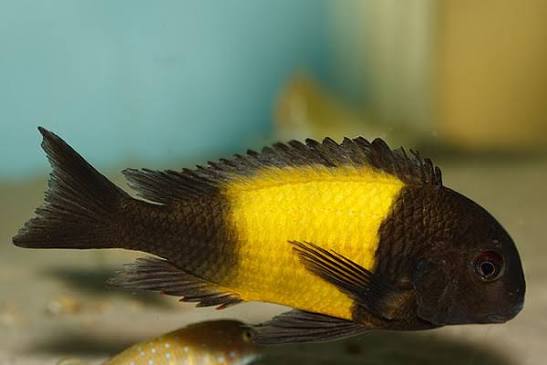
Tropheus ikola
| Qty (Stock) | Size | Sex | Unit price (Tax included) |
|---|---|---|---|
| 2" | - | 29$ |
IMPORTANT
Keeping fish in an aquarium requires an ethical and responsible approach that prioritizes animal welfare. Purchasing fish for an aquarium should never be an impulsive decision. It is essential to understand the specific needs of each species, including water quality, aquarium size, behavior, and diet. Only fish with similar water quality requirements should be kept together in the same aquarium.
A Little More Information...
Tropheus ikola is an iconic cichlid from Lake Tanganyika, valued for its compact body, dark coloration, and broad golden-yellow vertical band. This geographic form of Tropheus lives along Tanzania’s rocky shoreline, where it grazes on algae growing over the stones. Its active, territorial, and social behavior makes it fascinating to observe, but it requires a carefully planned aquarium. Very common in the aquarium hobby, it is best suited to aquarists who can provide alkaline water, strong filtration, and a predominantly plant-based diet.
General species description
Tropheus ikola belongs to the Tropheus group, cichlids specialized in feeding across the rocky surfaces of Lake Tanganyika. Its deep, laterally compressed body allows precise movement between rocks, while its grazing mouth removes algae and the small organisms living within the biological film. The species is social, but it forms a clear hierarchy: interactions can be frequent and vigorous, especially between males. A properly sized group distributes aggression more effectively than an isolated pair. In aquariums, this form is usually kept in a species-focused setup or with robust Tanganyikan tankmates. Its popularity comes from its distinctive pattern and constant activity. Like other Tropheus, it is sensitive to dietary mistakes, sudden parameter changes, and overcrowding. A stable social structure, clean water, and consistent feeding are central to long-term success.
Geographic origin and biotope
Tropheus ikola comes from Lake Tanganyika in East Africa, specifically its Tanzanian shoreline. It inhabits the rocky littoral zone, where stones provide grazing surfaces, shelter, and territorial boundaries. The water is clear, mineral-rich, and strongly alkaline, with weak to moderate movement depending on exposure along the shore. Aquatic vegetation is very limited; most food production comes from the algal and microbial film covering the rocks. In an aquarium, a structure made from many stable rocks is preferable to an open layout with few shelters. Efficient filtration, strong oxygenation, and water maintained around pH 8.0 to 9.0 better reflect the lake’s general conditions. The substrate may be sand or smooth small gravel. Stable water chemistry and regular maintenance are especially important for this grazing cichlid.
Precise location and local name
This population is associated with the locality of Ikola, on the Tanzanian coast of Lake Tanganyika. In the aquarium trade, it is mainly sold as Tropheus Ikola or Ikola Tropheus. The word “Ikola” therefore identifies its geographic origin and color form rather than a widely used traditional vernacular name among local lakeside communities. As with several Tanganyikan Tropheus, its commercial identity is closely tied to its collection locality. Aquarists generally avoid mixing different geographic forms in order to preserve their distinct characteristics and reduce hybridization. This origin should also guide the choice of tankmates, décor, and water conditions. Fish often display their strongest coloration when they feel secure, have a well-structured group, and territorial pressure is distributed throughout the aquarium. Good group management helps reduce excessive harassment.
Appearance and physical characteristics
Tropheus ikola has a stocky, deep, laterally compressed body typical of the genus. Its coloration is dominated by a black or very dark brown body, crossed by a broad vertical yellow to orange band through the middle of the body. Band intensity varies with mood, age, social rank, and maintenance conditions. The fins are usually dark, sometimes with blue or yellow highlights. Thick lips and a slightly downward-facing mouth reflect its grazing lifestyle and feeding method. Maximum adult size is approximately 14 cm, and males and females are externally very similar. Juveniles may show less contrast, which becomes stronger as they mature. The body shape, central band, and black-and-yellow contrast make it readily distinguishable from other geographic Tropheus forms, although identifying commercial forms still requires knowledge of their locality. Color may fade temporarily under stress or during social conflict.
General diet
Tropheus ikola should receive a predominantly plant-based diet. In nature, it grazes on the algal and microbial film growing over rocks, ingesting small organisms associated with that surface. In an aquarium, use flakes or pellets based on spirulina, algae, and vegetable ingredients, with small portions of suitably prepared vegetables. Feed frequent but modest meals to reproduce its grazing activity and limit leftovers. Foods high in animal matter or excessively rich diets should be avoided, as they can contribute to serious digestive problems in Tropheus. A fibrous diet, clean water, and strong oxygenation are essential. Feeding discipline is particularly important during acclimation and after a group change. Juveniles can receive portions suited to their size while keeping the same high-fiber foundation. Do not use a rich carnivorous diet simply because the fish accepts it; long-term digestive health depends on consistency.
Essential data
- River of origin: Lake Tanganyika; a littoral lake species with no known river of origin.
- Local name used: Ikola Tropheus; Tropheus Ikola.
- Origin of the scientific name: Tropheus is the genus name; ikola refers to the Ikola locality.
- Full-name etymology: Tropheus comes from the Greek trophē, associated with food or nourishment; ikola is a geographic name.
- Common/vernacular names: Tropheus Ikola, Ikola Tropheus, Ikola.
- Family: Cichlidae.
- Subfamily: Pseudocrenilabrinae.
- Name pronunciation: TRO-fee-us - ee-KO-la
- Maximum adult size: Approximately 14 cm.
- Water temperature and pH: 24 to 27 °C; pH 8.0 to 9.0.
- Waterway appearance and surrounding vegetation: Clear rocky lake shoreline; little aquatic vegetation and abundant algae on stones.
- Typical tankmates: Neolamprologus leleupi, Neolamprologus brichardi, Synodontis petricola.
- Temperament and behavior: Active, social, and territorial; a pronounced social hierarchy, especially among males.
- Water depth: Shallow rocky littoral zone, generally around 1 to 5 m.
- Sexual dimorphism: Very weak; sex is difficult to determine externally.
- Bottom structure and flow: Rocks, sand, and small gravel; weak to moderate movement with good oxygenation.
For greater success
To keep Tropheus ikola successfully, establish a sufficiently large group and build a stable rocky layout with broken sightlines. Maintain alkaline, mineral-rich, very clean water without rapid fluctuations. The main priority is a high-fiber diet low in animal-based ingredients. Watch for persistent chasing, injuries, and digestive problems, especially after adding new fish. Generous filtration, regular water changes, and carefully selected tankmates encourage more natural behavior. With these precautions, this very common aquarium Tropheus displays striking contrast and remarkable activity. A stable social group and disciplined feeding routine are more important than an elaborate decoration.
{540,337,347}