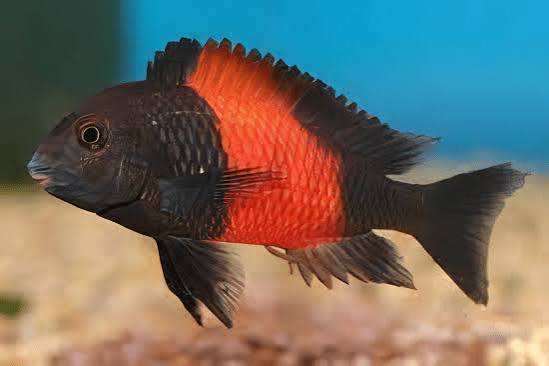
Tropheus mbemba var. Orange
| Qté (Stock) | Taille | Sexe | Prix unitaire (Taxes incluses) |
|---|---|---|---|
| 2" | - | 29$ |
IMPORTANT
La possession de poissons en aquarium requiert une approche éthique et responsable pour respecter les animaux. L'acquisition de poissons pour maintenance en aquarium ne doit pas se faire sur un coup de tête (achat impulsif). Il est essentiel de s'informer sur les besoins spécifiques des espèces (qualité eau, dimensions aquarium, comportement, alimentat). Seuls les poissons ayant des exigences similaires en matière de qualité d'eau devraient être maintenus ensemble dans un même aquarium.
Un peu plus d'informations...
Tropheus mbemba var. Orange is a trade variety associated with the Tropheus group from Lake Tanganyika. Its orange coloration immediately attracts attention, but its appeal goes beyond appearance: this is a highly territorial African cichlid specialized in grazing algae from rocks. Like other Tropheus, it generally does better in a structured group than as an isolated pair. This variety is considered very common in the specialized aquarium trade. It still requires a stable setup, alkaline water, and a mainly plant-based diet to maintain good condition and reduce digestive problems.
General species description
Tropheus mbemba var. Orange is a commercial form of the Tropheus complex, generally associated in the aquarium trade with Tropheus moorii. The name “Mbemba” refers to its locality, while “Orange” describes its dominant coloration. It remains a rocky-shore cichlid from Lake Tanganyika, adapted to continuous grazing of algal growth. It can be hardy when water quality remains consistent, but it is sensitive to sudden changes and excessive animal-based foods. A social hierarchy develops within the group; an adequate number of fish helps spread aggression among individuals.
Geographic origin and biotope
Reference country: Tanzania. Tropheus mbemba var. Orange is associated with the rocky shoreline of Lake Tanganyika, around the Mbemba area. Its natural habitat consists of mineral-rich shores, piled rocks, and surfaces covered with algae in clear, warm, strongly alkaline water. Aquatic vegetation is usually limited because rocky substrate dominates. In an aquarium, rocks should therefore be prioritized over delicate plants, together with efficient filtration and good water movement. Parameters must remain stable and well oxygenated.
Precise location and local name
The geographic reference used for this form is Mbemba, on Lake Tanganyika, in Tanzania. “Mbemba” is mainly a locality or population name used in the Tropheus trade rather than a widely standardized traditional vernacular name. “Orange” distinguishes the coloration of this strain from other geographic forms. To preserve its identity, fish from the same locality should preferably be kept together and not mixed with other Tropheus populations. The commonly used local trade name is therefore Tropheus Mbemba Orange.
Appearance and physical characteristics
Tropheus mbemba var. Orange has the compact, relatively deep body typical of Tropheus, with a rounded head and a small mouth adapted for scraping surfaces. Overall coloration ranges from golden orange to deeper orange, depending on age, sex, social rank, and condition. The fins may show darker or contrasting tones. Coloration is often more intense in dominant adults. Its most distinctive feature is its uniform or strongly dominant orange coloration, displayed on the compact body of this grazing cichlid.
General diet
Tropheus mbemba var. Orange should receive a diet made up mainly of plant-based foods. In nature, it grazes algae and the fine biological layer covering rocks. In the aquarium, quality spirulina-based pellets or flakes can be offered along with varied vegetable foods. Meals should be small and frequent to imitate its natural feeding pattern. Rich animal-based foods, worms, and overfeeding should be avoided because they may cause serious digestive issues, including bloat in Tropheus. Good water quality and prompt removal of uneaten food are also important.
Essential data
- Name of the original river: Lake Tanganyika; rocky shoreline habitat.
- Local name used: Mbemba Orange or Tropheus Mbemba Orange.
- Origin of the scientific name: Tropheus is the genus name assigned to grazing cichlids from Lake Tanganyika.
- Full-name etymology: Tropheus comes from Greek and refers to nourishment or feeding; mbemba refers to the locality; Orange describes the trade coloration.
- Common/vernacular names: Tropheus Mbemba Orange, Mbemba Orange.
- Family: Cichlidae.
- Subfamily: Pseudocrenilabrinae.
- Name pronunciation: troh-FEE-us mem-BEM-bah var. OR-anj
- Discovery: —
- Maximum adult size: about 14 cm.
- Water temperature and pH: 24 to 27 °C; pH approximately 8.0 to 9.0.
- Watercourse appearance and surrounding vegetation: extensive rocky shores, clear alkaline water; limited aquatic vegetation.
- Typical tankmates: other peaceful Lake Tanganyika cichlids of similar size, depending on available space.
- Temperament and behavior: gregarious, active, and territorial; a strong hierarchy with aggression distributed through group living.
- Water depth: shallow to moderately deep rocky shoreline zones.
- Sexual dimorphism: difficult to identify visually; males lack a consistent external difference.
- Bottom structure and flow: rocky and gravel substrate with regular circulation and strong oxygenation.
In your aquarium
To succeed with Tropheus mbemba var. Orange, provide a rocky layout with broken sightlines and maintain a group rather than a pair. Oversized filtration, stable alkaline water, and regular water changes are essential. Feed small portions of plant-based foods and remove leftovers quickly. Avoid overly timid tankmates or fish with very different requirements, and avoid mixing geographic populations when maintaining the strain’s identity matters. With a well-distributed hierarchy and clean water, this active cichlid can display remarkable orange coloration and highly engaging behavior.