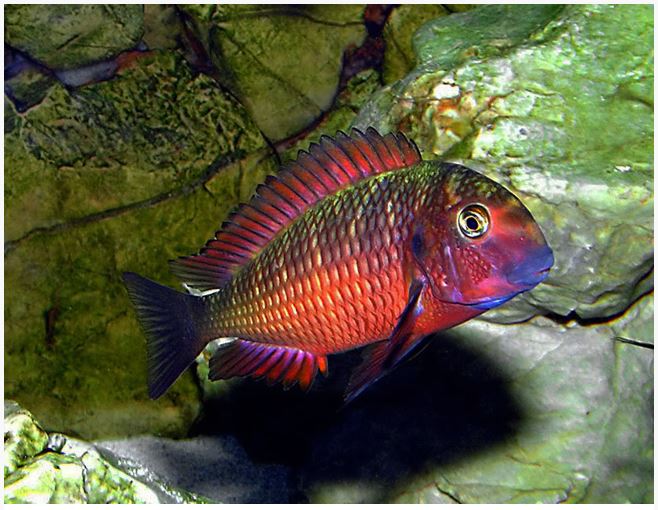
Tropheus sp. Red Moliro Firecracker Tropheus
| Qté (Stock) | Taille | Sexe | Prix unitaire (Taxes incluses) |
|---|---|---|---|
| Aucun en stock en ce moment! Communiquez avec nous | |||
IMPORTANT
La possession de poissons en aquarium requiert une approche éthique et responsable pour respecter les animaux. L'acquisition de poissons pour maintenance en aquarium ne doit pas se faire sur un coup de tête (achat impulsif). Il est essentiel de s'informer sur les besoins spécifiques des espèces (qualité eau, dimensions aquarium, comportement, alimentat). Seuls les poissons ayant des exigences similaires en matière de qualité d'eau devraient être maintenus ensemble dans un même aquarium.
Un peu plus d'informations...
The Tropheus sp. Red Moliro, also known as the Firecracker Tropheus, is a highly colorful geographical form from the Tropheus group of Lake Tanganyika. Recognized by its red-orange shades and robust body, this cichlid grazes on algae growing over shoreline rocks. Its active, territorial and social behavior requires a carefully planned aquarium, with alkaline water, strong filtration and a rocky layout. Like other Tropheus, it should receive a mainly plant-based diet and be kept in a sufficiently large group to reduce social pressure between individuals.
General description
Tropheus sp. Red Moliro is an African cichlid belonging to the Tropheus group, known for its constant activity and pronounced social behavior. It lives close to rocks, where it scrapes algae and the microorganisms associated with them. The commercial name Red Moliro refers to a population or geographical form from the Moliro area of Lake Tanganyika. This form is widely distributed in specialized aquarium keeping and is not generally regarded as a rare novelty. It is best suited to aquarists able to maintain stable water conditions and manage group interactions. Keeping it with other cichlids requires caution, since Tropheus actively defend space and may become aggressive toward fish using the same rocky areas.
Geographical origin and biotope
Reference country: Democratic Republic of the Congo. Tropheus sp. Red Moliro comes from Lake Tanganyika, in its western section near Moliro. This area is characterized by a rocky shoreline, clear and highly mineralized alkaline water, and good light penetration that supports algae growth. The natural biotope consists of boulders, slabs and crevices used both for grazing and shelter. Aquatic higher plants are generally limited in rocky sectors; algae attached to stones play a much more important role. In an aquarium, this structure should be recreated with stable rocks and numerous broken sight lines, while leaving open swimming space.
Precise location and local name
The Red Moliro form is associated with Moliro, on the western shore of Lake Tanganyika, in the Democratic Republic of the Congo. Moliro is used as a locality name and as a geographical reference in the aquarium trade. The local aquarium name is generally Red Moliro, while Firecracker Tropheus is its English and commercial name. This designation helps distinguish this red-orange form from other geographical Tropheus. Because it is a named form within a group containing many differently colored populations, geographical origin is important for avoiding mixing and preserving the identity of the captive strain.
Appearance and physical characteristics
Tropheus sp. Red Moliro has the deep, laterally compressed body typical of Tropheus, with a small mouth adapted for grazing rocky surfaces. Its coloration is dominated by flame-like red-orange tones, often becoming more intense on the flanks, head or fins depending on age, sex and social rank. Juveniles may be less vividly colored than adults. The dorsal and anal fins are relatively long, while the caudal fin is forked. The body pattern may darken during social interactions or periods of stress. Visual identification should take locality into account, since several Tropheus forms display overlapping color characteristics.
General diet
In nature, Tropheus sp. Red Moliro grazes on algae covering rocks and consumes a large amount of plant matter and associated microorganisms. In an aquarium, its diet should therefore be high in fiber and mainly plant-based. Quality dry foods made for herbivorous cichlids, spirulina and vegetable-based preparations are suitable. Small portions offered regularly are preferable to very heavy meals. Foods rich in animal matter, worms and fatty products should be avoided or used very sparingly, as they may contribute to digestive problems. A consistent, varied diet with limited excess protein helps maintain good body condition.
Essential data
- Origin river name: Lake Tanganyika; rocky lake habitat.
- Local name used: Red Moliro.
- Origin of the scientific name: Tropheus is the genus; sp. indicates a form or species not specified at the species level.
- Full-name etymology: Tropheus comes from the Greek trophē, associated with food or feeding; sp. is the abbreviation for species; Red Moliro describes the red coloration and the Moliro locality.
- Common/vernacular names: Red Moliro Tropheus; Firecracker Tropheus.
- Family: Cichlidae
- Subfamily: Pseudocrenilabrinae
- Name pronunciation: TROH-fee-us - red moh-LEE-roh
- Maximum adult size: about 14 cm.
- Water temperature and pH: 24 to 28 °C; pH about 8.0 to 9.0.
- Waterbody appearance and surrounding vegetation: clear, alkaline and mineral-rich lake; rocky shores with limited aquatic vegetation in grazing areas.
- Typical tankmates: Tropheus ikola, Neolamprologus leleupi, Altolamprologus calvus, Cyprichromis leptosoma, Synodontis petricola.
- Temperament and behavior: active, social and territorial; a strong hierarchy develops, with increased aggression in small groups.
- Water depth: shallow rocky shoreline areas.
- Sexual dimorphism: difficult to identify visually; differences in size, shape and behavior are variable.
- Bottom structure and flow: boulders and rocky slabs, crevices and algae-covered surfaces; generally moderate lake movement.
In your aquarium
Success with Tropheus sp. Red Moliro depends on a well-structured group, a stable rocky layout and alkaline water maintained without sudden fluctuations. Strong filtration, good oxygenation and regular water changes are essential. A plant-based diet should be prioritized, and overly peaceful tankmates or fish occupying the same ecological space should be avoided. Adding several individuals and creating visual barriers helps distribute dominance. With these precautions, this Tropheus provides a highly active presence and spectacular red coloration in an aquarium dedicated to the rocky Lake Tanganyika biotope.
{1274,540,69,1272,347}