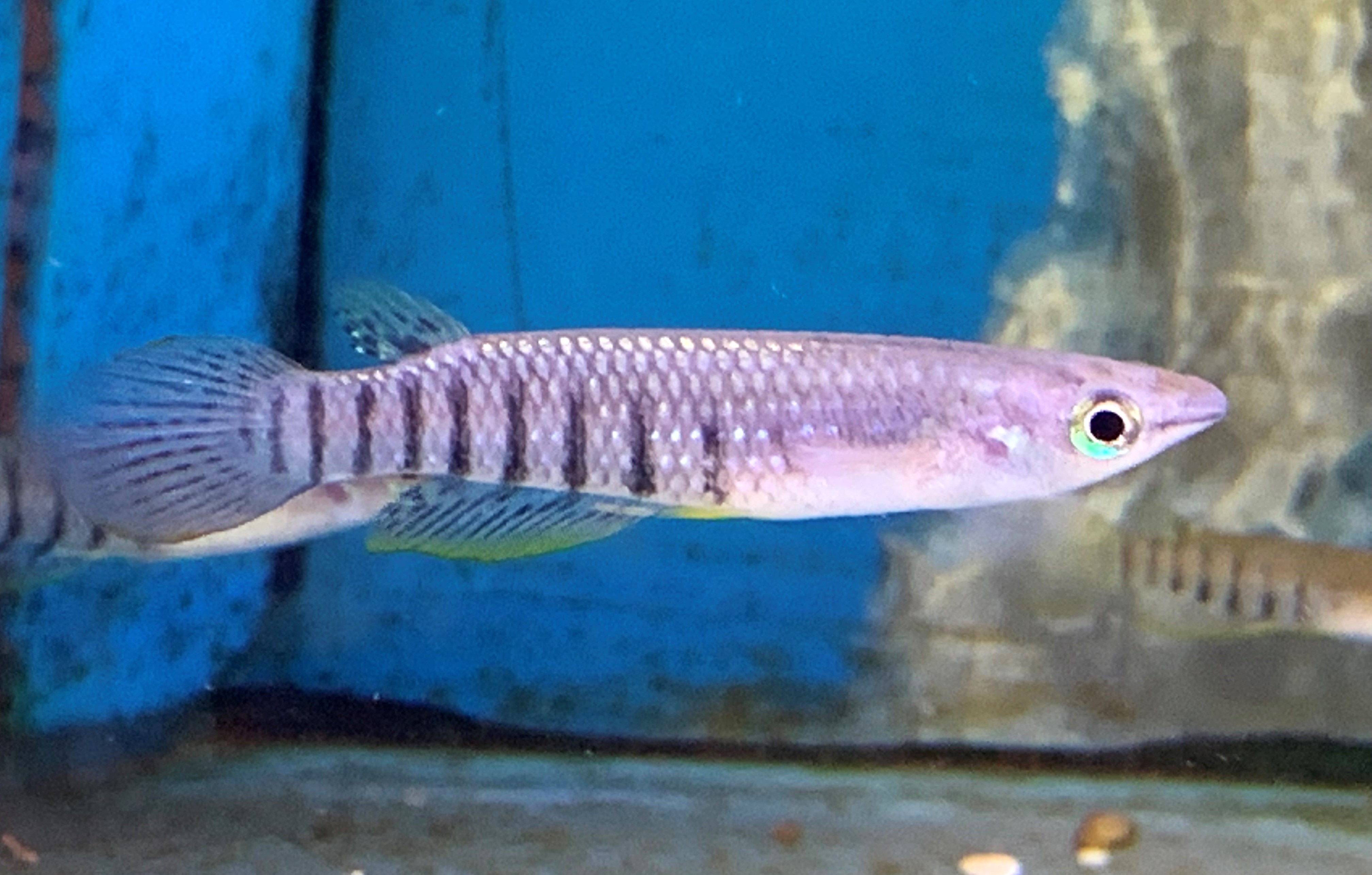
Aplocheilus lineatus Golden Wonder Striped Panchax
| Qté (Stock) | Taille | Sexe | Prix unitaire (Taxes incluses) |
|---|---|---|---|
| 1 ¾" | - | 26$ |
IMPORTANT
La possession de poissons en aquarium requiert une approche éthique et responsable pour respecter les animaux. L'acquisition de poissons pour maintenance en aquarium ne doit pas se faire sur un coup de tête (achat impulsif). Il est essentiel de s'informer sur les besoins spécifiques des espèces (qualité eau, dimensions aquarium, comportement, alimentat). Seuls les poissons ayant des exigences similaires en matière de qualité d'eau devraient être maintenus ensemble dans un même aquarium.
Un peu plus d'informations...
Aplocheilus lineatus, also known as the Golden Wonder Striped Panchax, is a small surface-dwelling fish from South Asia. Its slender body, upturned mouth, and golden coloration make it a striking choice for a carefully planned community aquarium. It is an insect-hunting predator that spends most of its time near the upper part of the water column and requires a tightly fitting lid because it jumps readily. This species remains very common in the aquarium trade. It suits aquarists who can provide clean water, gentle circulation, and tankmates too large to be swallowed. Floating plants, moderate lighting, and a varied diet help display its natural behaviour and maintain strong coloration.
General species description
Aplocheilus lineatus is an Asian killifish from the family Aplocheilidae, commonly kept for its constant surface activity and bright appearance. The golden form sold in the aquarium trade is often called Golden Wonder, while wild-coloured fish show more distinct lines and greenish or brownish reflections. It is hardy once properly acclimated, although it does not tolerate abrupt changes in water conditions well. It mainly uses the upper part of the aquarium and may defend a small area, especially when males are kept together. A tank with adequate swimming length, scattered planting, and a secure lid suits it well. Its **surface-predator behaviour** should be considered before adding very small fish or juvenile shrimp. Calm, medium-sized companions are generally safer than tiny schooling species.
Geographic origin and biotope
Aplocheilus lineatus comes from the Indian subcontinent, particularly **India and Sri Lanka**, where it inhabits calm or slow-moving freshwater environments. It occurs in ponds, ditches, rice fields, seasonal pools, and quiet sections of small streams. These habitats may be brightly lit, but floating vegetation creates shade and ambush points. Water conditions can range from soft to moderately mineralized and may change with seasonal rainfall. In an aquarium, stability is more important than reproducing one exact value. Gentle filtration, partial surface cover, and regular water changes imitate its habitat more effectively than strong current. The upper layer should remain accessible because this fish feeds and patrols there. Reference countries: **India and Sri Lanka**.
Precise location and local name
The species is broadly distributed through freshwater habitats of peninsular India and Sri Lanka, including coastal and inland drainage systems where still or slow water is common. This broad range is associated with variation in colour and with several trade names. The names most often used in the aquarium trade are **Golden Wonder**, Golden Wonder Panchax, and Striped Panchax. In French-speaking aquaria, names such as panchax rayé and panchax doré may also appear. The word panchax is a historical trade term used for several Asian killifishes and does not necessarily identify one specific local population. For aquarists, reliable identification therefore depends on the scientific name **Aplocheilus lineatus**, especially when distinguishing the golden form from other surface-dwelling killifishes.
Appearance and physical characteristics
The body of Aplocheilus lineatus is elongated, laterally compressed, and adapted for quick movement just below the surface. Its broad, upturned mouth reflects its feeding strategy: it takes prey that falls onto the water or lives in the surface film. Wild-coloured fish show longitudinal lines and olive, silver, or greenish reflections. The Golden Wonder form usually has a **yellow-gold to orange body**, with fins often enhanced by red or yellow tones. Adult males are generally more colourful and have more developed fins than females, which are often duller and rounder-bodied. Adults may approach **10 cm**, although many aquarium specimens remain smaller. Moderate lighting and a darker background can improve the contrast of its colours. A covered aquarium is essential because this active surface fish can jump through surprisingly small gaps.
General feeding
Aplocheilus lineatus is an opportunistic carnivore that naturally eats terrestrial insects, larvae, small crustaceans, and other suitably sized prey. In an aquarium, it accepts frozen or live foods such as mosquito larvae, brine shrimp, daphnia, and bloodworms. High-quality floating pellets may also be offered if they are small enough and eaten promptly. A varied diet supports body condition and colour. Keep portions moderate: although the mouth is large, excess food can pollute the water quickly. It actively hunts at the surface and may ignore food that sinks immediately. **Floating or slow-moving foods** are therefore especially useful. Small fish and juvenile shrimp may be treated as prey. Feed modest amounts once or twice daily, removing uneaten food whenever necessary to preserve water quality.
Essential data
- Name of native river: Streams and wetland habitats of the Indian subcontinent
- Local name used: Golden Wonder, Striped Panchax, panchax rayé
- Origin of the scientific name: Scientific name assigned during the species’ zoological description
- Complete name etymology: Aplocheilus approximately means “simple lip”; lineatus means “striped” or “lined”
- Common/vernacular names: Golden Wonder Striped Panchax, Golden Wonder, Striped Panchax
- Family: Aplocheilidae
- Subfamily: Aplocheilinae
- Name pronunciation: ap lo KAI lus - li nee AH tus
- Discovery: Achille Valenciennes, 1846
- Maximum adult size: About 10 cm
- Water temperature and pH: 20 to 28 °C; pH 6.0 to 8.0
- Stream appearance and surrounding vegetation: Still or slow water, often bordered by emergent and floating plants
- Typical tankmates: Peaceful, medium-sized fish that are not aggressive and are too large to swallow
- Temperament and behaviour: Active, curious surface predator; males may spar with one another
- Water depth: Shallow to medium, with heavy use of the surface layer
- Sexual dimorphism: Male usually more colourful, more slender, and equipped with more developed fins; female duller and rounder
- Bottom structure and flow: Muddy, sandy, or plant-litter substrate; low to moderate flow
In your aquarium
To keep Aplocheilus lineatus successfully, use a tightly covered aquarium because jumps toward the surface are common. Leave open swimming space while adding floating plants or stems for visual shelter. A temperature of **20 to 28 °C**, stable pH, and filtration without excessive current are generally suitable. Offer a significant proportion of floating foods and avoid very small tankmates. Males can be kept with several females to distribute courtship pressure. Clean water, gradual acclimation, and regular water changes are the foundation of long-term care. Because it is readily available and **very common**, this panchax suits many appropriately planned community aquariums. Careful feeding and a secure lid remain the most important practical points.
{}