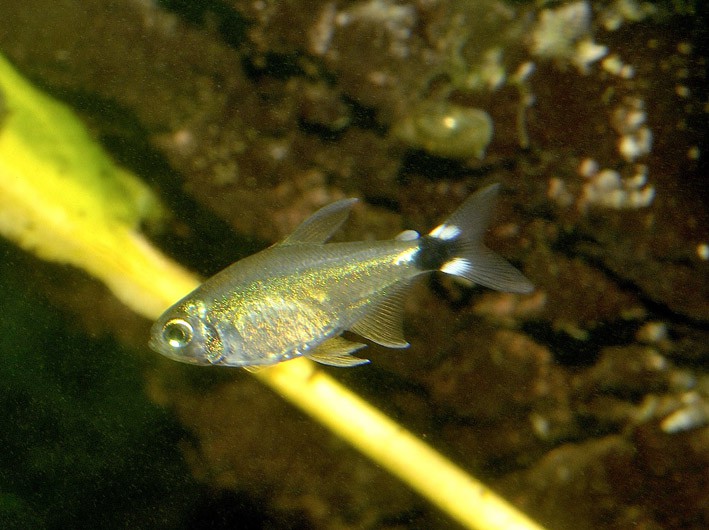
Hyphessobrycon elachys Reed Tetra
| Qté (Stock) | Taille | Sexe | Prix unitaire (Taxes incluses) |
|---|---|---|---|
| Aucun en stock en ce moment! Communiquez avec nous | |||
IMPORTANT
La possession de poissons en aquarium requiert une approche éthique et responsable pour respecter les animaux. L'acquisition de poissons pour maintenance en aquarium ne doit pas se faire sur un coup de tête (achat impulsif). Il est essentiel de s'informer sur les besoins spécifiques des espèces (qualité eau, dimensions aquarium, comportement, alimentat). Seuls les poissons ayant des exigences similaires en matière de qualité d'eau devraient être maintenus ensemble dans un même aquarium.
Un peu plus d'informations...
The Reed Tetra, sold under the scientific name Hyphessobrycon elachys, is a tiny characin native to Brazil. Its slender shape, subtle coloration, and schooling behavior make it an interesting choice for planted aquariums. It remains fairly uncommon in the aquarium trade, appealing mainly to aquarists who enjoy less frequently offered species. When kept in a group, it is peaceful and active without being constantly restless. A dark layout, subdued lighting, and soft to slightly acidic water help bring out its natural tones. Because of its small size, it should be housed with calm companions that cannot compete aggressively for food.
General species description
Hyphessobrycon elachys is a very small freshwater fish belonging to the family Characidae. It is a small characin adapted to group living and to calm or gently flowing habitats. Its aquarium appeal comes more from its delicate appearance and natural behavior than from brilliant coloration. It should be kept in a school of at least 8 to 10 fish, as a proper group reduces shyness and encourages interaction. Dense plants, shaded areas, and a few roots provide useful cover. Peaceful by nature, it is suitable for a community aquarium containing fish of comparable size. Its limited availability in the trade makes it less common than many better-known tetras.
Geographical origin and biotope
Reference country: Brazil. The species is associated with the rio Madeira basin, more specifically the rio Aripuanã drainage in central-western Brazilian Amazonia. It inhabits small streams and quiet areas where the current is weak to moderate. The natural environment generally includes plant cover and submerged wood, with light filtered by streamside vegetation. In an aquarium, a similar setting can include fine-leaved plants, roots, suitable leaf litter, and a dark substrate. Gentle filtration is preferable to avoid excessive water movement while still maintaining stable, well-oxygenated water.
Specific locality and local name
The known range of Hyphessobrycon elachys lies in the rio Aripuanã, an important tributary system of the rio Madeira basin in Brazil. This places it in an Amazonian region marked by small tributaries, forest streams, and heavily vegetated margins. The common name used in the international aquarium trade is Reed Tetra. The descriptive name “reed tetra” is also understandable in English and remains the most recognizable common name. Its relatively restricted distribution and irregular availability help explain why it is considered uncommon in the aquarium hobby.
Appearance and physical characteristics
This tetra has a very small, slender body that is slightly compressed from side to side. Its coloration is generally silvery to translucent, with yellowish or pinkish tones that can become more visible depending on lighting, mood, and water quality. The fins are delicate and may show subtle pigmentation, while mature males are often slimmer than females. Its small adult size is its main aquarium characteristic: it can be kept in a densely planted tank, but it requires calm, small tankmates. A dark substrate, floating plants, and moderate lighting enhance its natural appearance and translucent reflections.
General diet
Hyphessobrycon elachys is a small omnivore that generally accepts a varied diet of fine particles. In the aquarium, offer quality micro-pellets, powdered foods, and small frozen or live foods such as baby brine shrimp, cyclops, and small daphnia. Food must be small enough for its mouth and should be provided in small portions once or twice daily. A varied diet supports coloration, growth, and overall condition. Live or frozen foods are especially useful for stimulating natural foraging behavior. Remove uneaten food promptly, since its small size produces little waste but does not prevent rapid water deterioration in a small aquarium.
Essential data
- Native river: Rio Aripuanã
- Local name used: Reed Tetra
- Origin of the scientific name: A genus name created for small characins; the species epithet refers to the fish’s very small size.
- Etymology of the full name: Hyphessobrycon comes from Greek and refers to a small fish; elachys means small or diminutive.
- Common/vernacular names: Reed Tetra; reed tetra
- Family: Characidae
- Subfamily: Cheirodontinae
- Name pronunciation: hy-feh-soh-BRY-kon eh-LAKH-iss
- Discovery: Stanley Howard Weitzman, 1984
- Maximum adult size: About 2 cm
- Water temperature and pH: 24 to 28 °C; pH 5.5 to 7.0
- Stream appearance and surrounding vegetation: Small forest streams, filtered light, streamside vegetation, and shelter provided by branches or leaves.
- Typical tankmates: Nannostomus beckfordi, Carnegiella marthae, Hemigrammus ocellifer, Moenkhausia sanctaefilomenae, Corydoras habrosus
- Temperament and behavior: Peaceful, schooling, generally discreet, and most confident when kept in a group.
- Water depth: Shallow sections of small tributaries.
- Sexual dimorphism: Females are usually rounder; males are often slimmer.
- Bottom structure and flow: Dark bottom with leaves, wood, and plant debris; low to moderate current.
In your aquarium
For successful care of Hyphessobrycon elachys, use a mature, well-planted, covered aquarium with soft, stable, slightly acidic water. A sufficiently large group, subdued lighting, and filtration without strong current are the most important factors. Because this species is small and peaceful, avoid large or boisterous tankmates. Fine foods offered regularly, together with small water changes, will help maintain good condition. Its limited availability also makes careful acclimation and quarantine advisable whenever possible.